

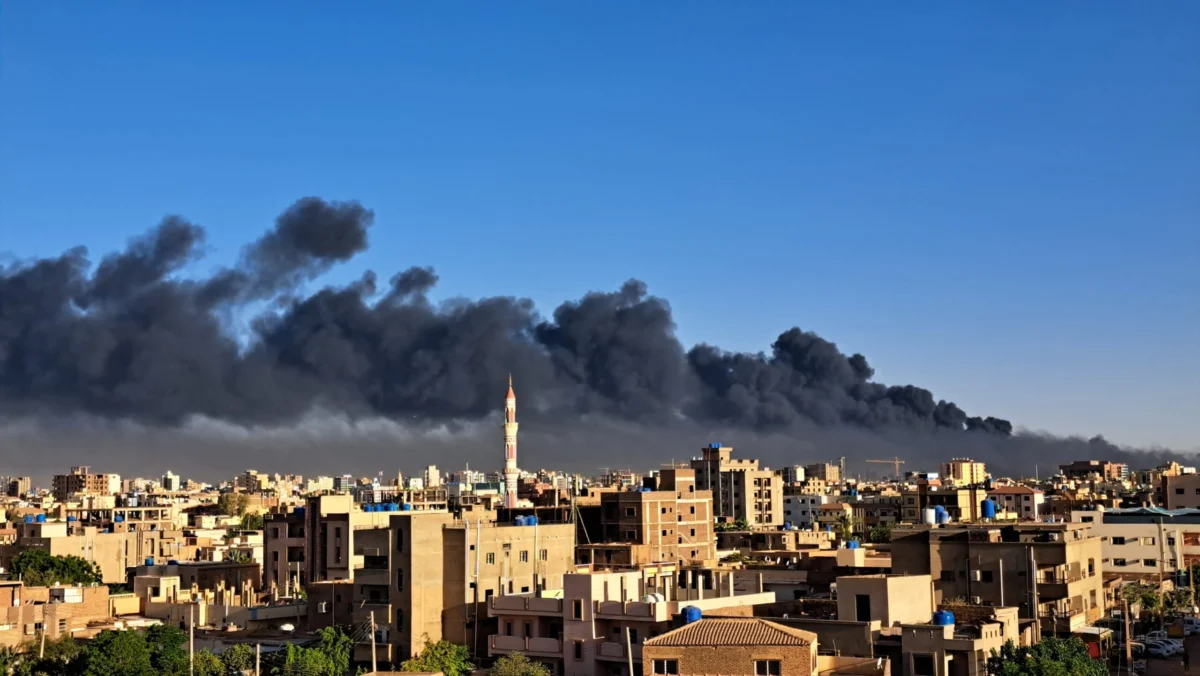
Sudanese government troops engaged in heavy combat on Wednesday, repelling successive waves of attacks by the paramilitary Rapid Support Forces (RSF) as the rival faction attempted to seize the national army headquarters in the heart of Khartoum. The intensification of the conflict comes in the wake of a collapsed U.S.-brokered ceasefire, a failure that has effectively paralyzed international efforts to evacuate foreign nationals and has left millions of local residents trapped in a city rapidly running out of essential supplies.
Continuous aerial bombardments and thunderous explosions echoed throughout central Khartoum on Wednesday, centered primarily around the sprawling compound housing the Sudanese Armed Forces (SAF) General Command. Similar scenes of devastation were reported at Khartoum International Airport, a strategic asset that has been rendered inoperable since the outbreak of hostilities on Saturday. Thick plumes of black smoke have become a permanent fixture of the city’s skyline, while the streets of the normally bustling metropolis—home to approximately 5.5 million people—remain eerily deserted, save for those braving the crossfire to find food or flee the violence.
The military ruler of Sudan, General Abdel Fattah al-Burhan, had previously indicated that he was directing operations from a presidential guesthouse located within the fortified General Command compound. However, as the siege tightened on Wednesday, his exact whereabouts remained unconfirmed. The SAF issued a formal statement mid-day, asserting that its forces were "responding to a new attack in the vicinity of the General Command," suggesting that the RSF is committing significant resources to decapitating the army’s leadership structure.
The Humanitarian Toll and the Collapse of Basic Services
The human cost of the power struggle between General Burhan and his former deputy, RSF leader General Mohamed Hamdan Dagalo—widely known as Hemedti—is mounting at an alarming rate. According to data released by the Sudanese Health Ministry and cited by the World Health Organization (WHO), at least 270 people have been confirmed dead, with more than 2,600 others injured. However, medical professionals on the ground warn that these figures are likely a significant undercount, as many bodies remain in the streets, unreachable due to the intensity of the sniper fire and shelling.
For the residents of Khartoum, the conflict has transformed daily life into a desperate struggle for survival. Widespread power outages have plunged neighborhoods into darkness, and the water supply has been severed in many districts. Hadeel Mohamed, an architect residing in the capital, expressed the growing sense of dread shared by many. "Today we were starting to run out of some essentials," she said, noting that her brother had been forced to venture out into the combat zone to search for food, a journey fraught with the risk of being caught in the indiscriminate gunfire that has rattled the southern and western sectors of the city.
The timing of the conflict is particularly poignant, occurring during the final days of the holy month of Ramadan. With the Eid al-Fitr festival approaching, which traditionally marks a period of celebration and family gatherings, many residents have abandoned their homes in a desperate bid to reach Al Gezira state to the south, where fighting has not yet been reported.
A Chronology of the Crisis: From Transition to Civil War
To understand the current eruption of violence, it is necessary to examine the fractured political landscape of Sudan over the last four years. The current conflict is the culmination of a long-standing rivalry between two military entities that were once uneasy allies.
- April 2019: Following months of pro-democracy protests, the Sudanese military ousts long-time autocrat Omar al-Bashir. A Transitional Sovereignty Council is formed, intended to lead the country toward civilian rule.
- October 2021: General Burhan, supported by Hemedti and the RSF, leads a military coup that dissolves the civilian-led government. This move draws widespread international condemnation and the suspension of foreign aid.
- December 2022: Under immense domestic and international pressure, the military signs a "framework agreement" to hand over power to a civilian government. However, the deal hinges on the integration of the RSF into the regular army.
- Early 2023: Tensions escalate over the timeline for this integration. The SAF demands a two-year integration period, while the RSF insists on a ten-year window. Disagreements also arise regarding the future chain of command.
- April 15, 2023: Following days of mobilization, heavy fighting breaks out in Khartoum and Merowe. Both sides trade blame for the initial spark.
- April 18-19, 2023: A 24-hour humanitarian ceasefire, brokered by U.S. Secretary of State Antony Blinken, fails within minutes of its scheduled commencement.
Geopolitical Implications and Regional Stability
Sudan’s geographic position makes the current conflict a matter of grave international concern. Situated at the crossroads of Sub-Saharan Africa and the Arab world, Sudan borders seven countries: Egypt, Libya, Chad, the Central African Republic, South Sudan, Ethiopia, and Eritrea. It also possesses a significant coastline along the Red Sea, a vital artery for global trade.
Analysts suggest that a protracted civil war in Sudan could destabilize the entire Sahel region. There are also concerns regarding the involvement of external actors. Egypt has historical and strategic ties to the Sudanese army, while Hemedti’s RSF has previously developed relationships with the Russian mercenary group Wagner, particularly regarding gold mining interests in Sudan’s Darfur region. The United States and Saudi Arabia have been leading diplomatic efforts to prevent a total state collapse, fearing that a vacuum of power could be exploited by extremist groups or lead to a massive refugee crisis impacting Europe and the Middle East.
The Thwarted Evacuation Efforts
The failure of the ceasefire has left foreign diplomatic missions in a state of limbo. On Wednesday, several nations reported that their plans to evacuate citizens had been put on hold due to the "uncertain security situation."
The U.S. State Department confirmed that there are currently no plans for a government-coordinated evacuation of American citizens, citing the closure of Khartoum International Airport and the danger of overland travel. Similarly, Germany was forced to halt a mission involving three Luftwaffe A400M transport planes intended to fly out approximately 150 citizens. Japan, however, has announced that it is preparing its Self-Defense Forces to evacuate roughly 60 Japanese nationals, though the timing remains contingent on a lull in the fighting.
The situation for humanitarian workers is equally dire. The United Nations has reported targeted attacks on aid personnel, including reports of sexual violence. The World Food Programme (WFP) has suspended its operations—one of the largest in the world—after three of its staff members were killed in the early hours of the conflict. This suspension is expected to have catastrophic consequences for the nearly 25% of the Sudanese population who were already facing acute hunger before the fighting began.
Military Maneuvers and the Battle for Supply Lines
On the tactical front, the SAF appears to be leveraging its superior air power and heavy artillery to isolate RSF units within the capital. Witnesses have reported army reinforcements moving toward Khartoum from eastern regions near the Ethiopian border. In the north, images broadcast by the Al Arabiya network suggested that the army had successfully retaken the Merowe military airport, which had been seized by the RSF in the opening hours of the conflict.
Conversely, the RSF has embedded itself within residential neighborhoods, using urban density as a shield against airstrikes. A heavy exchange of gunfire was reported in the Jabra neighborhood of west Khartoum, an area where Hemedti and his family maintain residences. The RSF has accused the army of violating international law by using heavy artillery in civilian-populated areas, while the SAF maintains it is conducting "surgical strikes" to dislodge "rebel militias."
Conclusion: A Nation at a Breaking Point
As the RSF announced a new unilateral commitment to a ceasefire starting at 6 p.m. local time on Wednesday, skepticism remains high. Previous commitments have vanished the moment the first shot was fired. Without a functional mechanism for monitoring a truce, the residents of Khartoum remain at the mercy of two generals who appear convinced that a total military victory is still within reach.
The transition to democracy, which seemed a possibility in 2019, has been replaced by a grim struggle for survival. As the international community struggles to find leverage, the specter of a long-term, fragmented conflict looms over Sudan, threatening to undo decades of development and plunge the Horn of Africa into a new era of volatility. The coming days, particularly the period surrounding the Eid holiday, will be a critical litmus test for whether any semblance of humanitarian order can be restored to the streets of Khartoum.
