

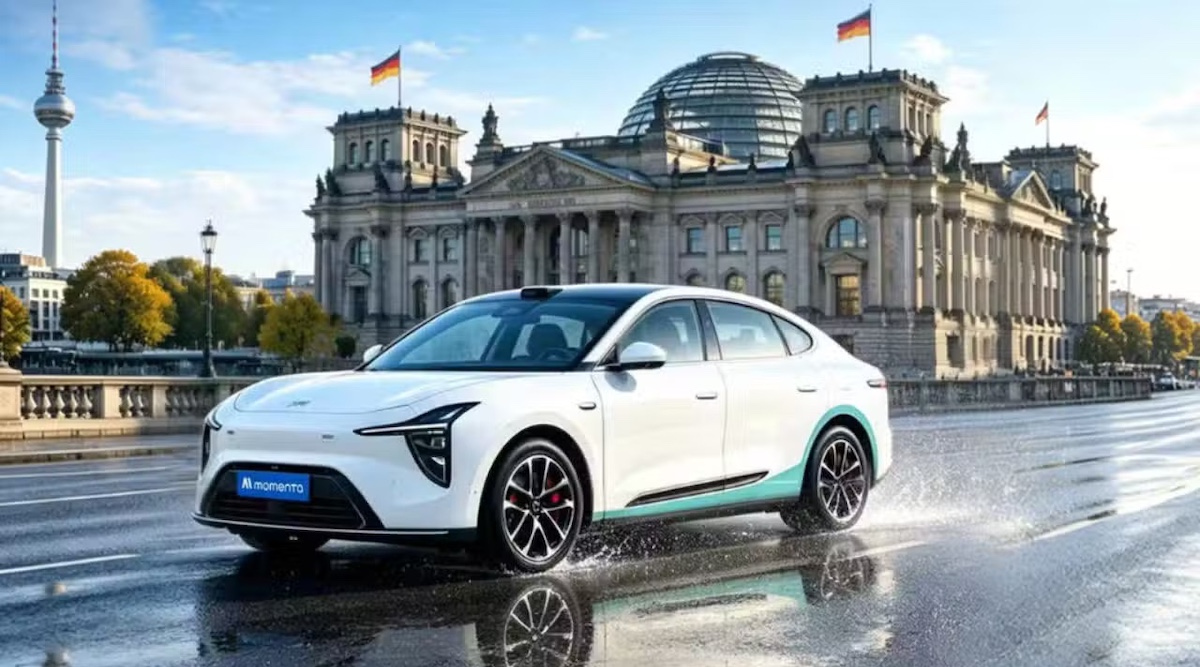
Momenta, a leading artificial intelligence and autonomous driving startup, has officially secured approval from Germany’s Federal Motor Transport Authority (Kraftfahrt-Bundesamt or KBA) to conduct Level 4 autonomous driving tests on urban roads across the country. This milestone marks a significant historical shift in the global automotive landscape, as Momenta becomes the first Chinese autonomous driving technology provider to receive such a high-level authorization from one of the world’s most rigorous transport regulators. The approval encompasses testing in complex urban environments, signaling a major leap forward from highway-only testing and positioning the company to compete directly with European and American autonomous vehicle (AV) developers on European soil.
The KBA’s decision is not merely a local permit but a validation of Momenta’s safety protocols and technical maturity. According to regulatory filings and company statements, Momenta’s safety validation standards are now directly aligned with the European Union’s stringent regulatory framework, which is often cited as the global benchmark for passenger and pedestrian safety. By meeting these requirements, Momenta has effectively created a blueprint for its subsequent expansion into other highly regulated European markets, including the Netherlands, France, and Belgium.
Technical Significance of Level 4 Autonomy in Urban Settings
To understand the weight of this approval, one must look at the Society of Automotive Engineers (SAE) levels of driving automation. While Level 2 and Level 3 systems—which require various degrees of human supervision—have become increasingly common in premium consumer vehicles, Level 4 represents "High Automation." At this level, the vehicle is capable of performing all driving functions and monitoring the environment without human intervention within a specific geographic area or under defined conditions.
Testing Level 4 systems on urban roads presents a far greater challenge than highway testing. Urban environments in Germany are characterized by narrow streets, high densities of cyclists and pedestrians, complex intersections, and diverse public transport systems like trams. Momenta’s ability to secure testing rights for these environments suggests that its "World Model" AI architecture—a unified technological foundation designed to power everything from robotaxis to heavy-duty trucks—has demonstrated the necessary predictive capabilities to navigate the unpredictability of European city centers.
The Strategic Partnership with Uber and German Automakers
Momenta’s entry into the German market is the result of a long-term strategic play involving both financial investment and deep technical integration with local industry giants. The company has maintained a presence in Germany for several years, fostering relationships with the "Big Four" of German motoring: Mercedes-Benz, BMW, Audi, and the Volkswagen Group.
The relationship with Mercedes-Benz is particularly noteworthy. The luxury automaker invested in Momenta as early as 2017, making it the company’s first international OEM (Original Equipment Manufacturer) investor. This early backing provided Momenta with critical insights into European safety expectations and vehicle integration standards long before the current testing approval was sought.
Furthermore, Momenta has solidified a powerful alliance with Uber. The ride-hailing giant has not only invested in Momenta but has also specifically increased its stake in SMB Holding Corporation, a wholly owned subsidiary of Momenta, during the company’s recent financial maneuvers. This partnership is set to bear fruit in Munich, where the two companies plan to launch a pilot robotaxi service. Munich, as a global hub for automotive engineering and the headquarters of BMW, serves as a high-stakes proving ground for this collaboration.
Financial Trajectory and the Hong Kong IPO
The KBA approval comes on the heels of a massive capital infusion. On July 8, Momenta successfully listed on the Hong Kong Stock Exchange, raising HK$6.8 billion (approximately $870 million USD). This successful Initial Public Offering (IPO) provided the company with the "war chest" necessary to fund expensive international testing programs and the deployment of sensor-heavy test fleets.
The IPO was seen by market analysts as a vote of confidence in Momenta’s "flywheel" approach to data. Unlike some competitors that rely solely on small fleets of specialized test vehicles, Momenta utilizes data from mass-production consumer vehicles equipped with its Level 2+ systems to train its Level 4 algorithms. This dual-track strategy—simultaneously developing consumer-grade assisted driving and fully autonomous robotaxis—allows for a faster iteration cycle and more robust edge-case detection.
Chronology of Momenta’s Global Expansion
The journey from a Beijing-based startup to a KBA-approved autonomous leader has been marked by several key milestones:
- 2016: Momenta is founded with a focus on deep learning for environmental perception and path planning.
- 2017: Mercedes-Benz leads a Series B funding round, marking the start of Momenta’s European strategic alignment.
- 2021: The company closes a Series C funding round exceeding $1 billion, involving investors like GM, SAIC Motor, and Toyota.
- 2023: Momenta begins large-scale pilot programs for its "M-Pilot" (consumer-focused) and "M-Drive" (robotaxi-focused) platforms in several Chinese tier-one cities.
- July 8, 2024: Momenta completes its HK$6.8 billion IPO in Hong Kong.
- Late July 2024: The German Federal Motor Transport Authority (KBA) grants Level 4 urban testing approval, the first for a Chinese firm.
Official Reactions and Corporate Vision
Momenta’s leadership has emphasized that the choice of Germany as a primary international hub was intentional due to the country’s reputation for excellence in engineering and regulation. Momenta CEO Cao Xudong remarked that Germany serves as a "global benchmark for autonomous-driving regulation," noting that the country’s rigorous approach ensures that public safety is never compromised for the sake of technological speed.
"Our goal is to use one ‘World Model’ to enable safe and efficient autonomous driving across all vehicle types," Cao stated. This vision implies that the software being tested in German robotaxis will share a common DNA with the autonomous vans (robovans) and heavy-duty trucks (robotrucks) the company is developing for the logistics sector.
Industry observers in Europe have noted that the KBA’s approval of a Chinese company is a testament to the "globalization of innovation." While trade tensions in the electric vehicle sector remain high between the EU and China, the autonomous driving sector appears to be maintaining a level of technical cooperation, driven by the shared goal of reducing traffic fatalities and improving urban mobility.

Analysis of Market Implications and Future Outlook
The entry of Momenta into the German urban testing landscape has several far-reaching implications for the global automotive industry:
1. Pressure on European Legacy Manufacturers:
While Mercedes-Benz and VW are partners with Momenta, the speed at which the Chinese firm has secured L4 testing rights may serve as a wake-up call for European software departments. It highlights the competitive advantage of AI-first companies that can iterate software more rapidly than traditional hardware-centric manufacturers.
2. Standardizing Safety across Borders:
By aligning with the EU regulatory framework, Momenta is helping to bridge the gap between Chinese and Western safety standards for AI. This alignment could facilitate easier cross-border tech transfers in the future, provided data privacy concerns—a major hurdle in the EU—are addressed through Momenta’s localized data processing strategies in Germany.
3. The Munich Robotaxi Pilot as a Litmus Test:
The upcoming launch with Uber in Munich will be the first real-world test of how European passengers interact with Chinese autonomous technology. The success of this pilot will depend not just on the AI’s ability to drive, but on the "human-machine interface" and the ability of the system to handle the unique social cues of European driving culture.
4. Diversification of the Autonomous Fleet:
Momenta’s plan to deploy the same tech stack in "robovans" suggests they are looking at the middle-mile and last-mile delivery markets. In Europe, where driver shortages in the logistics sector are acute, autonomous delivery vans could find a more immediate commercial pathway than passenger robotaxis.
Conclusion
The authorization granted by the KBA is a watershed moment for Momenta and the broader autonomous driving industry. It validates the technical prowess of Chinese AI on a global stage and sets the stage for a new era of mobility in Europe. As Momenta begins its Level 4 trials on the streets of German cities, the data gathered will not only refine its "World Model" but will also play a critical role in shaping the future of European transport policy and the global race for fully autonomous mobility. With the backing of Uber and the established German automotive elite, Momenta is no longer just a participant in the autonomous driving race; it has become a frontrunner in the quest to redefine how the world moves.
