

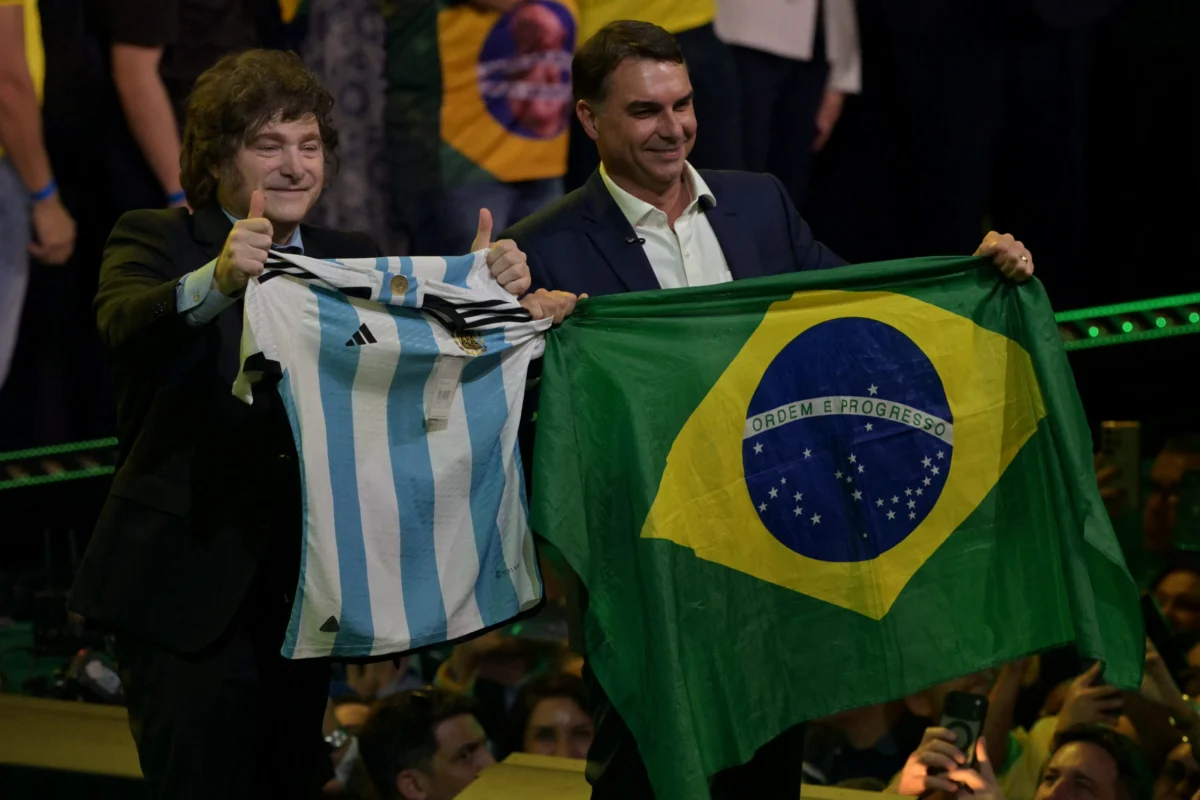
Flavio Bolsonaro has officially inaugurated his Brazilian presidential campaign, seeking to rally the nation’s political right with high-profile international endorsements, despite facing significant headwinds in domestic polls against incumbent President Luiz Inacio Lula da Silva. The formal launch on Saturday, hosted by his father’s Liberal Party, marked the anticipated entry of the younger Bolsonaro into the race, positioning him as the presumptive standard-bearer for a conservative movement still deeply influenced by the legacy of his father, former President Jair Bolsonaro. However, the event highlighted a stark contrast between robust international backing and a noticeable lack of prominent support from within Brazil’s own political establishment, underscoring the formidable challenges his campaign faces.
The campaign launch was characterized by a fervent ideological declaration from Flavio Bolsonaro, who framed the upcoming election as a monumental struggle for the nation’s soul. "This is more than a party convention," Bolsonaro declared to attendees, setting an immediate tone of high stakes and existential conflict. "This is the beginning of the toughest battles of our life. A fight between good and evil." This rhetoric, echoing the polarizing language often employed by his father, aimed to galvanize a base that perceives the Workers’ Party government of President Lula as a threat to traditional Brazilian values and economic liberty.
The Global Right’s Endorsement: A Transnational Alliance
A defining feature of Bolsonaro’s campaign kickoff was the prominent display of support from leading figures of the global right-wing movement. Argentinian President Javier Milei and Israeli Prime Minister Benjamin Netanyahu extended their endorsements, lending an international dimension to the nascent campaign. Milei, a self-proclaimed anarcho-capitalist who swept to power in Argentina on a wave of anti-establishment sentiment, made a tangible show of support by flying to Brazil the night before the event. He met with Sao Paulo Governor Tarcisio de Freitas, a key ally, before delivering a fiery speech that sharply criticized Lula’s left-wing policies and lauded Flavio Bolsonaro as a potential savior for Brazil. "We will continue offering our testimony everywhere against the lies of socialism," Milei asserted, positioning the Brazilian election within a broader regional and global ideological battle against socialist principles. His presence underscored a growing network of conservative and libertarian leaders in Latin America who share a common anti-leftist agenda and often draw parallels between their respective political struggles.
Netanyahu, a long-standing figure on the global right, contributed a video message, further solidifying the international alignment. "Flavio, my friend, I want to congratulate you on the official launching of your campaign," Netanyahu conveyed in the recording, as reported by Brazilian outlet Metropoles. "You’re a great champion of Brazil, you’re a great champion of the friendship between our peoples." This endorsement reflects the strong diplomatic and ideological ties forged during Jair Bolsonaro’s presidency with Israel, a relationship Flavio Bolsonaro is keen to maintain and leverage. These international endorsements, while energizing a segment of the base, also risked reinforcing the perception of foreign interference in Brazilian politics, a sensitive issue in a nation with a history of resisting external pressures.
Domestic Hurdles and the Shadow of Imprisonment
Despite the fanfare of international support, Flavio Bolsonaro’s campaign launch revealed significant domestic challenges. Notably, few prominent Brazilian politicians from beyond his immediate circle were in attendance. Centre-right parties, often crucial for building broad electoral coalitions in Brazil, have largely maintained their distance from the younger Bolsonaro. This reluctance stems from a variety of factors, including strategic calculations about electability, concerns over the radicalism often associated with the Bolsonaro brand, and a desire to avoid being linked to the controversies that have plagued the family. The absence of a unified right-wing front suggests a fragmented political landscape that Flavio Bolsonaro will struggle to consolidate.
Perhaps the most poignant and symbolic absence was that of his father, Jair Bolsonaro, who is currently serving a 27-year prison sentence for his role in a coup attempt following his 2022 electoral loss to Lula. The former president’s presence at the convention was reduced to a video message, eerily crafted with artificial intelligence. This digital apparition served as a stark reminder of the former president’s fall from power and the legal repercussions he faces, a reality that casts a long shadow over his son’s political ambitions. While designed to rally his father’s loyal base, the AI-generated message also highlighted the extraordinary circumstances under which Flavio Bolsonaro is attempting to inherit the mantle of Brazil’s conservative movement.
Chronology of Challenges and Political Context
Flavio Bolsonaro’s journey to the presidential bid has been marked by a series of "setbacks and scandals," contributing to his current struggle in the polls. As the son of a former president, he was long considered the presumptive candidate for Brazil’s political right. However, his path has been far from smooth. His political career, which includes terms as a state deputy and senator, has seen him implicated in various investigations, including allegations of illicit financial schemes and connections to controversial figures. While he has consistently denied wrongdoing, these controversies have chipped away at his public image and provided ammunition for his political opponents.
The 2022 presidential election, in which Jair Bolsonaro narrowly lost to Lula, was a pivotal moment. The aftermath saw a period of intense political turmoil, culminating in the January 8, 2023, attacks on government buildings in Brasília, for which Jair Bolsonaro was later convicted of attempting a coup. This dramatic sequence of events not only led to the former president’s imprisonment but also significantly fractured the right-wing movement, leaving Flavio Bolsonaro with the arduous task of rebuilding and re-energizing a base that feels both marginalized and embattled. The legacy of these events means Flavio Bolsonaro is campaigning not just against an incumbent president, but also against the specter of his father’s contentious presidency and its dramatic conclusion.
The Electoral Landscape: Trailing Lula and the Fight for the Center
Recent polls consistently show Flavio Bolsonaro trailing President Lula by a significant margin. This polling deficit is a critical indicator of the uphill battle his campaign faces. While specific numbers fluctuate, the trend has been consistent, with Lula maintaining a comfortable lead among the electorate. Bolsonaro’s campaign faces the dual challenge of energizing his father’s staunch conservative base while simultaneously attempting to appeal to a broader, more moderate segment of the Brazilian electorate, which appears wary of the hardline rhetoric and past controversies associated with the Bolsonaro name. The struggle to attract centre-right voters is particularly damaging, as these parties often represent a crucial swing bloc in Brazilian elections.
President Lula’s Workers’ Party is scheduled to hold its own convention on August 2, an event expected to formally confirm the 80-year-old president’s re-election bid. Lula’s return to power in 2022 marked a remarkable political comeback, having previously served two terms from 2003 to 2010 before facing corruption charges that briefly led to his imprisonment. His current administration has focused on social programs, economic recovery, and re-establishing Brazil’s international standing, often contrasting his approach with the more confrontational foreign policy of his predecessor. Lula’s deep roots in Brazilian politics, his charismatic appeal to the working class, and his ability to forge diverse coalitions present a formidable challenge to any opponent, particularly one struggling with internal divisions and a polarizing image.
Concerns Over Election Integrity and Perceived Foreign Meddling
A contentious aspect of Flavio Bolsonaro’s campaign, echoing his father’s strategy, is the repetition of false claims regarding the reliability of Brazil’s electronic voting infrastructure. These assertions, often made without credible evidence, have raised significant alarm among democratic institutions and observers, who view them as a dangerous pretext for potentially denying the legitimacy of the voting process should Bolsonaro lose to Lula. The insistence on questioning electoral integrity fuels distrust in democratic institutions and has drawn parallels to similar rhetoric seen in other countries, most notably in the United States during and after the 2020 presidential election.
Further exacerbating concerns about democratic norms, Bolsonaro and his allies have faced criticism for allegedly attempting to leverage their ties to the administration of former US President Donald Trump to boost the campaign, inviting what many Brazilians perceive as foreign meddling in domestic affairs. This includes past instances where Flavio Bolsonaro reportedly asked Trump to delay tariffs on Brazil until after the election, and broader accusations of courting US intervention on various issues. These actions are viewed by critics as undermining national sovereignty and creating an unhealthy precedent for external influence in Brazil’s electoral process.
The sensitivity surrounding this issue was highlighted by a recent incident reported by the AFP news agency. On the Saturday of Bolsonaro’s campaign launch, Brazil reportedly denied visas to a pair of Trump administration officials who sought to meet with the country’s election authorities. The stated purpose of their visit was to discuss "freedom of expression related to the elections," a phrase that, in the current political climate, was interpreted by many as a thinly veiled attempt to inject external pressure into discussions about electoral integrity. The Brazilian government’s decisive action in denying these visas underscored its commitment to protecting the autonomy of its electoral process and resisting perceived foreign interference, sending a clear message about the boundaries of international engagement in its domestic politics.
Broader Implications and The Road Ahead
The confluence of Flavio Bolsonaro’s campaign launch, his international backing, domestic struggles, and the controversies surrounding election integrity paints a complex picture for Brazil’s political future. The election is poised to be a pivotal moment for the nation, testing the resilience of its democratic institutions and the future direction of its socio-economic policies. For Flavio Bolsonaro, the challenge lies not only in overcoming Lula’s electoral advantage but also in forging a cohesive and broadly appealing conservative movement that can move beyond the shadow of his father’s divisive legacy. He must demonstrate an ability to unite disparate factions of the right and center-right, while simultaneously convincing a skeptical electorate that he offers a viable, stable alternative to the incumbent.
The international endorsements, while providing a morale boost, also highlight the increasingly transnational nature of political movements, particularly those on the right. This global alignment could offer strategic advantages in terms of fundraising and ideological exchange but also risks alienating nationalist sentiments within Brazil. Lula, on the other hand, will likely seek to consolidate his support by emphasizing his administration’s focus on social welfare, economic stability, and a pragmatic approach to governance, contrasting it with what he will likely portray as the divisive and potentially destabilizing rhetoric of the opposition. The upcoming months will undoubtedly be characterized by intense political campaigning, ideological clashes, and a critical examination of Brazil’s democratic foundations, as the nation prepares to once again choose its leader amidst a deeply polarized political landscape.
