

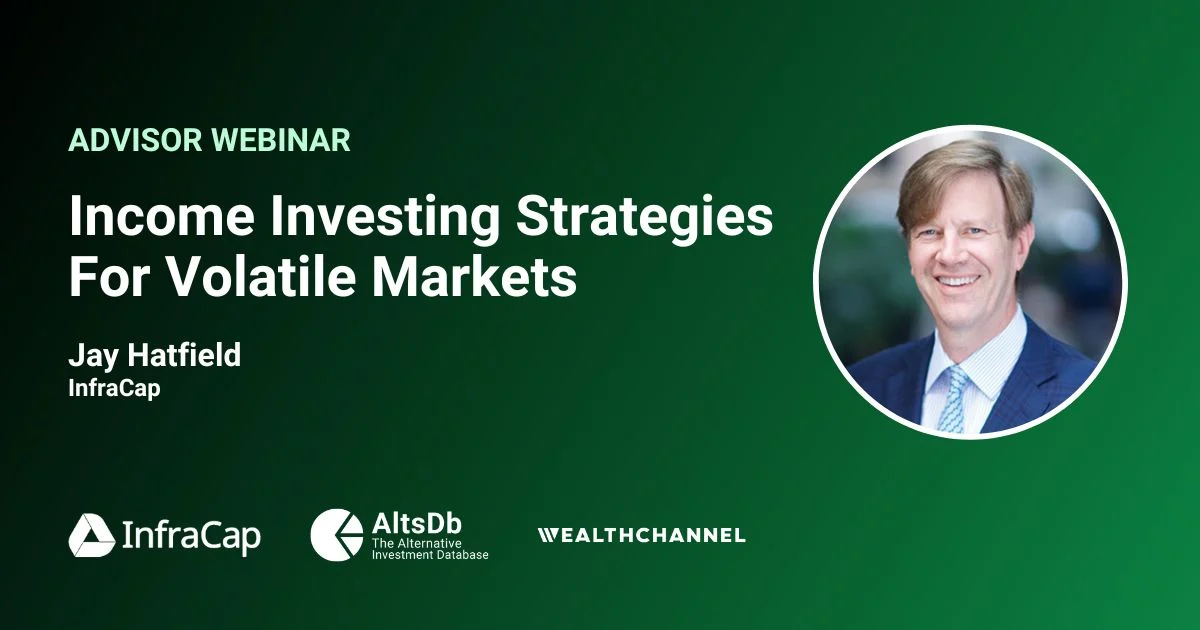
On February 8, AltsDb co-founder Jimmy Atkinson hosted Jay Hatfield, founder and CEO at InfraCap, on a live one-hour webinar designed for financial advisors. The session, which has been recognized by the CFP Board for one hour of continuing education credit, delved into sophisticated income investing strategies tailored to navigate the complexities of today’s macroeconomic environment. The webinar provided a comprehensive overview of approaches financial professionals can employ to generate consistent returns for their clients amidst persistent market uncertainty, inflation concerns, and evolving interest rate landscapes.
The presentation, recorded and made available for further viewing, addressed the critical need for advisors to adapt their income-generating strategies in response to a shifting economic paradigm. The current financial climate, characterized by a confluence of factors including elevated inflation, aggressive monetary policy tightening by central banks, geopolitical instability, and the lingering effects of global supply chain disruptions, presents unique challenges and opportunities for income-focused portfolios. Financial advisors are tasked with the dual mandate of preserving capital while also seeking to deliver reliable income streams that can help clients meet their financial objectives, whether for retirement income, funding educational expenses, or other long-term goals.
Webinar Overview and Key Themes
The webinar, titled "Income Investing Strategies For Volatile Markets," aimed to equip financial advisors with actionable insights and a robust framework for constructing and managing income-oriented portfolios in the current economic climate. Jay Hatfield, a seasoned professional with extensive experience in alternative investments and portfolio management, shared his expertise on how to identify and capitalize on income-generating opportunities that are resilient to market fluctuations.
Key topics covered during the webinar included:
- Understanding the Current Macroeconomic Landscape: A detailed examination of the prevailing economic conditions, including inflation drivers, interest rate trajectories, and their implications for fixed-income and other income-producing assets. This segment likely provided data-driven perspectives on inflation trends, GDP growth forecasts, and central bank policy stances.
- Diversification Strategies for Income Portfolios: Exploration of how to build diversified portfolios that spread risk across various asset classes and income sources, thereby enhancing stability and reducing reliance on any single investment type. This would have touched upon the benefits of incorporating alternative income strategies alongside traditional fixed income.
- Alternative Income Sources: In-depth discussion of less conventional but potentially higher-yielding income streams, such as private credit, infrastructure debt, real estate income, and dividend-paying equities with strong fundamentals. The webinar likely highlighted the risk-reward profiles of these alternatives and how they can complement traditional income investments.
- Risk Management in Income Investing: Strategies for mitigating risks associated with income-generating assets, including interest rate risk, credit risk, and liquidity risk, particularly in a volatile market. This would have involved discussions on duration management, credit analysis, and the importance of due diligence.
- Portfolio Construction and Implementation: Practical guidance on how to integrate these income strategies into client portfolios, considering individual risk tolerance, time horizon, and financial goals. This could have included case studies or model portfolio allocations.
The presentation emphasized that in an environment where traditional fixed-income yields may be insufficient to meet client needs, or subject to significant price volatility due to interest rate changes, a more nuanced and diversified approach to income investing is paramount. Advisors were encouraged to look beyond standard bond offerings and explore avenues that can provide attractive yields with carefully managed risk profiles.
The Role of InfraCap and Jay Hatfield’s Expertise
InfraCap, led by Jay Hatfield, is a firm specializing in alternative investments, with a particular focus on income-generating strategies. Their expertise lies in identifying opportunities within less traditional asset classes that can offer diversification and enhanced yield potential. Hatfield’s background and the firm’s investment philosophy likely informed the practical and evidence-based advice shared during the webinar.
The webinar format, a live one-hour session, underscores the demand from financial advisors for timely and relevant professional development. The acceptance of the webinar by the CFP Board for CE credit signifies its adherence to rigorous educational standards and its value in helping certified financial planners maintain their credentials while staying abreast of industry best practices. This recognition also highlights the growing importance of alternative investments and income strategies in the financial planning landscape.
Broader Economic Context and Data
The timing of the webinar, February 8, 2023, placed it within a period of significant economic recalibration. As of early 2023, inflation remained a persistent concern globally, although signs of moderation were beginning to emerge. The U.S. Consumer Price Index (CPI) had shown a slight easing from its peaks in 2022, but remained elevated above the Federal Reserve’s target of 2%. For instance, the CPI for January 2023, released in February, indicated a 6.4% year-over-year increase, still considerable but a slowdown from the 6.5% in December 2022 and the mid-9% highs of mid-2022.

In response to high inflation, the Federal Reserve had embarked on an aggressive series of interest rate hikes throughout 2022 and into early 2023. By February 2023, the federal funds rate had been raised significantly from near zero levels in early 2022, impacting borrowing costs across the economy and influencing the pricing of all fixed-income securities. This environment created a dual challenge for income investors: while higher rates offered the potential for better yields on new investments, existing bond portfolios faced valuation declines due to the inverse relationship between bond prices and interest rates.
Geopolitical events, such as the ongoing conflict in Ukraine, continued to exert pressure on energy and food prices, contributing to inflationary pressures and global economic uncertainty. Supply chain issues, while showing some signs of improvement, also remained a factor influencing economic stability and investment returns.
In this context, financial advisors are under pressure to deliver solutions that can provide a hedge against inflation and generate income without exposing clients to excessive market risk. Traditional income-generating assets like U.S. Treasury bonds, corporate bonds, and dividend stocks have faced headwinds. For example, the Bloomberg U.S. Aggregate Bond Index, a broad measure of the U.S. investment-grade bond market, experienced a significant decline in 2022, one of its worst years on record. This performance underscored the need for advisors to explore strategies that offer diversification and potentially more resilient income streams.
Implications for Financial Advisors and Investors
The insights shared in the AltsDb and InfraCap webinar have significant implications for financial advisors and their clients. In a market environment where capital preservation and reliable income generation are paramount, advisors must be adept at identifying and implementing strategies that go beyond traditional fixed-income investments.
The emphasis on alternative income sources suggests a growing recognition of their role in a diversified portfolio. Private credit, for instance, has seen increased investor interest as it can offer floating rates, which are advantageous in a rising rate environment, and shorter durations compared to traditional fixed-rate bonds. Infrastructure debt can provide stable, long-term cash flows, often linked to inflation, making it an attractive option for income-focused portfolios. Real estate income, through various investment vehicles, can offer both rental income and potential capital appreciation.
Furthermore, the focus on risk management highlights the critical need for due diligence and a deep understanding of the underlying assets and strategies employed. Advisors must be able to articulate the risks associated with these alternative income sources and ensure they align with their clients’ risk tolerance and investment objectives.
The availability of the webinar presentation deck for download provides a valuable resource for advisors seeking to deepen their understanding and implement these strategies. This accessibility allows for continued learning and application of the concepts discussed.
Connecting with InfraCap
The webinar also provided avenues for financial professionals to connect with InfraCap and learn more about their offerings. This interaction is crucial for advisors looking to partner with specialized firms that can provide access to unique investment opportunities and expertise in alternative income strategies. The inclusion of contact information and resources for InfraCap underscores the collaborative nature of the financial services industry, where specialized knowledge and access to diverse investment solutions are key to client success.
Conclusion
The webinar hosted by AltsDb and InfraCap represents a timely and valuable contribution to the professional development of financial advisors. By focusing on income investing strategies for volatile markets, the session addressed a critical need in the current economic climate. The detailed discussion on macroeconomic conditions, diversification, alternative income sources, and risk management equipped advisors with the knowledge to construct more resilient and effective income-generating portfolios for their clients. As markets continue to evolve, the insights provided by Jay Hatfield and InfraCap offer a forward-looking perspective on navigating challenges and capitalizing on opportunities within the income investing landscape, reinforcing the importance of continuous learning and strategic adaptation in financial advisory practice. The CFP Board’s recognition further validates the educational merit and practical applicability of the webinar’s content.
