

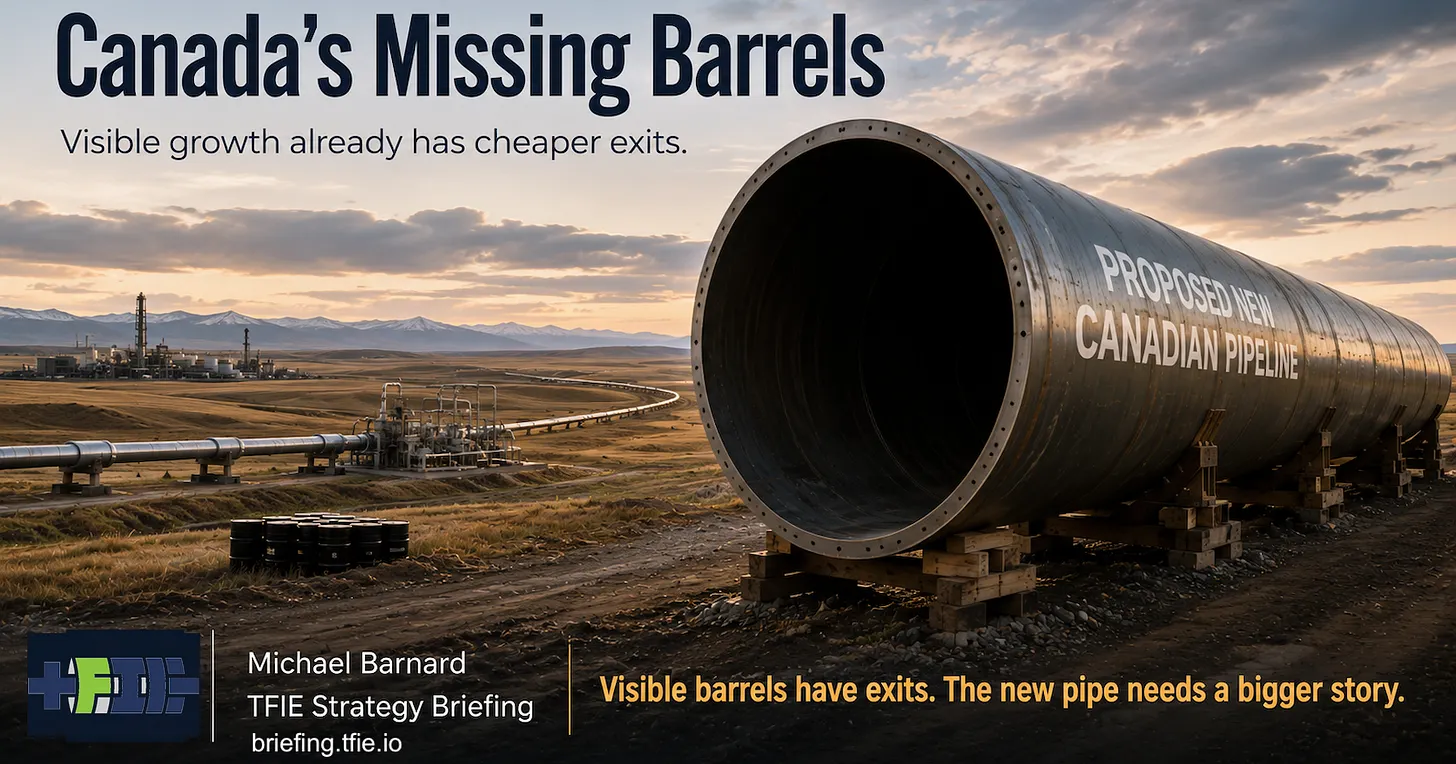
The landscape of Canadian energy infrastructure is witnessing a significant shift as federal and provincial authorities advance plans for a massive new export route. Canada has recently solidified the political and structural framework for a proposed one-million-barrel-per-day pipeline connecting the Edmonton region to the southern coast of British Columbia. This project, intended to provide a high-capacity exit for Alberta’s oil sands, has moved from a theoretical policy option to a tangible project with a defined route, a public-sector builder, and a complex ownership structure. However, as the project gains political momentum, energy analysts and economists are increasingly questioning the underlying commercial logic, noting a significant discrepancy between the proposed pipeline’s capacity and the actual projected growth of Alberta’s oil production.
The official project concept envisions a corridor stretching from the industrial heartland of Alberta to the Pacific tidewater, utilizing Trans Mountain as the public-sector developer and operator. The ownership consortium is a tripartite arrangement involving Trans Mountain, the Alberta Petroleum Marketing Commission (APMC), and Pembina Pipeline Corporation. By integrating a federal Crown corporation into the project’s DNA, Ottawa has signaled a commitment that goes beyond mere political support, effectively putting public capital at the forefront of the nation’s next potential energy megaproject. Despite this institutional backing, the fundamental question remains: where will the million barrels per day come from to fill this new line?
A Statistical Mismatch: Production Forecasts vs. Pipeline Capacity
To understand the commercial hurdles facing the west-coast line, one must examine the official production forecasts provided by the Alberta Energy Regulator (AER). According to the AER’s latest "Alberta Energy Outlook," raw bitumen production is expected to rise from approximately 3.558 million barrels per day (bpd) in 2024 to 4.061 million bpd by 2034. This represents a total projected increase of roughly 503,000 bpd over the next decade.
Crucially, the nature of this growth has changed from the "boom" years of the early 2000s. The AER does not anticipate any new greenfield oil-sands mines—massive, multi-billion-dollar projects built from scratch—to enter service during this forecast period. Instead, the projected half-million-barrel increase is expected to stem from "optimization, debottlenecking, and the expansion of existing facilities." This characterizes a mature-asset growth phase rather than a rapid industry-wide expansion.
When translating raw bitumen into pipeline volume, the numbers shift slightly due to the physics of heavy oil transport. Raw bitumen is too thick to flow through pipelines on its own and must be either upgraded into synthetic crude or blended with a lighter hydrocarbon, known as diluent (typically pentanes-plus), to create "dilbit." The AER’s removals forecast suggests that by 2034, upgraded bitumen will increase by 48,000 bpd, non-upgraded bitumen by 329,000 bpd, and the required diluent by 183,000 bpd. Together, the total increase in the oil-sands-related pipeline stream is estimated at 560,000 bpd. Notably, nearly one-third of this volume is not new oil production, but rather the diluent required to move the product.
This leaves the proposed one-million-barrel pipeline at nearly double the size of the total visible growth in the region. If the line were to be built today, it would have to "cannibalize" existing barrels from other major routes, such as the existing Trans Mountain system or the Enbridge Mainline. While this might provide shippers with more options, it transforms the project from essential new infrastructure into a displacement project that must compete for existing traffic—a difficult proposition when trying to secure the long-term, multi-decade contracts required to finance a project of this magnitude.
The Competitive Landscape: Incremental vs. Greenfield Egress
The proposed west-coast pipeline does not exist in a vacuum; it faces stiff competition from existing infrastructure players who are finding more cost-effective ways to increase capacity. For midstream companies, the path of least resistance—and lowest capital risk—is the expansion of current systems rather than the construction of entirely new 1,250-kilometre corridors.

Trans Mountain itself has indicated that through the use of drag-reducing agents (chemicals that allow oil to flow more smoothly) and its Mainline Optimization Project, it could add up to 300,000 bpd to its existing system by the end of 2028. Similarly, Enbridge has reached a final investment decision on an optimization phase for its Mainline system, which will add 150,000 bpd, with an additional 100,000 bpd expected on the Flanagan South line by 2027. Furthermore, South Bow (formerly part of TC Energy) is actively marketing 450,000 bpd of firm service from Hardisty, Alberta, to U.S. delivery points via its proposed Prairie Connector.
These incremental projects offer several advantages over a new greenfield pipeline. They utilize existing rights-of-way, leverage established pump stations and marine terminals, and tap into long-standing refinery relationships. This typically results in lower capital exposure, shorter regulatory and construction schedules, and significantly less volume risk. When these planned expansions are tallied, the majority of Alberta’s projected 560,000 bpd growth already has a plausible exit strategy before the new million-barrel line is even considered.
The "Pathways Plus" Strategy: Policy-Driven Production
The federal and provincial governments appear aware of this volume gap. Documents related to the "Pathways Plus" initiative—a collaborative framework between the government and the Pathways Alliance (a group of Canada’s largest oil sands producers)—suggest a "capacity-first" approach. Under this strategy, the infrastructure is planned first, and then the government implements financial and policy supports intended to incentivize the massive upstream investment required to fill it.
The scale of this requirement is staggering. To fill a million-barrel pipeline with genuinely new production would require a development cycle equivalent to roughly 30% of Alberta’s current total bitumen output. This would necessitate a new wave of in-situ projects, mines, processing facilities, and steam-assisted gravity drainage (SAGD) infrastructure.
Industry analysts estimate that such an upstream expansion would require approximately C$100 billion in new investment from oil producers. When the costs of the pipeline, the marine terminal, and required carbon capture and storage (CCS) systems are added, the total package could exceed C$200 billion. This creates a "chicken and egg" dilemma: producers are hesitant to commit to C$100 billion in new projects without guaranteed export capacity, while the pipeline cannot be financed without firm volume commitments from producers.
Shifting Financial Risks to the Public Balance Sheet
One of the most significant aspects of the new proposal is its ownership structure. With the Alberta Petroleum Marketing Commission and Trans Mountain (a federal Crown corporation) set to own the majority of the project, the financial risk is shifting from the private sector to the public balance sheet.
In a traditional private-sector pipeline project, the risk of underutilization—where a pipeline runs half-empty—is borne by the shareholders and the shippers through tolling agreements. In this proposed model, if the "missing barrels" do not materialize, the public treasury could be left to absorb the shortfall. This includes the risk of "toll pressure," where the cost of moving oil must be raised to cover the project’s debt, potentially making Canadian oil less competitive in the global market.
The political momentum for the project is driven by the desire for "energy security" and the pursuit of higher prices for Canadian crude by reaching Asian markets. However, critics argue that using public funds to bridge the gap between current production and a million-barrel target is a high-stakes gamble on the future of global oil demand.

Global Market Constraints and the Energy Transition
The commercial viability of a west-coast pipeline also depends on the appetite of international buyers. Alberta’s primary export is diluted bitumen, a heavy, sour crude that requires specialized refining equipment. Historically, the primary market for this product has been the U.S. Gulf Coast and California.
However, the California market is shrinking. The state has seen a substantial loss in refining capacity as it pivots toward aggressive climate goals and electric transportation. While Asian markets, particularly China and India, remain significant importers of crude, their long-term demand profile is changing. China’s rapid adoption of electric vehicles, battery-swapping technology, and high-speed rail is expected to weaken the growth of diesel and gasoline demand over the multi-decade life of a new pipeline.
Furthermore, Canadian heavy crude is not a generic commodity; it must compete with heavy barrels from Mexico, Venezuela, and the Middle East. If a new pipeline leads to a surge in supply without a corresponding surge in specific refining capacity in Asia, the "tidewater premium" that proponents hope for may never fully materialize.
Chronology of West Coast Pipeline Egress
The journey toward increasing west-coast egress has been long and fraught with challenges. Understanding this timeline is essential to contextualizing the current million-barrel proposal:
- 2013-2016: Enbridge’s Northern Gateway project faces intense legal and environmental opposition, eventually being cancelled by the federal government.
- 2018: The federal government purchases the Trans Mountain Pipeline for C$4.5 billion to ensure the expansion project (TMX) proceeds after Kinder Morgan threatens to walk away.
- 2019-2023: TMX faces significant cost overruns, with the price tag ballooning from an initial C$7.4 billion to over C$30 billion.
- May 2024: The Trans Mountain Expansion officially enters service, nearly tripling the capacity of the original line to 890,000 bpd.
- Late 2024: Discussions emerge regarding the "Pathways Plus" framework and the potential for a second, even larger, million-barrel-per-day line to follow TMX.
The current proposal is essentially an attempt to build on the momentum of TMX, but it faces a much more difficult economic environment where the easy "low-hanging fruit" of production growth has already been harvested.
Conclusion: The Burden of Proof
While the proposed million-barrel pipeline is now "politically real," it remains commercially speculative. The project represents a monumental bet that Alberta can—and should—launch another massive oil-sands investment cycle in an era of global energy transition and increasing climate regulation.
For policymakers and taxpayers, the central question is one of risk. If the barrels, the shippers, and the global buyers do not align as perfectly as the government’s vision suggests, the resulting infrastructure could become a "stranded asset" or a permanent drain on public resources. The "missing barrels" are not merely a statistical curiosity; they are the fundamental commercial requirement that must be established before the first shovel hits the ground. As the project moves forward, the burden of proof lies with the proponents to show that a million-barrel-per-day exit is a necessary evolution of the Canadian energy sector, rather than an over-ambitious project chasing a production boom that has already matured.
