

The landscape of American manufacturing reveals a complex picture of resilience and caution, as a robust demand for goods and services currently buoys the sector, yet a palpable sense of apprehension clouds the outlook for the coming year. While most U.S. manufacturers report stronger demand compared to twelve months ago, a noticeable softening in their 12-month projections suggests a tempering of executive optimism, indicating a strategic recalibration in the face of persistent economic uncertainties. This evolving sentiment was captured in the latest Chief Executive CEO Confidence Index, a comprehensive survey that offers a granular view into the minds of American business leaders.
A Divergence in Confidence: Present Strength, Future Hesitation
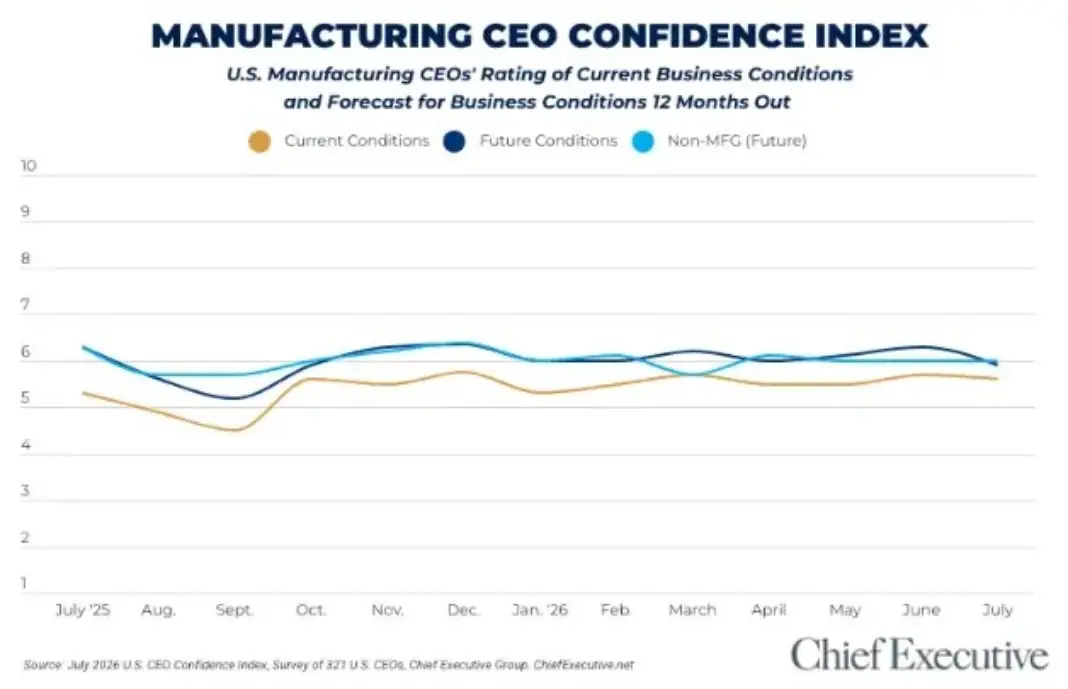
The dynamic between manufacturers’ near-term assessments and their long-term aspirations has undergone a significant shift. In June, the gap between immediate concerns and future hopes appeared to be narrowing. However, the July survey, conducted between the 7th and 9th among 321 U.S. CEOs, witnessed an inversion of this trend. Current confidence has held relatively steady, while year-ahead sentiment has begun to lose momentum, signaling a growing divergence in how manufacturers perceive the present versus the future.
The CEO Confidence Index, a barometer of executive sentiment, found that manufacturers rated current business conditions at an average of 5.6 out of 10, where 1 signifies "Poor" and 10 denotes "Excellent." This rating, while representing a marginal 2 percent decline from June, remains among the strongest figures observed for the sector throughout the year. A historical analysis of this "current confidence" metric reveals a striking pattern of stability. Since February 2026, ratings have consistently hovered between 5.5 and 5.7 out of 10. This stability suggests that despite any reservations about future economic trajectories, the sector’s assessment of the present operating environment has remained remarkably consistent over the past six months. This steadiness can be attributed to several factors, including sustained consumer spending on manufactured goods and the ongoing need for industrial production across various sectors.
In contrast, the outlook for the year ahead paints a more cautious picture. Manufacturers are forecasting that business conditions will reach 5.9 out of 10 by this time next year, a notable 6 percent decrease from June’s more optimistic 6.3 out of 10. This decline marks the sector’s lowest year-ahead forecast of 2026 and the first instance since October 2025 that the Index has dipped below the 6.0 threshold. While this projected score still indicates an expectation of improvement over current conditions, it strongly suggests that manufacturers have adopted a more measured perspective regarding the extent of future growth they anticipate. This recalibration of future expectations is a crucial indicator, as it often precedes strategic adjustments in investment, hiring, and production planning.
Erosion of Optimism Gap and Key Drivers of Sentiment
The recent pullback in year-ahead sentiment has also effectively erased the optimism gap that manufacturers had maintained over their non-manufacturing counterparts since May 2026. The current forecast of 5.9 for manufacturers now sits just below the 6.0 rating that non-manufacturing businesses have sustained for three consecutive months. This convergence in future outlooks suggests a broader, sector-wide reassessment of economic prospects, rather than an isolated phenomenon within manufacturing.
At the heart of manufacturers’ current confidence lies the overwhelming consensus on improving and healthy demand. This robust demand for their products and services is a primary driver, enabling them to maintain a positive view of the present economic climate. However, this optimism is concurrently tempered by significant concerns. CEOs are expressing anxieties regarding the escalating burden of regulatory frameworks, the relentless rise in operational costs, and the unpredictable nature of rapidly shifting policy landscapes.
Greg Immell, CEO of Saporito Finishing, a small-sized industrial manufacturing firm, articulated this duality: "Revenues are increasing as we see increased demand; however, healthcare, energy, and wages have increased. The battle is to improve efficiencies to protect margins." This statement encapsulates the core challenge: leveraging strong demand while navigating cost pressures that threaten profitability.
John Evans, president of a small-sized lumber manufacturing firm, highlighted the disruptive impact of policy inconsistencies: "If we can keep the same tariff policies for more than a month, I think the industry will be confident to make plans longer than a few weeks." This sentiment underscores the critical need for policy stability to foster long-term strategic planning and investment within the manufacturing sector. Such unpredictability can lead to hesitations in capital expenditures, expansion plans, and supply chain optimizations.
Further reinforcing these concerns, other industry leaders cited "higher costs driven by geopolitics [and] interest rates" as significant headwinds. This paints a picture of a sector poised to capitalize on strong demand, yet finding its ability to fully benefit hampered by external economic forces and rising input expenses. The interplay between robust demand and increasing costs presents a complex operating environment, where the margin for error is shrinking.
Economic Outlook: A Mixed Bag of Growth Expectations
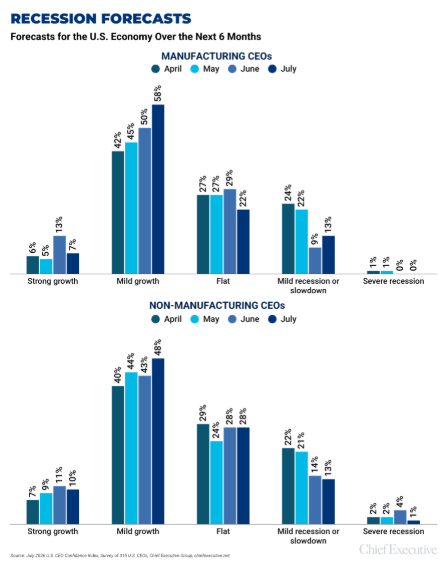
Despite the softening 12-month forecast for their own sector, manufacturing CEOs’ expectations for the broader U.S. economy continued to show improvement in July. A significant 65 percent of respondents now anticipate some form of economic growth over the next six months, an increase from 63 percent in June and marking the third consecutive monthly improvement in this metric. This growing optimism about the national economy, however, is not uniformly distributed. The proportion of CEOs forecasting significant growth has fallen by nearly 50 percent compared to the previous month, indicating that while the general direction is positive, the magnitude of expected growth is becoming more modest.
Concurrently, the proportion of manufacturers forecasting some kind of recession has ticked upward, from 9 percent in June to 13 percent in July. While still a minority, this increase suggests a heightened awareness of potential downside risks, even amidst overall positive economic sentiment. This nuanced view reflects an understanding that the path to sustained economic expansion may be uneven and subject to unforeseen disruptions.
In comparison to their non-manufacturing peers, manufacturers remain more bullish on the prospect of economic growth. Only 58 percent of non-manufacturing CEOs forecast economic growth. However, the recessionary fears within the non-manufacturing sector have softened somewhat, decreasing by 22 percent since June. This suggests that while both sectors are navigating a complex economic environment, their specific concerns and outlooks may differ in intensity and focus.
Demand Dynamics: The Unwavering Engine of Manufacturing Resilience
The survey data unequivocally points to sustained demand as the primary pillar supporting the resilience of the U.S. manufacturing sector. More than half of manufacturers polled (52 percent) reported that demand for their products and services is higher today than it was a year ago. A notable segment of these respondents, 18 percent, described this increase as "significant," underscoring a substantial uplift in market appetite. In stark contrast, only 22 percent of manufacturers indicated that demand has declined.
This robust performance in demand outpaces that of their non-manufacturing counterparts. Among non-manufacturers, a mere 12 percent described a "significant change" in demand, suggesting that the manufacturing sector is experiencing a more pronounced surge in customer interest and purchasing activity. This heightened demand can be attributed to several factors, including post-pandemic recovery efforts, ongoing infrastructure projects, and the persistent need for essential manufactured goods across various industries, from automotive and aerospace to consumer electronics and healthcare.
Corporate Forecasts: A Looming Shadow of Rising Expenditures
The outlook for corporate forecasts within the manufacturing sector presents a more mixed and concerning picture, particularly concerning operational expenditures. A staggering 77 percent of manufacturers foresee increases in their operational expenditures, a significant surge of 60 percent compared to June. This dramatic jump follows a month where manufacturers had expressed unusual optimism regarding the burden of organizational costs. The sharp reversal suggests that previously underestimated cost pressures have intensified or new ones have emerged, significantly impacting the financial planning of manufacturing firms.
This rise in anticipated operational expenditures is likely driven by a confluence of factors, including escalating raw material prices, increased energy costs, rising labor wages, and the lingering effects of global supply chain disruptions. The increased cost of doing business directly impacts profit margins, forcing manufacturers to either absorb these costs, pass them on to consumers through higher prices, or find ways to significantly improve operational efficiencies. The latter, as noted by Greg Immell, is proving to be a constant "battle."
About the CEO Confidence Index: A Long-Standing Barometer
The CEO Confidence Index, compiled by Chief Executive Group since 2002, has served as a crucial indicator of executive sentiment within the U.S. business community. The Index surveys hundreds of U.S. CEOs across organizations of all types and sizes, providing a comprehensive overview of confidence levels in both current and future business environments. The methodology involves assessing CEOs’ observations of various economic and business components, offering valuable insights into the prevailing mood and strategic outlook of American leadership. For further information and historical data, the ChiefExecutive.net website provides a dedicated section for the CEO Confidence Index. This ongoing data collection allows for the tracking of trends, identification of emerging challenges, and understanding of the cyclical nature of business confidence in response to evolving economic conditions.
Implications and Broader Impact
The divergence between strong current demand and a more cautious future outlook for U.S. manufacturers carries significant implications. On one hand, the sustained demand is a testament to the essential nature of manufactured goods and the ongoing recovery in many economic sectors. It suggests that the fundamental underpinnings of the manufacturing economy remain sound.
However, the tempering of future optimism is a signal that CEOs are keenly aware of the prevailing headwinds. Rising costs, regulatory complexities, and policy uncertainties create an environment where long-term investment decisions are approached with greater deliberation. This could translate into slower capital expenditure growth, more cautious hiring practices, and a potential dampening of innovation if companies prioritize short-term cost management over long-term strategic expansion.
The impact extends beyond individual firms. A more cautious manufacturing sector could have ripple effects on the broader economy, influencing employment levels, supply chain stability, and the availability of goods. The persistent concerns about operational costs, particularly in light of geopolitical tensions and interest rate fluctuations, highlight the vulnerability of U.S. manufacturers to global economic forces.
The data also underscores the critical role of policy in shaping business confidence. The call for policy stability, particularly concerning tariffs and trade, from industry leaders like John Evans, emphasizes the need for predictable regulatory frameworks to foster a conducive environment for growth and investment.
Ultimately, the current sentiment among U.S. manufacturers reflects a pragmatic approach to a complex economic landscape. While they are capitalizing on present opportunities driven by strong demand, they are also prudently preparing for potential challenges and uncertainties that lie ahead, demonstrating a strategic foresight essential for navigating the ever-evolving global market. The coming months will be crucial in determining whether the current resilience can overcome future headwinds, or if the tempered optimism will give way to more significant adjustments in the manufacturing sector.
