

The United States electric vehicle market, once clouded by the expiration of significant federal tax credits and a perceived cooling of consumer interest, is currently witnessing a robust period of revitalization and structural transformation. At the forefront of this shift is Rangeway, a California-based startup that is redefining the public charging experience by moving away from utilitarian parking lot stalls toward a hospitality-centric model. Recently, the company announced a strategic expansion into the St. Louis, Missouri, metropolitan area, signaling a significant investment in the American Midwest—a region traditionally viewed as a laggard in the transition to sustainable mobility. This move, supported by a network of technology partners and a joint venture with sustainable builders, highlights a broader trend where charging quality and driver experience are becoming as critical as vehicle range and price.
The Evolution of the American Electric Vehicle Market
The narrative surrounding electric vehicles (EVs) in the United States underwent a dramatic shift following the legislative changes to federal tax incentives in late 2023. While many analysts predicted a prolonged "EV winter," the market has instead shown remarkable resilience. Sales data from 2024 and 2025 indicated that while the rate of growth normalized, the absolute number of EV registrations continued to climb, driven by lower manufacturer pricing and an influx of more diverse models.
A critical component of this resilience has been the rapid maturation of the charging infrastructure. The industry is transitioning from a "quantity-first" approach—focused purely on the number of plugs—to a "quality-first" strategy. This involves the creation of dedicated EV charging facilities that exclude internal combustion engine (ICE) vehicles, thereby eliminating the phenomenon of "ICE-ing," where gasoline cars block charging ports. Rangeway’s entry into the market is a direct response to this demand for premium, reliable, and exclusive charging environments.
Rangeway’s Hospitality-Focused Strategy
Founded on the premise that charging should be an integrated part of a journey rather than a chore, Rangeway has developed a suite of facility designs tailored to different driver needs. Their strategy focuses on scenic corridors and high-traffic destinations where traditional infrastructure is often lacking. The company’s portfolio includes four distinct tiers of service:
- Trailhead: These are sheltered stations designed for quick stops, providing protection from the elements while maintaining a high-speed charging throughput.
- Waystation: These facilities feature fully enclosed lounges, offering drivers a climate-controlled environment to work or relax while their vehicles replenish.
- Basecamp: A more comprehensive version of the Waystation, the Basecamp is designed for longer stays, potentially featuring expanded amenities and retail options.
- Boutique Motels: Perhaps the most ambitious of Rangeway’s offerings, these modular overnight stay facilities integrate off-grid charging, allowing travelers to wake up to a full battery in remote locations.
By focusing on the "experience problem" rather than just the "infrastructure problem," Rangeway aims to attract a demographic of drivers who value comfort and safety. This approach mirrors the historical development of the American highway system, where gas stations evolved from simple pumps into comprehensive service plazas.
Technological Integration and Off-Grid Capability
The feasibility of Rangeway’s remote and high-end locations is underpinned by a robust technological ecosystem. The company has assembled a specialized team to ensure uptime and operational efficiency. Key partners include ChargeMate, which provides a driver assistance platform; WattsUp, focusing on real-time reliability monitoring; and Juice Serve, which handles vision-based identification and payment processing.
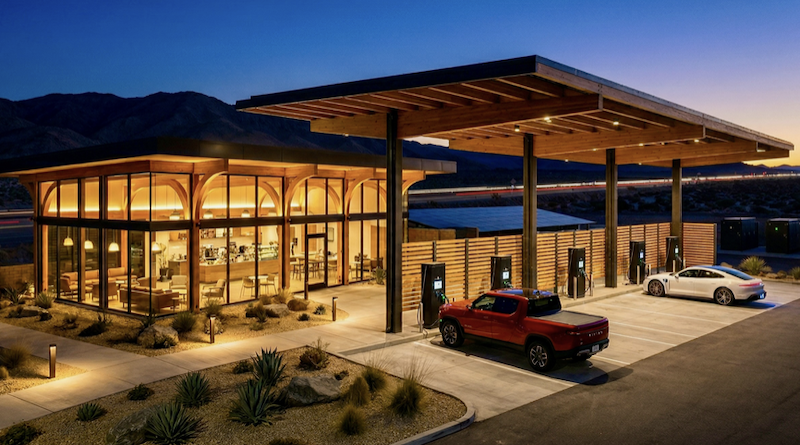
However, the most significant technological hurdle for remote charging is grid constraint. To solve this, Rangeway partnered with HyWatts, a California energy firm specializing in modular "Power-Plant-in-a-Box" systems. These units integrate solar generation with advanced battery storage and hydrogen-ready power modules.
The HyWatts system utilizes an integrated electrolysis and fuel cell process. During periods of high solar output, the system uses excess energy to split water into hydrogen. This hydrogen is stored and can be converted back into electricity via fuel cells when solar production is low or demand is high. This "green hydrogen" cycle provides a zero-emission, off-grid solution that bypasses the need for expensive and time-consuming utility grid upgrades. This technology is similar to systems deployed in extreme racing environments, such as Extreme H, proving that high-speed charging is possible even in the most geographically isolated areas.
Strategic Focus: The St. Louis Metro Area
Rangeway’s selection of St. Louis, Missouri, as its initial focus area might appear counterintuitive given the state’s political landscape and its implementation of an annual EV fee. Missouri currently charges EV owners a $150 annual fee, a figure set to increase in the coming years to offset the loss of fuel tax revenue. However, the economic and geographic realities of Missouri make it a strategic hub.
St. Louis serves as a critical junction for several major interstate highways, including I-70, I-55, I-44, and I-64. This makes the city a vital corridor for cross-country travel and regional commerce. Furthermore, Missouri’s EV market is performing better than many of its neighbors. Local auto dealers have noted a steady increase in EV interest, particularly in urban centers where charging density is highest.
Political leadership has also played a role. Former St. Louis Mayor Lyda Krewson’s 2021 mandate to electrify the city’s fleet laid a foundation for municipal support. Additionally, the local utility provider, Ameren, has been proactive in encouraging EV adoption. Ameren offers reduced rates for off-peak charging and has published data showing that the average Missouri EV driver can save approximately $1,300 annually in fuel costs and 50% in maintenance costs. These savings effectively neutralize the state’s annual EV fee, making the total cost of ownership highly competitive.
The Rangeway St. Louis Joint Venture
To execute its vision in the Midwest, Rangeway has formed a joint venture titled "Rangeway St. Louis" with LoüTeq, a sustainable building firm. This partnership leverages LoüTeq’s expertise in eco-friendly construction to ensure that the physical structures of the charging stations meet the same environmental standards as the energy powering them.
As part of this venture, Luke Schuette, the founder and CEO of LoüTeq, has been appointed as Rangeway’s Director of Design and Construction. Schuette’s philosophy aligns with Rangeway’s hospitality-first model, treating the charging station as a piece of architectural design rather than a mere utility. This partnership is expected to accelerate the rollout of premium facilities across the St. Louis region, with specific site announcements expected in the near future.

Competitive Landscape: IONNA and the Global Automakers
Rangeway does not operate in a vacuum. It faces competition from massive industry consortia, most notably IONNA. Launched in 2024, IONNA is backed by a powerhouse group of automakers including BMW, General Motors, Honda, Hyundai, Kia, Mercedes-Benz, Stellantis, and Toyota. Like Rangeway, IONNA is focusing on a lounge-style aesthetic and standalone facilities that cater exclusively to EV drivers.
IONNA has also pursued a dual-track strategy. While building its own dedicated sites, it has partnered with the global convenience store giant Circle K. Under the "Rechargeries @ Circle K" brand, IONNA plans to convert and upgrade charging stations at 85 existing sites across the U.S., with a significant scale-up planned for 2027.
The competition between a boutique, agile startup like Rangeway and a multi-national consortium like IONNA reflects the healthy tension in the market. While IONNA offers scale and brand recognition, Rangeway is positioning itself as a more curated, hospitality-driven alternative that can thrive in niche or grid-constrained locations where large-scale corporate rollouts might struggle.
Broader Implications for Infrastructure and Regional Economies
The expansion of companies like Rangeway into the Midwest signifies a "normalization" of electric vehicles across the American heartland. By investing in high-quality infrastructure in states like Missouri, these companies are addressing the "range anxiety" and "charging anxiety" that remain the primary barriers to EV adoption for many consumers.
The economic impact of these facilities extends beyond the automotive sector. Hospitality-driven charging stations encourage travelers to spend more time—and money—in local communities. Whether it is a boutique motel stay or a visit to a lounge-style waystation, the "charging stop" is becoming an economic driver for the surrounding area.
Furthermore, the integration of green hydrogen and solar-plus-storage technologies at these sites serves as a real-world laboratory for decentralized energy grids. As Rangeway proves the viability of off-grid, hydrogen-powered charging, it provides a blueprint for other industries to follow, potentially leading to more resilient and sustainable energy infrastructure across the United States.
Conclusion
The emergence of Rangeway St. Louis marks a pivotal moment in the U.S. transition to electric mobility. By prioritizing the driver experience and leveraging cutting-edge energy technology, Rangeway is moving the conversation beyond the limitations of the federal tax credit. As the company begins its rollout in Missouri, it stands as a testament to the fact that the future of transportation is not just about moving from point A to point B, but about the quality of the journey in between. With the backing of sustainable builders and innovative energy partners, Rangeway is well-positioned to turn the "show-me" state into a leader for the next generation of American travel.
