

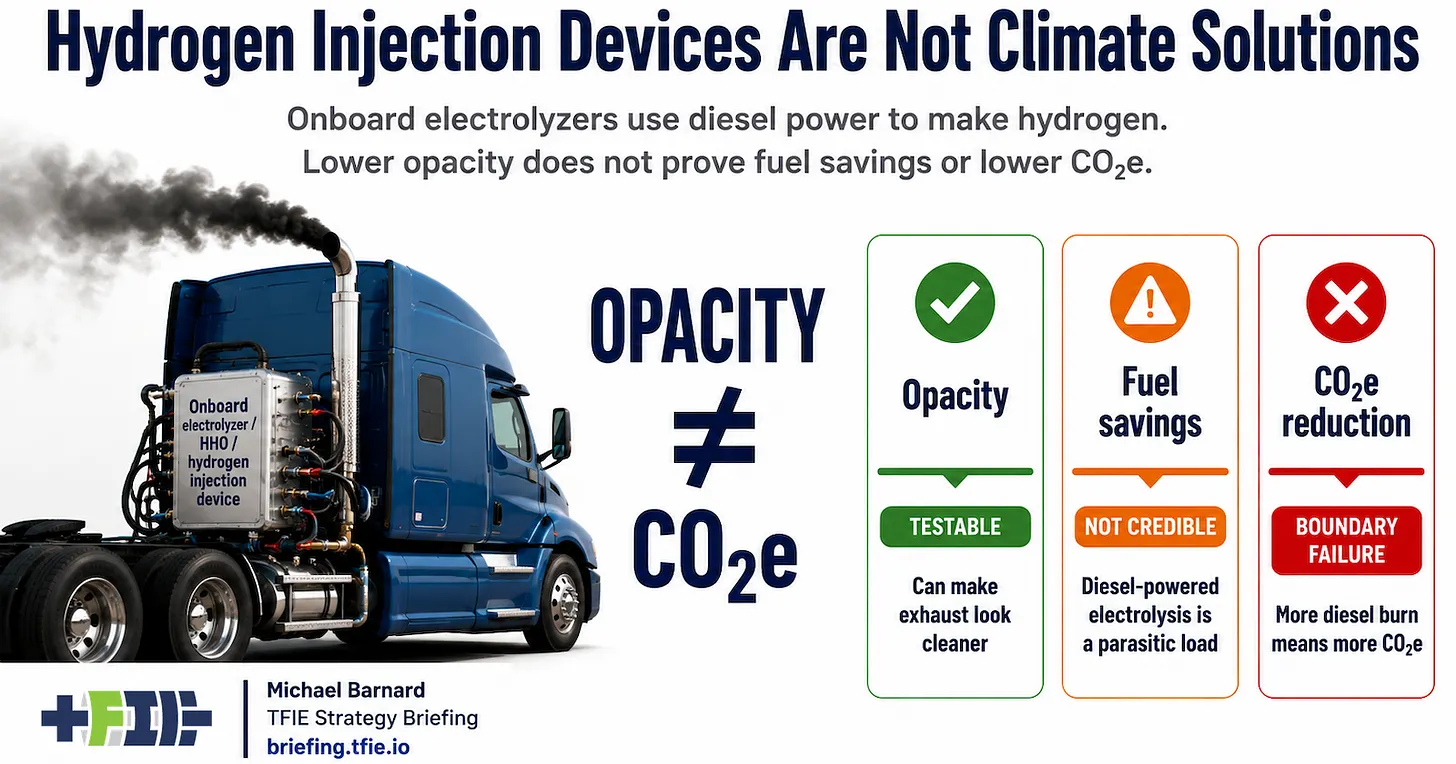
The promise of a simple, bolt-on solution to the carbon footprint of heavy-duty diesel engines has long captivated the logistics and transportation industries. Among the most persistent of these technologies is onboard hydrogen injection, a process that uses the vehicle’s own electrical system to generate hydrogen gas for combustion enhancement. However, a growing body of technical analysis and independent testing suggests that while these systems can effectively reduce the visible smoke—or opacity—of exhaust, they often fail to deliver the promised reductions in fuel consumption and carbon dioxide equivalent (CO2e) emissions. In many cases, the thermodynamic reality of these systems results in a net energy loss, creating a "smoke screen" that masks a lack of genuine climate performance.
The Technical Mechanism and the Thermodynamics of Loss
Onboard hydrogen injection systems, often marketed as HHO or "oxyhydrogen" generators, operate on a relatively simple principle of electrolysis. The system uses electricity produced by the vehicle’s alternator to split water into its component gases, hydrogen and oxygen. This gas mixture is then fed into the engine’s air intake. The marketing pitch relies on the fact that hydrogen has a much higher flame speed and different ignition characteristics than diesel. When introduced into the combustion chamber, hydrogen can act as a combustion catalyst, potentially leading to a more complete burn of the diesel fuel.
From a chemical perspective, this can indeed reduce the formation of soot and particulate matter, leading to an exhaust plume that appears cleaner to the naked eye. However, the fundamental challenge lies in the first and second laws of thermodynamics. The energy used to split the water molecules must come from the engine itself. Diesel fuel is burned to produce mechanical work; a portion of that work turns the alternator; the alternator converts mechanical energy into electricity; and the electrolyzer uses that electricity to produce hydrogen.
Each step in this chain involves significant energy losses due to heat and mechanical friction. For the system to provide a net fuel saving, the combustion improvement gained from the hydrogen must be large enough to overcome the parasitic load placed on the engine to generate the gas in the first place. Recent modeling by the Transition Fuel and Innovation Engineering (TFIE) group highlights the scale of this hurdle. Based on a common industry claim of 40 liters of gas per minute, the model estimates an 8.7% fuel-economy penalty if the flow is oxyhydrogen. If the flow is interpreted as pure hydrogen, the estimated penalty rises to a staggering 13.0%.
The Opacity Trap: Visual vs. Chemical Cleanliness
The primary evidence offered by proponents of hydrogen injection is often a reduction in exhaust opacity. Opacity is a measure of the amount of light blocked by particulate matter in an exhaust stream. While a reduction in opacity is a positive indicator for local air quality and engine "smoothness," it is a poor proxy for overall environmental impact or fuel efficiency.

A cleaner-looking stack does not necessarily mean the engine is consuming less fuel. In fact, an engine can produce less visible soot while simultaneously producing higher levels of nitrogen oxides (NOx) or maintaining the same level of CO2 output. Because CO2 emissions are directly proportional to the amount of carbon-based fuel burned, if the engine is working harder to power an electrolyzer, it may actually be emitting more CO2 despite the lack of visible smoke. Furthermore, modern diesel engines are equipped with sophisticated aftertreatment systems, including Diesel Particulate Filters (DPF) and Selective Catalytic Reduction (SCR) units. These systems are designed to handle specific particulate loads; altering the combustion chemistry upstream can have unpredictable effects on the longevity and efficiency of these expensive components.
A History of Market Evolution and Defunct Claims
The landscape of onboard hydrogen injection is populated by a rotating cast of companies, many of which share technological lineages. The Canadian Hydrogen Energy’s Hy-Drive HFI system was a prominent player in the mid-2000s, targeting the trucking industry with claims of alternator-powered efficiency. Over the subsequent two decades, a variety of similar systems emerged, including HY-Impact, dynaCERT’s HydraGEN, HYDI, and HydroFuture’s Hydro-Zilla.
The volatility of this sector is evidenced by the disappearance of brands like HydroFuture and Hydro-Zilla, which have since become defunct. However, the underlying technology frequently resurfaces under new branding. For instance, Water Assisted Energy, a current player in the market, is led by David Packer, who was previously associated with the Hydro-Zilla lineage. While each new iteration of the technology deserves individual assessment, the historical pattern suggests a recurring cycle: a product is launched with bold claims of 15% to 25% fuel savings, fails to produce repeatable results in independent laboratory settings, and eventually fades away or rebrands.
One company that has attempted a more rigorous approach is dynaCERT. Their HydraGEN system underwent a structured assessment by the PIT Group, an independent testing organization. However, the results were telling. The study reported fuel savings ranging from less than 1% to approximately 5%—far below the double-digit figures often cited in sales brochures. Crucially, the report found no significant difference in carbon dioxide measurements between the baseline and the test runs, casting doubt on whether any meaningful energy savings were achieved.
Regulatory Misinterpretations and the CARB Order
A common tactic in the marketing of hydrogen injection devices is the citation of regulatory "approvals" or "certifications" that are often taken out of context. A notable example involves orders from the California Air Resources Board (CARB). Historically, some manufacturers in this category have pointed to CARB Executive Orders as proof of their technology’s efficacy.
However, a closer look at these documents reveals a different story. One such order applied to a specific group of heavy-duty diesel engines manufactured between 1970 and 2006—engines that lacked modern sensors and regeneration systems. The CARB order merely stated that the device did not reduce the effectiveness of the vehicle’s existing pollution controls. It was not a certification of fuel savings, nor was it an endorsement of the device’s climate benefits. In fact, CARB expressly prohibits manufacturers from claiming their products are "Approved by the Air Resources Board" in a way that implies a performance guarantee. Despite this, marketing materials frequently conflate a lack of regulatory objection with a proactive endorsement of fuel-saving claims.

The Burden of Proof: What Real Evidence Looks Like
For hydrogen injection to be considered a viable climate solution, it must meet a rigorous standard of evidence that goes beyond anecdotal testimonials from fleet owners. Professional engineering standards for fuel-economy testing require:
- Gravimetric Fuel Measurement: Fuel must be weighed or measured with high-precision flow meters under controlled conditions.
- Measured Electrical Demand: The exact amount of energy the electrolyzer pulls from the alternator must be accounted for in the net efficiency calculation.
- Independent Verification: Tests must be conducted by third-party laboratories using standardized drive cycles (such as the FTP-75 or SET cycles).
- Statistical Significance: Results must be repeatable across multiple trials and different engine loads.
- Comprehensive Emissions Profiles: Data must include CO2, NOx, and particulate number (PN), not just opacity.
In many cases, when these rigorous controls are applied, the perceived benefits of hydrogen injection evaporate. A study involving a diesel generator—where engine load can be more precisely controlled than in a moving truck—showed that diesel consumption actually rose linearly as the flow of HHO increased. In high-flow, high-load scenarios, the fuel increase reached 5.2%, confirming that the energy required to produce the hydrogen was not being recovered during combustion.
Broader Implications and the Path to True Decarbonization
The persistence of hydrogen injection claims represents a potential distraction from more effective decarbonization strategies. For fleet managers under pressure to meet Scope 1 emissions targets, the "quick fix" of a retrofit device is understandably attractive. However, the misallocation of capital into unproven technologies can delay the adoption of genuinely transformative solutions.
The relevant comparators for hydrogen injection are not the "dirty" engines of the 1990s, but the modern, highly efficient diesel engines and zero-emission alternatives available today. True climate performance in the transport sector is being driven by:
- Electrification: Battery electric trucks (BETs) offer a total energy efficiency that far exceeds any internal combustion engine, regardless of additives.
- Freight Efficiency: Aerodynamic improvements, low-rolling-resistance tires, and telematics-driven route optimization provide measurable, repeatable fuel savings.
- Alternative Fuels: Externally supplied hydrogen (where the energy for production is not taken from the vehicle’s engine) or renewable diesel (HVO) can significantly lower the carbon intensity of existing fleets.
- Modal Shifts: Moving freight from road to rail remains one of the most effective ways to reduce the carbon footprint of logistics.
Conclusion
Onboard hydrogen injection hardware can indeed produce gas, alter the chemistry of a flame, and make a diesel engine’s exhaust look cleaner. However, the scientific consensus and available data suggest that these visual changes do not translate into the material fuel savings or carbon reductions required for climate action. The "professional question" for the industry is whether these devices can deliver a repeatable net reduction in CO2e after accounting for the full energy loop and the parasitic load on the engine. To date, the public evidence does not support such a judgment. Until manufacturers provide transparent, independently verified data that accounts for the laws of thermodynamics, onboard hydrogen injection remains a technology that addresses the symptoms of diesel combustion rather than the underlying challenge of energy efficiency.
