

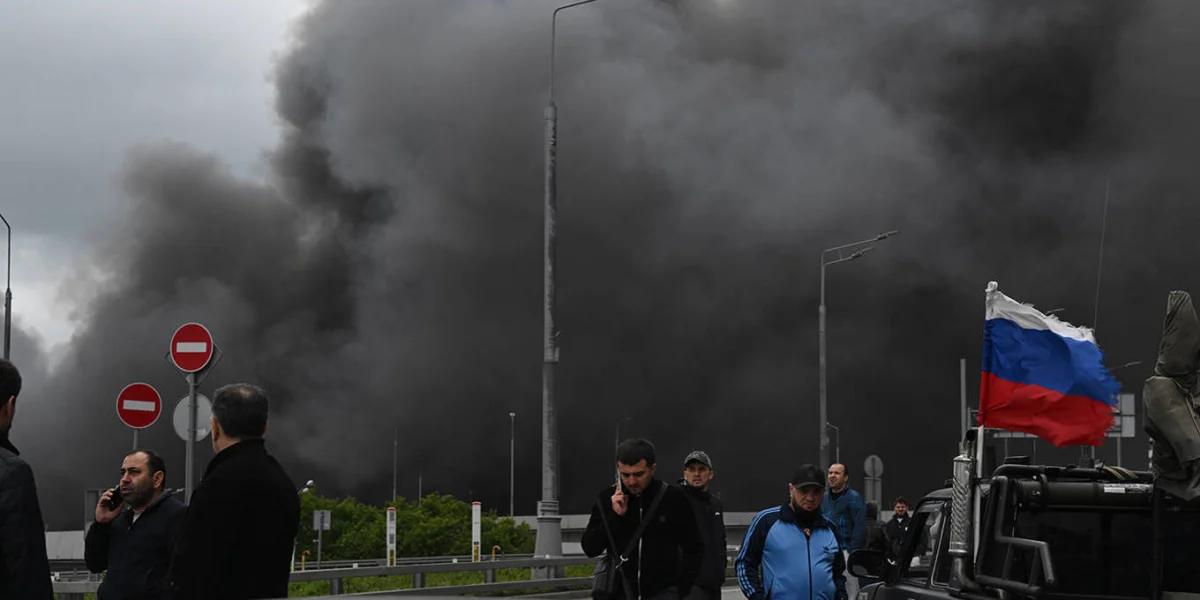
NEW YORK – As Russia grapples with mounting pressures on multiple fronts, President Vladimir Putin finds himself in an increasingly precarious position, arguably the most challenging of his quarter-century at the helm of the Kremlin. While his grip on power remains firm, the escalating situation fuels growing concerns that he may seek an escape from his current predicament through a significant escalation of the conflict with the West.
The strategic importance of Crimea, annexed by Russia in 2014, has become a focal point in this escalating tension. Ukraine’s persistent and increasingly sophisticated attacks on the peninsula, coupled with strikes deep within Russian territory and efforts to frustrate frontline forces, are placing immense strain on Russia’s military and economy. These sustained disruptions, if continued, are likely to amplify the pressure on Putin, potentially increasing his temptation to pursue a "game-changing" offensive to alter the course of the conflict and project strength both domestically and internationally.
The Shifting Tides of Conflict: A Multifaceted Russian Dilemma
The current predicament for the Kremlin is not a monolithic issue but rather a confluence of interconnected challenges. On the battlefield, Ukraine, bolstered by Western military aid and employing innovative tactics, has demonstrated a remarkable resilience and capacity for offensive operations. The successful targeting of Russian logistics, command centers, and airfields within occupied territories, including Crimea, has significantly hampered Moscow’s operational capabilities. Furthermore, strikes on Russian soil, though often denied or downplayed by Moscow, represent a psychological blow and a direct challenge to Putin’s narrative of a secure and stable nation.
Economically, Russia continues to feel the impact of extensive international sanctions imposed by a coalition of Western nations. While the Russian economy has shown a degree of adaptation, the long-term effects of sanctions on its industrial capacity, technological development, and access to global markets are undeniable. The ongoing costs of the war, both in terms of military expenditure and the economic isolation, are creating internal strains that could erode public support and further complicate Putin’s decision-making.
A Timeline of Escalation and Resistance
The roots of the current crisis trace back to Russia’s full-scale invasion of Ukraine in February 2022, an act that dramatically reshaped the geopolitical landscape. However, the seeds of this conflict were sown much earlier, with the annexation of Crimea in 2014 and the subsequent support for separatists in eastern Ukraine.
Key Milestones:
- February 2014: Russia annexes Crimea following a pro-Russian government’s ouster in Kyiv. International condemnation and sanctions follow.
- March 2014: The United States and the European Union impose sanctions on Russia, targeting individuals and entities involved in the annexation.
- February 2022: Russia launches a full-scale invasion of Ukraine, citing security concerns and the need to "demilitarize" and "denazify" the country.
- March 2022 – Present: Ukraine, with substantial Western military and financial support, launches counteroffensives and defensive operations, reclaiming significant territory.
- Mid-2023 – Present: Ukraine intensifies its campaign to disrupt Russian military infrastructure and logistics in occupied territories, including Crimea, employing drones and long-range missiles. Strikes on airbases, naval facilities, and supply lines become increasingly frequent and impactful.
- Late 2023 – Early 2024: Russia faces internal economic pressures and continued international isolation. Simultaneously, Ukraine’s ability to strike targets within Russian territory raises the stakes of the conflict.
This chronology illustrates a pattern of sustained Ukrainian resistance and adaptation, forcing Russia to continually reassess its strategy and resources.
Supporting Data: The Economic and Military Strain
The economic repercussions of the conflict and sanctions are multifaceted. While official Russian statistics often present a picture of resilience, independent analyses suggest a more complex reality. For instance, the International Monetary Fund (IMF) has projected that while Russia’s GDP might show some growth in the short term, driven by increased military spending, this is not indicative of sustainable economic health. The reliance on military production diverts resources from other crucial sectors, potentially leading to long-term structural weaknesses.
Military expenditures have also surged. Russia’s defense budget has reportedly increased by a significant margin since the start of the full-scale invasion, placing a considerable burden on state finances. Reports suggest that the war is consuming a substantial portion of the national budget, impacting social programs and infrastructure development.
On the Ukrainian side, the effectiveness of its drone and missile strikes can be gauged by the reported damage to Russian military assets. While specific figures are often difficult to independently verify due to the ongoing conflict, credible reports indicate the destruction or damage of numerous aircraft, naval vessels, and crucial infrastructure elements in Crimea. The psychological impact of these strikes, coupled with their tangible military consequences, contributes to the pressure on Russian leadership.
Official Responses and International Reactions
The international community remains deeply divided on the conflict. Western nations, led by the United States and the European Union, continue to provide robust support to Ukraine, including advanced weaponry and financial aid. Their stated objective is to enable Ukraine to defend its sovereignty and territorial integrity, while also imposing costs on Russia for its aggression.
Russia, in turn, consistently frames the conflict as a defensive measure against NATO expansion and a response to perceived threats to its security. Moscow has repeatedly warned against further Western involvement, accusing Kyiv and its allies of engaging in a proxy war. Statements from the Kremlin often emphasize Russia’s resolve and its determination to achieve its objectives, while simultaneously blaming external actors for prolonging the conflict.
Ukraine’s leadership, under President Volodymyr Zelenskyy, has consistently called for increased military assistance and a firm stance against Russian aggression. Kyiv views the strikes on Russian territory and occupied Crimea as legitimate acts of self-defense and essential for reclaiming its sovereign lands.
Broader Impact and Implications: The Specter of Escalation
The increasing pressure on Putin carries with it the inherent risk of escalation. A cornered leader, facing mounting domestic and international criticism, may be tempted to resort to more extreme measures to regain control of the narrative and achieve a decisive outcome. This could manifest in several ways:
- Increased Conventional Attacks: A more aggressive conventional military campaign by Russia, potentially involving larger-scale offensives or the use of more destructive weaponry.
- Tactical Nuclear Weapons: While a highly dangerous and unlikely scenario, the possibility of Russia using tactical nuclear weapons cannot be entirely discounted, especially if it perceives an existential threat. This would have catastrophic humanitarian and geopolitical consequences.
- Hybrid Warfare Tactics: Russia could intensify its efforts in cyber warfare, disinformation campaigns, and other hybrid tactics to destabilize Western alliances and sow discord.
- Escalation in Other Regions: A diversionary tactic could involve increased Russian assertiveness or military action in other neighboring regions to draw attention away from Ukraine.
The implications of such an escalation are profound. A wider conflict in Europe would have devastating humanitarian consequences, disrupt global supply chains further, and potentially lead to a new era of geopolitical instability. The risk of miscalculation and unintended escalation remains a paramount concern for international policymakers.
The ongoing pressure on Russia, driven by Ukraine’s persistent military actions and the sustained impact of international sanctions, creates a volatile dynamic. President Putin’s response to this mounting pressure will undoubtedly shape the future trajectory of the conflict and the broader international order. The international community watches with apprehension, hoping for de-escalation and a diplomatic resolution, while simultaneously preparing for the potential ramifications of further Russian aggression.
