

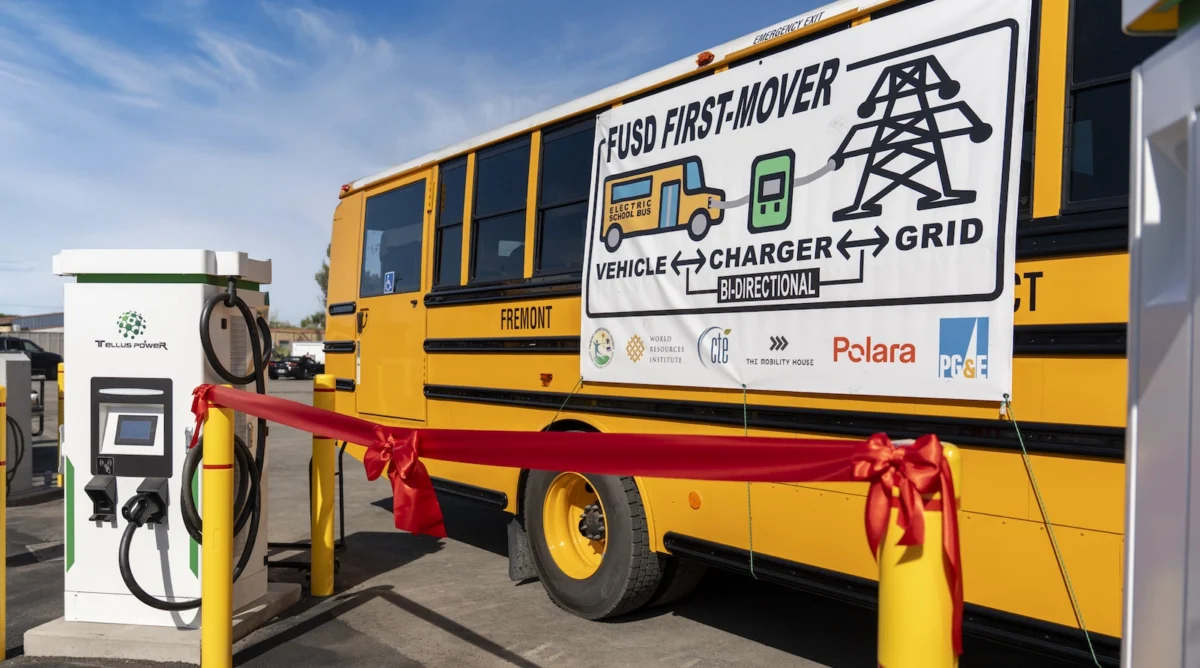
The Fremont Unified School District, in partnership with The Mobility House and Pacific Gas & Electric (PG&E), recently unveiled one of the first vehicle-to-grid (V2G) school bus depots in Northern California, marking a significant milestone in the integration of zero-emission transportation and grid resiliency. This unveiling serves as a centerpiece for a broader national movement where the humble yellow school bus is being reimagined not just as a vehicle for student transport, but as a critical component of the American energy infrastructure. As record-breaking summer temperatures strain electrical grids across the United States, the ability of these high-capacity batteries to discharge power back into the system is moving from a theoretical concept to a functional necessity.
Across the United States, the transition to electric school buses (ESBs) has reached a critical mass. According to recent data from the World Resources Institute’s (WRI) Electric School Bus Initiative, there are currently more than 6,700 electric school buses deployed or in the process of being delivered across 49 states, Washington D.C., and several tribal nations. While the primary driver for this transition has been the reduction of diesel emissions and the improvement of student health, the secondary benefit—energy storage—is increasingly becoming the focus of utility providers and school administrators alike.
The Mechanics of Vehicle-to-Grid Integration
Vehicle-to-Grid (V2G) technology utilizes bi-directional charging systems that allow electricity to flow both into the vehicle battery from the grid and out of the battery back to the grid. School buses are uniquely suited for this application. Unlike transit buses or long-haul trucks that operate throughout the day, school buses typically follow a predictable schedule with long periods of downtime. Most importantly, they remain largely idle during the summer months—the exact period when electrical demand peaks due to air conditioning and industrial cooling requirements.
A typical electric school bus is equipped with a battery capacity ranging from 155 kilowatt-hours (kWh) to over 220 kWh. To put this in perspective, a single bus holds enough energy to power an average American home for nearly a week. When networked together in a fleet, these buses function as a "Virtual Power Plant" (VPP). Currently, V2G projects involving approximately 230 electric school buses across the country have the combined capacity to supply roughly 8 megawatt-hours (MWh) of power to the grid at any given moment. While this represents a small fraction of total grid demand, experts suggest it is the "backbone" of a future decentralized energy system.
California as the National V2G Testing Ground
California has established itself as the vanguard of V2G adoption, driven by aggressive climate mandates and state-funded incentives. The California Energy Commission and the California Air Resources Board have implemented policies requiring that many electric school buses funded through state grants be equipped with V2G-capable hardware.

The Oakland Unified School District currently hosts the nation’s largest operational V2G school bus project. In collaboration with the transit provider Zum and PG&E, the district operates a fleet of 74 electric buses. This fleet is estimated to be capable of returning 2.1 gigawatt-hours (GWh) of electricity to the grid annually. This initiative is soon to be eclipsed by a project in the San Francisco Unified School District, also managed by Zum, which is scheduled for launch in late 2024. The San Francisco fleet will initially consist of 104 buses, expected to return 3 GWh of energy during peak hours, with plans to expand the fleet to 238 buses by the 2027–2028 academic year.
The Fremont Unified School District project, highlighted by The Mobility House, showcases the technical orchestration required for these systems. Beyond the buses themselves, the "smart" charging software is the most vital component. This software must balance the district’s primary mission—ensuring buses are sufficiently charged for their morning routes—with the grid’s needs, discharging only when it is financially and operationally viable.
Regional Developments and Resilience Applications
While California leads in volume, other states are exploring V2G for diverse applications, particularly in disaster resilience. In Connecticut, the Branford Public Schools district is preparing to deploy 46 V2G-capable buses. This move aligns with state goals to modernize the grid and reduce the reliance on "peaker plants"—older, less efficient power plants that only run during times of extreme demand.
In North Carolina, the Cherokee Boys Club, which operates buses for Cherokee Central Schools, has partnered with Duke Energy on a V2G pilot program. This project explores the "Vehicle-to-Building" (V2B) concept. In the event of a power outage caused by severe weather, the buses can act as mobile generators for school buildings. Because schools are often designated as emergency shelters during hurricanes or floods, the ability to maintain power for lighting, medical equipment, and refrigeration using bus batteries provides a significant boost to community safety.
Similarly, in Florida’s Glades County School District, officials are looking at their fleet of Blue Bird electric buses as mobile cooling centers. In a state prone to hurricane-induced power outages, a fleet of 13 electric buses can provide a climate-controlled environment for residents during the sweltering aftermath of a storm. Daniel Thomas, the district’s director of administrative services, noted that while the primary goal is student transport, the secondary use of these vehicles as emergency infrastructure is a critical hedge against the increasing frequency of extreme weather events.
Technical Barriers and Economic Considerations
Despite the promising trajectory of V2G, several hurdles remain before the technology can achieve universal adoption. One of the primary concerns among fleet operators is battery degradation. Lithium-ion batteries have a finite number of charge-discharge cycles; there is a persistent worry that frequent V2G participation could shorten the lifespan of the expensive battery packs and potentially void manufacturer warranties. However, recent studies and pilot data suggest that "smart" V2G—which manages the rate and depth of discharge—can actually have a negligible impact on battery health, and in some cases, the thermal management during controlled cycles can be beneficial.

Another significant challenge is the lack of a universal technical standard. Interoperability between different bus manufacturers, charging station hardware, and utility software is not yet seamless. Furthermore, the regulatory framework for how school districts are compensated for the energy they provide is still under development in most states. Currently, 31 utilities and 21 states are actively engaged in V2G school bus projects, each working through the complexities of "interconnection agreements"—the legal and technical permits required to back-feed power into the public grid.
The upfront costs are also substantial. An electric school bus can cost three times as much as a traditional diesel bus, and V2G-capable bi-directional chargers are significantly more expensive than standard chargers. These costs are currently being mitigated by federal programs, such as the Environmental Protection Agency’s (EPA) Clean School Bus Program, which has allocated billions of dollars in rebates and grants to transition the nation’s 480,000 school buses to zero-emission models.
Future Implications for the American Grid
The transition to V2G school buses represents a paradigm shift in how we view public assets. Historically, school buses were seen as a cost center for districts. Through V2G, they have the potential to become revenue generators. By selling power back to the grid during peak pricing periods, school districts can offset the higher purchase price of the vehicles and lower their overall operating costs.
From a grid management perspective, the timing of the school bus transition is fortuitous. Regional transmission organizations like PJM, which manages the grid for 67 million people in the Mid-Atlantic and Midwest, are facing unprecedented peak loads. During recent heatwaves, PJM required more than 160,000 megawatts of power to meet demand. While 230 buses providing 8 MWh is a drop in the bucket today, the scaling of this technology to include a significant portion of the 480,000 buses in the U.S. would create a massive, distributed energy storage reserve.
Steve Letendre, a senior advisor to the Vehicle Grid Integration Council, emphasizes that while it is "very early days," the school bus fleet will eventually serve as a "critically important backbone" of national V2G capacity. As the technology matures and standards are codified, the sight of a yellow school bus plugged into a charging station will no longer just represent a vehicle refueling, but a community-owned battery helping to keep the lights on for everyone. The unveiling at Fremont Unified is not just a local achievement; it is a preview of a more resilient, electrified, and interconnected future.
