


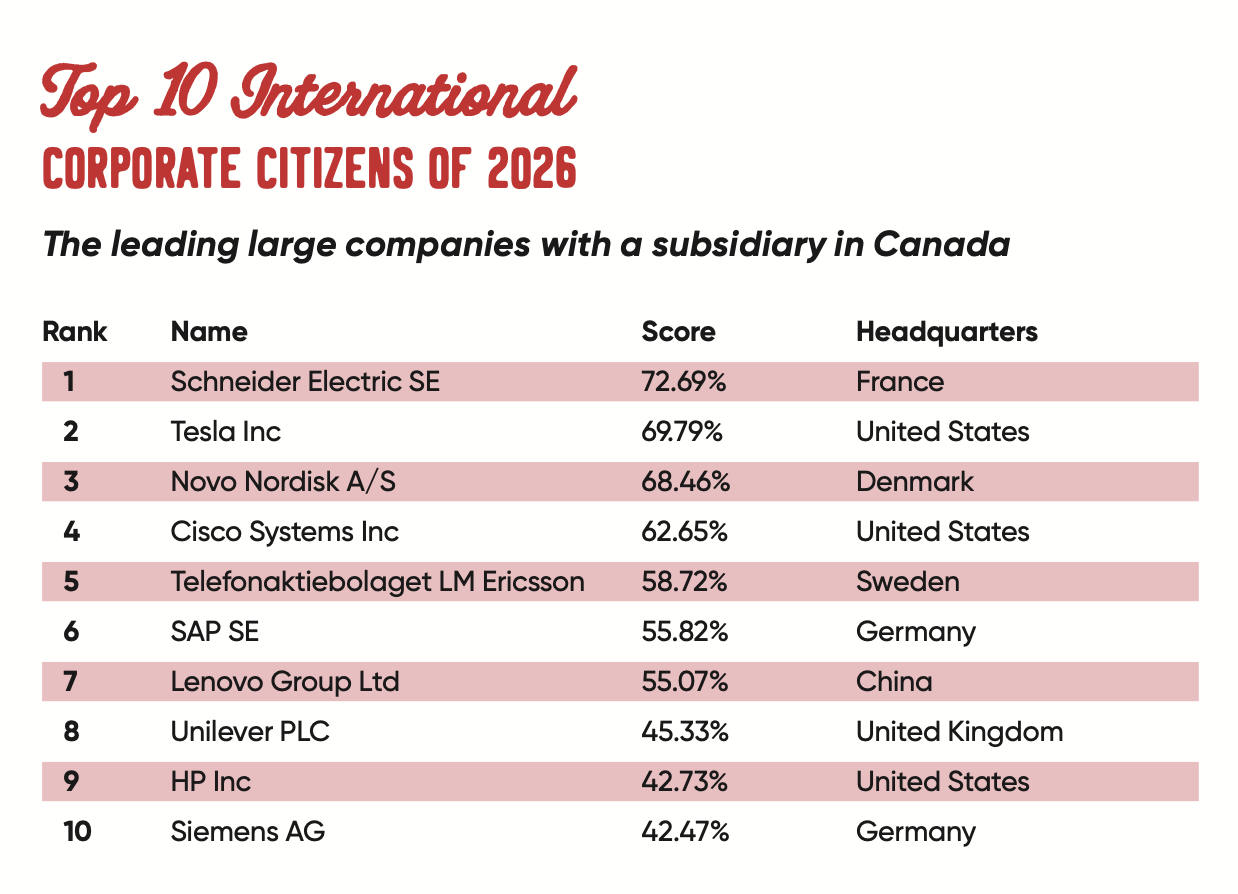
The landscape of global commerce is undergoing a fundamental transformation as sustainability moves from a peripheral corporate social responsibility concern to a core driver of financial performance and investment strategy. This shift is highlighted in the latest 2026 ranking of the Top 10 International Corporate Citizens, released by Corporate Knights. Leading the pack this year is the French multinational Schneider Electric SE, followed closely by the American electric vehicle pioneer Tesla Inc. and the Danish pharmaceutical giant Novo Nordisk A/S. These rankings, which serve as a benchmark for corporate sustainability, underscore a broader economic trend: investment in sustainable activities is now growing significantly faster than traditional, non-sustainable business models.
The Top 10 International Corporate Citizens list is a specialized subset of the broader Global 100 most sustainable corporations in the world. To qualify for this specific ranking, companies must generate more than $1 billion in annual revenue within Canada, while being headquartered and listed outside of the country. This distinction identifies the foreign-based entities that contribute most significantly to Canada’s green transition and maintain the highest standards of environmental, social, and governance (ESG) performance on a global scale.
The 2026 Leaders: A Deep Dive into Sustainable Performance
Schneider Electric SE secured the top position with an overall sustainability score of 72.69%. This achievement marks a continuation of the company’s dominance in the field, having previously been named the world’s most sustainable company in the 2025 Global 100 list. Schneider Electric’s success is largely attributed to its integrated approach to energy management and industrial automation. By focusing on electrification and digital efficiency, the company helps its clients—and its own operations—drastically reduce carbon footprints. Their business model is built on the premise that the most sustainable energy is the energy that is never consumed.
In the second spot, Tesla Inc. earned a score of 69.79%. While Tesla is often the subject of intense public and media scrutiny, its core metrics regarding "clean revenue" and "clean investment" remain peerless in the automotive sector. As the company scales its energy storage solutions and continues to dominate the global electric vehicle market, its impact on decarbonizing the transportation sector remains a primary factor in its high ranking.
Novo Nordisk A/S rounded out the top three with a score of 68.46%. The Danish healthcare leader has been recognized for its "Circular for Zero" environmental strategy, which aims to have zero environmental impact across its entire value chain. Beyond environmental metrics, Novo Nordisk excels in social indicators, including executive-to-worker pay ratios and robust investments in healthcare access in developing regions.
The remainder of the 2026 list reflects a heavy concentration of technology and industrial firms. Cisco Systems and HP Inc., both based in the United States, made the cut, highlighting the critical role of digital infrastructure in the modern economy. These firms are increasingly focusing on the circular economy—refurbishing hardware and reducing the rare-earth mineral footprint of their supply chains.

The only traditional fast-moving consumer goods (FMCG) company to make the top 10 this year was Unilever PLC, which ranked eighth. Unilever’s presence on the list is a testament to its long-standing commitment to sustainable sourcing and the reduction of plastic waste, though its inclusion highlights the difficulty consumer goods companies face in achieving the high scores seen in the technology and electrification sectors.
Methodology and the Rigor of Sustainability Metrics
The ranking is based on a rigorous methodology employed by Corporate Knights for their 2026 Global 100 analysis. This methodology involves a screening of nearly 7,000 companies with more than $1 billion in annual revenue. The evaluation process is based on 21 key performance indicators (KPIs) that cover resource management, employee management, financial management, clean revenue and clean investment, and supplier performance.
A significant weight in the 2026 methodology was placed on "clean revenue"—income derived from products and services that have a clear environmental or social benefit—and "clean investment," which tracks capital expenditures and R&D directed toward sustainable outcomes. For companies like Schneider Electric and Tesla, clean revenue accounts for the vast majority of their total income, a factor that separates them from legacy industrial firms that are still in the early stages of transitioning their portfolios.
Other KPIs include:
- Carbon Productivity: The amount of revenue generated per unit of greenhouse gas emissions.
- Taxes Paid: A measure of corporate citizenship that evaluates whether companies are paying their fair share in the jurisdictions where they operate.
- Board Diversity: The representation of women and minorities in leadership roles.
- Safety Performance: Tracking lost-time incidents and workplace fatalities.
- Sustainable Pay: Linking executive compensation to the achievement of ESG targets.
The Economic Signal: Quality Over Quantity
Toby Heaps, CEO and co-founder of Corporate Knights, emphasized that the 2026 rankings provide a vital signal to the Canadian and global markets. "Corporate investment is a major preoccupation in Canada today, but quality matters at least as much as quantity," Heaps stated. He noted that the Best 50 analysis—the Canadian domestic counterpart to the international list—shows that economy-wide investment in sustainable activities is growing materially faster than non-sustainable counterparts.
This observation is backed by global financial trends. Institutional investors are increasingly funneling capital into firms that can demonstrate long-term resilience against climate change and regulatory shifts. In Canada, where the economy has traditionally been tied to resource extraction, the influx and success of high-performing international "corporate citizens" provide both competition and a roadmap for domestic firms.
The data suggests that the "sustainability premium" is no longer a theoretical concept. Companies scoring in the top decile of the Corporate Knights methodology have historically shown a strong correlation with higher stock market returns and lower volatility compared to the MSCI All Country World Index. This financial outperformance is a key reason why international firms are racing to improve their ESG disclosures and operational footprints.
Chronology of the Corporate Knights Rankings
The Corporate Knights Global 100 was launched in 2005, making it one of the world’s oldest and most respected sustainability rankings. Over the past two decades, the criteria have evolved from simple "do no harm" environmental metrics to a sophisticated analysis of a company’s entire economic impact.
- 2005–2012: Focus was primarily on environmental efficiency and transparency.
- 2013–2018: Introduction of social metrics, such as gender diversity on boards and CEO-to-worker pay ratios.
- 2019–Present: Shift toward "Clean Revenue" and "Clean Investment" as the primary drivers of the score, reflecting the need for companies to actively contribute to the green transition rather than just reducing their own emissions.
- 2025: Schneider Electric is named the most sustainable company globally, setting the stage for its 2026 performance in the international citizen category.
- 2026: The current ranking shows a consolidation of power among electrification and digital infrastructure firms, with a widening gap between leaders and laggards in the consumer goods and traditional energy sectors.
Industry Implications and the Path to Electrification
The dominance of technology and industrial firms on the 2026 list—including Cisco, HP, and Schneider Electric—underscores the "electrification of everything." As nations move away from fossil fuels, the demand for smart grids, efficient data centers, and industrial automation has skyrocketed. These companies are the "arms dealers" of the energy transition, providing the tools necessary for other sectors to decarbonize.
However, the list also highlights a challenge for the broader economy. The fact that only one FMCG company (Unilever) made the top 10 suggests that sectors with high plastic use and complex, globalized agricultural supply chains are finding it harder to meet the stringent sustainability criteria required for a top-tier ranking. For these companies, the path forward involves radical innovations in packaging and a complete overhaul of logistics networks.
The inclusion of Tesla, despite ongoing debates regarding its corporate governance, reflects the heavy weighting of product impact. In the Corporate Knights methodology, the transition to zero-emission transport is viewed as a critical planetary priority. Tesla’s ability to force the entire global automotive industry toward electrification remains a powerful factor in its sustainability valuation.
Future Outlook and Global Regulatory Pressure
Looking toward 2027 and beyond, international corporate citizens operating in Canada will face even stricter scrutiny. The introduction of the International Sustainability Standards Board (ISSB) rules and the European Union’s Corporate Sustainability Reporting Directive (CSRD) are forcing multinationals to provide audited, granular data on their environmental and social impacts.
For the companies on the 2026 list, these regulations are an opportunity to widen their lead. Firms that have already integrated sustainability into their financial reporting and operational DNA are better positioned to navigate the rising cost of carbon and the increasing demand for "green" procurement in both the public and private sectors.
The 2026 Top 10 International Corporate Citizens list serves as a reminder that the global economy is at a turning point. As Toby Heaps noted, the growth of sustainable investment is one of the most "encouraging economic signals" of the current era. For Canada, hosting these high-performing international firms provides not only capital but also a benchmark for domestic excellence. As the "quality" of investment becomes the new standard for economic health, the firms on this list represent the vanguard of a more resilient and productive global market.
