

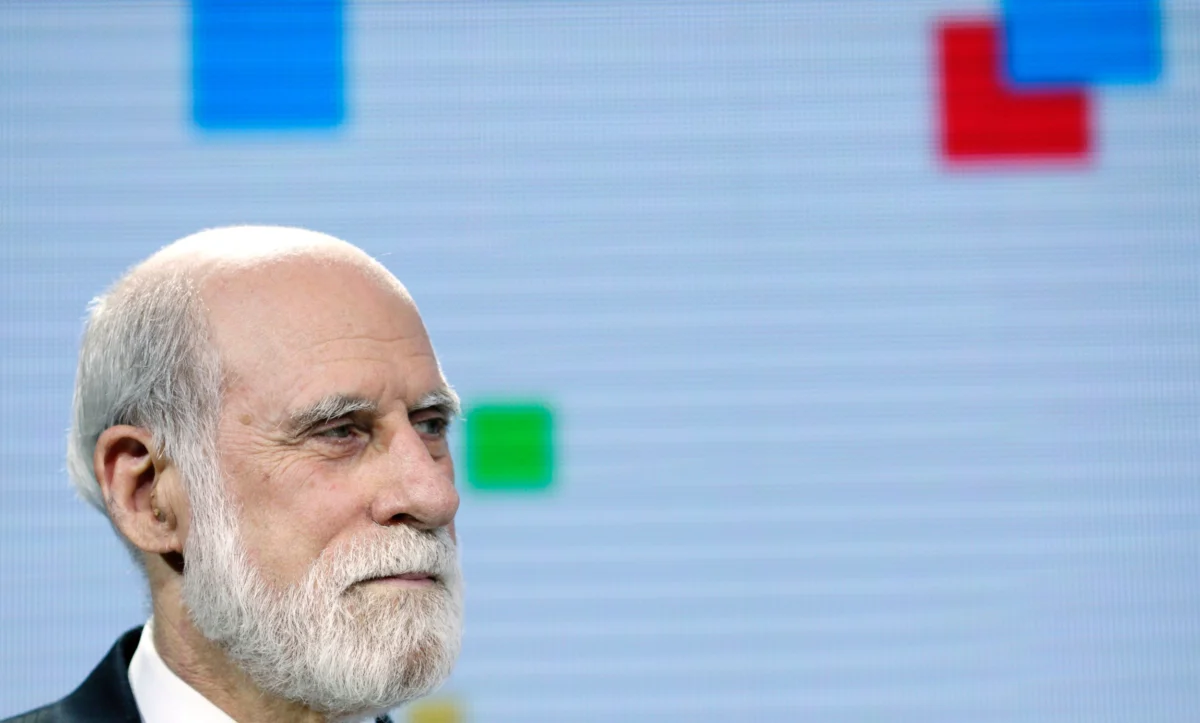
Vinton G. Cerf, the computer scientist widely revered as one of the "fathers of the internet," will officially step down from his role as Google’s Vice President and Chief Internet Evangelist next week, concluding a nearly two-decade tenure at the search giant and a career that spans more than half a century of technological revolution. The announcement of his retirement came during a video address at the Open Frontier conference, an event hosted by the Laude Institute that gathers the world’s leading minds in open-source architecture and decentralized computing. The news was shared with the public by Dave Patterson, a University of California, Berkeley professor and a pioneer in RISC (Reduced Instruction Set Computer) architecture, who paused the proceedings to honor Cerf’s contributions. Patterson noted that Cerf has been with Google for more than 20 years and invited the audience to offer a round of applause for what he characterized as a "relatively good career"—a humble understatement for a man whose work provides the foundational layer for modern civilization.
The departure of Cerf, 83, marks a symbolic turning point for the technology industry. Having joined Google in 2005, Cerf’s title of "Chief Internet Evangelist" was more than a corporate designation; it was a mission statement. During his time at the company, he served as a global ambassador for internet accessibility, security, and the preservation of open standards. His retirement arrives at a moment when the internet he helped build is undergoing a radical transformation driven by artificial intelligence, prompting Cerf to use his final public appearances to warn the industry about the necessity of rigorous standards in the age of autonomous software agents.
The Architectural Foundation: A Legacy of Interoperability
To understand the weight of Cerf’s retirement, one must look back to the early 1970s, when the concept of a global network of computers was still a theoretical ambition. While working at the Defense Advanced Research Projects Agency (DARPA), Cerf and his collaborator Robert Kahn designed the Transmission Control Protocol and the Internet Protocol (TCP/IP). This suite of protocols solved the fundamental problem of "internetting"—allowing disparate, often incompatible computer networks to communicate with one another through a unified set of rules.
Before TCP/IP, computer networks were closed silos. Cerf and Kahn’s breakthrough was the creation of a "handshake" that allowed data to be broken into packets, transmitted across various routes, and reassembled at the destination, regardless of the hardware being used. This commitment to an open, decentralized architecture is what allowed the internet to scale from a few dozen research nodes to a global infrastructure supporting billions of users. For this work, Cerf has received almost every major honor in the field, including the A.M. Turing Award (often called the Nobel Prize of Computing), the Presidential Medal of Freedom, and the National Medal of Technology.
Two Decades at Google: From Search to Global Policy
When Cerf joined Google in 2005, the company was transitioning from a dominant search engine into a global infrastructure provider. His role was unique: he was tasked with identifying new enabling technologies and supporting the development of the internet as a tool for social and economic progress. During his tenure, Google expanded its reach into undersea fiber optic cables, satellite internet initiatives, and advanced research into the "interplanetary internet"—a project Cerf has long championed to extend networking protocols to space exploration.
Cerf also became a prominent voice in the "Protocol Wars" and the ongoing debates regarding Net Neutrality. He consistently argued that the internet’s strength lay in its lack of centralized control, a philosophy that often put him at odds with telecommunications providers seeking more control over data traffic. His presence at Google provided the company with a direct link to the internet’s foundational ethos, ensuring that even as the web became increasingly commercialized, the importance of open standards remained a topic of internal and external discussion.
A Vision for the Future: The Challenge of Agentic AI
At the Open Frontier conference, Cerf’s retirement announcement was paired with a forward-looking analysis of the next great shift in computing: the rise of Artificial Intelligence agents. Cerf participated in a panel alongside other luminaries, including François Chollet, the creator of Keras; John Ousterhout, the creator of Tcl; and Matei Zaharia, the co-founder of Databricks. The discussion centered on the durability of open-source projects and the risks of centralization in the AI era.
Cerf expressed concern regarding the current trend of "black box" AI models controlled by a handful of well-funded corporations. He argued that the next phase of the digital economy will be defined by "agentic" AI—software capable of acting autonomously to perform tasks, negotiate with other programs, and execute transactions on behalf of users. According to Cerf, the success of this ecosystem depends on the same principles that made the early internet successful: standardization and interoperability.
"The agentic model of AI, with multiple agents from multiple sources interacting with each other, is going to force composability, and a requirement for interoperability and standardization," Cerf told the audience. He warned against the industry’s current reliance on natural language (such as English) as the primary medium for AI-to-AI communication. While Large Language Models (LLMs) excel at processing human language, Cerf argued that the inherent ambiguity of human speech is "terrifying" when applied to autonomous software coordination.
"I don’t think English is going to be the best choice," Cerf said, citing the potential for a digital version of the "telephone game," where messages become distorted as they pass through multiple agents. He insisted that for agents to truly cooperate, they require formal, precise protocols that ensure both parties understand exactly what they have agreed to do. This "precision for interagent interaction" is, in Cerf’s view, the modern equivalent of the TCP/IP challenge he faced 50 years ago.
Chronology of a Career: The Vint Cerf Timeline
The trajectory of Cerf’s career mirrors the evolution of digital technology itself. Below is a timeline of the milestones that defined his journey:
- 1943: Vinton Gray Cerf is born in New Haven, Connecticut.
- 1965: Graduates from Stanford University with a degree in Mathematics; joins IBM as a systems engineer.
- 1972: Receives his Ph.D. from UCLA, where he worked on the ARPANET, the precursor to the internet.
- 1973–1974: Cerf and Robert Kahn develop the basic architecture of the internet and publish "A Protocol for Packet Network Intercommunication."
- 1976–1982: Serves at DARPA, leading the development of TCP/IP and packet security technologies.
- 1983: On January 1, the ARPANET officially switches to TCP/IP, marking the birth of the modern internet.
- 1992: Co-founds the Internet Society (ISOC) to provide leadership in internet-related standards, education, and policy.
- 1997: President Bill Clinton presents Cerf and Kahn with the U.S. National Medal of Technology.
- 2004: Receives the A.M. Turing Award.
- 2005: Joins Google as Vice President and Chief Internet Evangelist.
- 2005: Awarded the Presidential Medal of Freedom by George W. Bush.
- 2012–2013: Serves as President of the Association for Computing Machinery (ACM).
- 2024: Announces retirement from Google to focus on the next generation of open infrastructure and AI standards.
Industry Reaction and the "Best Dressed" Legacy
The reaction to Cerf’s retirement has been a mix of reverence and reflection. Within Google, Cerf has been a mentor to thousands of engineers, known as much for his technical brilliance as for his courtly demeanor. Dave Patterson shared a lighthearted anecdote during the conference regarding Cerf’s penchant for three-piece suits—a rarity in the casual, "hoodie-and-jeans" culture of Silicon Valley.
"He’s always been the best-dressed computer scientist I’ve ever met," Patterson remarked. Cerf, responding with his characteristic wit, explained that his choice of attire was a deliberate attempt to "stick out" during the 1970s. While his peers were adopting the counter-culture aesthetic of long hair and casual dress, Cerf opted for the precision of a vest and tie, a sartorial choice that reflected his professional philosophy of clarity and structure.
While Google did not provide an official statement by the time of the conference, the company’s internal culture has long been influenced by Cerf’s advocacy for IPv6 adoption and his efforts to bridge the digital divide. His departure leaves a significant void in Google’s leadership, particularly as the company navigates the ethical and technical complexities of the AI "arms race."
Broader Implications for the Tech Landscape
Cerf’s retirement comes at a time when the "open" nature of the internet is under threat from increased regulation, geopolitical fragmentation (often called the "splinternet"), and the proprietary nature of modern AI ecosystems. His final plea for "agentic" standards highlights a looming crisis: if AI agents cannot communicate across different platforms using a common language, the digital economy may fracture into incompatible "walled gardens."
Analysis of Cerf’s recent statements suggests that he views the current state of AI as being in its "pre-TCP/IP" phase. Just as early computer networks needed a common protocol to flourish, the AI agents of the future will need a standardized framework to ensure security, accountability, and efficiency. Without these standards, the risk of autonomous systems making errors or being exploited increases exponentially.
As Vinton Cerf steps away from his formal role at Google, his influence remains embedded in every packet of data sent across the globe. From the foundation of the 1970s to the AI challenges of the 2020s, his career has been defined by a singular vision: that technology is at its most powerful when it is open, interoperable, and accessible to all. While he may be retiring from his corporate post, the "evangelism" of Vint Cerf is far from over; his work continues to serve as the blueprint for the digital world.
