

The global financial landscape is currently bifurcated, presenting a stark contrast between the surging optimism in U.S. equity markets and the persistent headwinds buffeting China’s economy and stock valuations. While U.S. stocks continue their impressive ascent, with the tech-heavy Nasdaq Composite recently concluding its most robust quarter since 2020, Chinese equities find themselves entrenched in a prolonged bear market, raising questions about their immediate future. Yet, amidst this gloom, a curious pattern has emerged in the options market: a significant surge in bullish bets on Chinese internet stocks, signaling that a segment of traders believes a rebound may be on the horizon.
The Tale of Two Markets: A Global Divergence
The performance disparity between the world’s two largest economies has become increasingly pronounced. In the United States, technology and growth stocks have been key drivers, propelling the Nasdaq to record highs. Fueled by enthusiasm surrounding artificial intelligence advancements, strong corporate earnings, and a resilient domestic economy, the index has demonstrated remarkable momentum. Major tech companies have seen their valuations soar, contributing significantly to overall market capitalization gains. This period of sustained growth has instilled confidence among investors, with many anticipating continued upside, albeit with an eye on inflation and interest rate trajectories.
Across the Pacific, the narrative for China has been markedly different. The iShares China Large-Cap (FXI), a bellwether for major Chinese companies, has recorded an 18% decline year-to-date, extending a bear market that has now stretched for nine consecutive months. More acutely, the popular KraneShares CSI China Internet ETF (KWEB), which tracks leading Chinese internet and technology firms like Tencent, Alibaba, JD.com, and PDD Holdings, has plummeted more than 40% from its peak recorded in October of the previous year. This precipitous decline reflects a confluence of factors, including ongoing concerns over inflated AI valuations in a global context, recurrent trade war flare-ups between Beijing and Washington, and perhaps most critically, anxieties surrounding the resilience and spending power of the Chinese consumer.
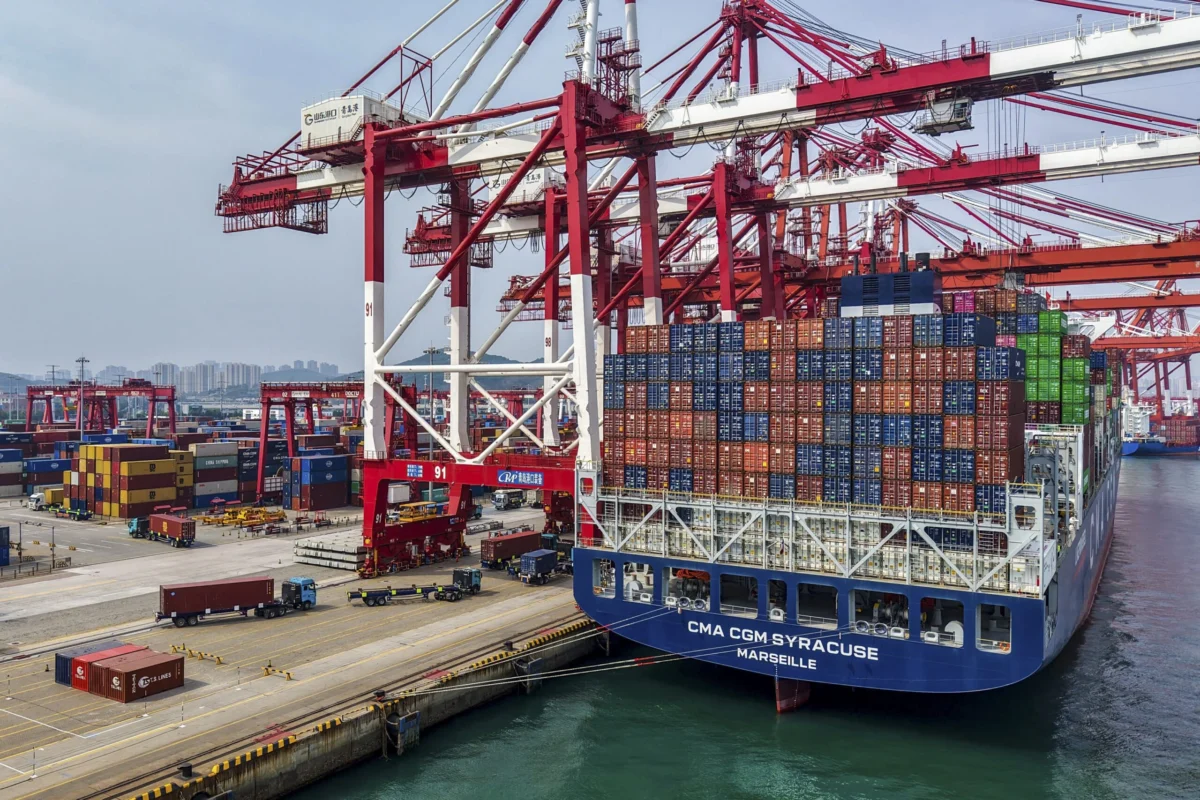
The fragility of the Chinese consumer market was underscored recently by global sportswear giant Nike. Despite reporting an earnings beat, Nike’s shares dipped in after-hours trading following the company’s cautionary remarks regarding the durability of consumer demand within China. This statement from a multinational corporation with deep market penetration served as a tangible indicator of the underlying economic pressures faced by ordinary Chinese citizens, impacting everything from discretionary spending to overall economic sentiment. The image of a container ship berthed at Qingdao, one of China’s busiest ports, on June 25, 2026, while symbolizing China’s enduring role as a global manufacturing and export powerhouse, inadvertently highlights a contrasting domestic challenge: ensuring robust internal consumption to balance its export-driven growth model.
Flickers of Hope: Recent Chinese Economic Data
Despite the overarching bearish sentiment, recent economic indicators from China have offered a glimmer of hope, potentially influencing the nascent bullish sentiment in the options market. Towards the end of the last week, China reported that its manufacturing activity had returned to growth territory, a critical development for the world’s factory floor. Concurrently, the services Purchasing Managers’ Index (PMI) registered its highest level since May, suggesting a revitalization in non-manufacturing sectors, including retail, hospitality, and transportation. These figures, while not signaling a full-blown economic boom, provided concrete evidence that efforts to stabilize and stimulate the economy might be yielding initial results.
Historically, the manufacturing PMI is a closely watched barometer for China’s industrial health, with a reading above 50 indicating expansion. Its return to growth suggests renewed factory output and potentially increased domestic and international demand for Chinese goods. Similarly, a strong services PMI points to a recovery in consumer-facing industries, which are vital for job creation and boosting household incomes. While these data points are encouraging, market analysts remain cautious, often highlighting the need for sustained positive trends rather than isolated upticks to confirm a genuine and durable economic recovery. The property sector, for instance, continues to be a significant drag on confidence and investment, and youth unemployment remains a pressing concern, tempering broader optimism.
The Bullish Bet: Options Traders Eye a Rebound
It is against this backdrop of macroeconomic uncertainty and divergent market performance that a peculiar phenomenon has unfolded in the options market for the KraneShares CSI China Internet ETF (KWEB). Options traders, often at the forefront of anticipating market shifts, appear to be positioning themselves for a potential reversal in fortunes for Chinese tech stocks.
On a recent Tuesday, the volume of options traded in KWEB surged to nearly three times its 30-day average. A deeper dive into the trading data, provided by Cboe LiveVol and ThinkOrSwim, reveals an extraordinary imbalance: out of approximately 628,000 contracts traded, an overwhelming 612,000 were call options. This represents a "bullish skew," a rare degree of optimism in options flows, particularly for a security that has demonstrated such significant negative price momentum. Furthermore, a substantial portion of these trades, more than a quarter-million, were likely initiated by buyers, in stark contrast to fewer than 4,000 put option purchases. The financial commitment behind this bullish stance was equally striking: of the $48 million in premium traded, an astonishing $46 million was tied to calls.
This kind of concentrated bullish activity in call options suggests that a significant cohort of traders believes KWEB’s underlying assets are poised for an upward move. A call option gives the holder the right, but not the obligation, to buy a stock or ETF at a specified "strike price" before a certain "expiry date." Buyers of call options profit when the underlying asset’s price rises above the strike price plus the premium paid. Conversely, put options give the right to sell, and their buyers profit from price declines. The heavily skewed call-to-put ratio, therefore, is a powerful indicator of market participants betting on an appreciation.
The detailed analysis of these trades further illuminates the strategic intent. Among the top 20 contracts traded in KWEB on that Tuesday, 17 were calls. Notably, this wasn’t merely short-term speculation, as only two contracts were for Thursday expiry. The most popular contract, both by volume and dollar amount, was the 29-strike call expiring on December 18. This particular trade implies a need for KWEB to rally by approximately 23% from its current levels to reach the break-even point for those holding the option.
The single largest trade of the session involved a buyer acquiring almost 102,000 of these 29-strike calls for December 18, representing an $11 million purchase. This significant outlay was partially offset by the sale of $930,000 worth of 35-strike calls expiring on the same day, and an additional $770,000 of 33-strike calls expiring on September 18, according to SpotGamma data. This structure, often referred to as a "call spread" or "vertical call spread," suggests a sophisticated strategy. By buying lower-strike calls and simultaneously selling higher-strike calls, traders can reduce their upfront premium cost while still betting on an upward movement, albeit with a capped profit potential. This implies a belief in a substantial, but not unlimited, rally for Chinese internet stocks by the end of the year.
Deep Dive: Factors Shaping China’s Market Landscape
The current state of Chinese equities is a complex interplay of several profound factors, extending beyond immediate economic data.
Regulatory Environment: The past few years have seen an unprecedented regulatory crackdown on China’s powerful technology sector. Measures targeting everything from anti-monopoly practices to data security, gaming addiction, and private education have significantly impacted the business models and profitability of major internet companies. While the intensity of this crackdown has somewhat abated, the specter of future regulatory interventions continues to weigh on investor sentiment and valuation multiples. Any clear signal of a consistent, supportive regulatory framework could be a powerful catalyst for a market rebound.
Geopolitical Tensions: The ongoing strategic competition between the U.S. and China remains a significant overhang. Trade disputes, technology export controls (particularly on advanced semiconductors and AI chips), and broader geopolitical friction create uncertainty for companies operating in both spheres. These tensions can disrupt supply chains, impact market access, and deter foreign investment into China, directly affecting the profitability and growth prospects of Chinese enterprises.
Domestic Economic Challenges: Beyond the consumer, China faces several structural economic challenges. The property sector, a cornerstone of the economy, is grappling with significant debt and defaults, affecting consumer wealth and financial stability. Local government debt has also swelled, limiting their capacity for stimulus. High youth unemployment rates, coupled with an aging population, pose long-term demographic and economic hurdles. These issues collectively dampen domestic demand and investor confidence.
Consumer Sentiment and Spending: The cautious tone from Nike is echoed by broader trends. Chinese consumer confidence has been slow to recover post-pandemic, impacted by job insecurity, property market woes, and a general shift towards saving rather than spending. Retail sales figures, while showing some growth, often fall short of pre-pandemic levels or government targets, indicating a need for more robust demand-side stimulus.
Expert Perspectives and Market Sentiment
Market strategists and economic analysts offer varied interpretations of the bullish options activity. Some view it as a classic contrarian bet, where sophisticated traders are taking advantage of deeply depressed valuations and oversold conditions, anticipating a mean reversion. They argue that many Chinese tech companies, despite regulatory risks, possess strong fundamentals, large addressable markets, and innovative capabilities, making them attractive at current price levels.
Others remain more cautious, suggesting that while the options activity is noteworthy, it could also represent speculative trading rather than a fundamental shift in institutional sentiment. They point to the persistent structural issues in China’s economy and the unpredictable nature of geopolitical events as reasons to temper enthusiasm. Institutional investors, while acknowledging the potential for a rebound, often require clearer policy signals and sustained economic improvement before significantly increasing their allocations to Chinese equities. There’s a common refrain that "China is uninvestable" for some long-term funds due to regulatory risks and opacity, even if short-term trading opportunities arise.
Potential Catalysts and Risks on the Horizon
For the bullish options bets to pay off, several catalysts would likely need to materialize. Significant and sustained government stimulus measures, particularly those aimed at boosting consumer spending and stabilizing the property market, could reignite economic growth. A de-escalation of trade tensions and a more predictable geopolitical environment would also significantly improve investor confidence. Furthermore, if the recent improvements in manufacturing and services PMIs prove to be the start of a sustained recovery, fundamental support for equity prices would strengthen. The current low valuations of many Chinese tech companies also present an intrinsic catalyst, as a perception of being "cheap" can attract bargain hunters.
However, substantial risks remain. Any renewed regulatory crackdown, even minor, could quickly reverse positive sentiment. An escalation of geopolitical conflicts, such as further restrictions on technology transfer or increased friction over Taiwan, could severely impact market stability. A continued slowdown in global growth would dampen demand for Chinese exports, further straining the economy. Moreover, if the government’s stimulus measures prove insufficient or ineffective, the current economic malaise could persist, leading to continued market underperformance.
Conclusion
The current landscape of global markets presents a compelling dichotomy: the roaring success of U.S. equities against the backdrop of a prolonged struggle in China. The recent surge in bullish call options on Chinese internet ETFs, particularly KWEB, introduces a fascinating speculative element to this narrative. It suggests that a segment of the market sees deep value and potential for a significant rebound, despite the significant headwinds. While recent positive economic data from China offers a sliver of hope, the path forward for Chinese equities remains fraught with challenges, including regulatory uncertainty, geopolitical tensions, and structural economic issues. Whether this bullish options activity signals a genuine turning point or merely a speculative gamble in an oversold market will be a critical storyline to watch as the year progresses, underscoring the high stakes involved in navigating the complexities of China’s economic future.
