

In the final decade of the 20th century, the city of Markham, Ontario, faced a critical crossroads that would define its architectural and environmental legacy for decades to come. As the 1990s progressed, the municipality recognized that the prevailing model of low-density urban sprawl was becoming increasingly unsustainable in the face of looming climate concerns and the inevitable transition toward a more complex energy landscape. In 1999, Markham’s city councillors made a visionary decision: they would move away from the traditional model of individual building boilers and chillers, instead investing in a centralized district energy system to serve its burgeoning downtown core. This shift represented a fundamental pivot toward denser, more efficient urban planning, laying the groundwork for what would become one of the most successful community energy networks in North America.
Today, nearly 25 years after that initial investment, the results of Markham’s foresight are visible—and tangible—beneath the city’s streets. A sophisticated network of insulated pipes carries hot and chilled water from central energy plants to a diverse array of buildings spanning more than 14 million square feet of development. By centralizing the production of thermal energy, Markham has not only accelerated its transition to cleaner power sources but has also fortified its urban resilience, providing a reliable and flexible energy grid that evolves alongside the community’s needs.
The Genesis of an Urban Energy Revolution
District energy systems operate on a simple yet profound principle: rather than every building maintaining its own mechanical room with separate heating and cooling equipment, a central plant services an entire neighborhood. This "economy of scale" allows for the integration of high-efficiency technologies that would be cost-prohibitive for a single building owner to install and maintain. According to Peter Ronson, Chief Operating Officer of Markham District Energy, the centralized model offers a unique advantage in the race toward decarbonization.
"The thing we’re able to do with centralized plants is adopt new technologies long before a building would," Ronson explains. "And so the buildings on a district energy system benefit from the transition to higher efficiency and a lower carbon footprint without having to manage those upgrades individually."
This flexibility is essential as Canada targets net-zero emissions by 2050. As newer, greener technologies—such as industrial-scale heat pumps or biomass integration—become available, they can be implemented at the central plant, instantly "greening" every building connected to the network.
A Chronology of Growth: From Blueprint to 14 Million Square Feet
The evolution of Markham’s energy landscape provides a blueprint for other Canadian municipalities. The journey began in the late 1990s during a period of rapid growth for the city, often referred to as "Silicon Valley North" due to its high concentration of technology firms.
- 1999: Markham City Council officially backs the creation of Markham District Energy Inc. (MDEI), a move aimed at supporting the development of Markham Centre, a new, high-density downtown core.
- 2000–2005: The first energy plant is commissioned, and the initial network of pipes is laid. Early adopters include municipal buildings and flagship commercial developments.
- 2010s: The system sees exponential growth as Markham Centre expands. The reliability of the system becomes a selling point for developers, who can save on floor space by eliminating large on-site mechanical rooms.
- 2020–2023: The system reaches a milestone of 14 million square feet. Strategic partnerships with federal and private financial institutions facilitate further expansion.
- 2024 and Beyond: Markham prepares to commission its newest plant, which utilizes innovative sewer heat recovery technology, further diversifying its energy sources.
The Economic Engine: De-risking Clean Infrastructure
While the environmental benefits of district energy are clear, the financial hurdles can be daunting. These systems are capital-intensive, requiring significant upfront investment in underground piping and central plant facilities before a single building is connected. This is where the Federation of Canadian Municipalities (FCM) and its Green Municipal Fund (GMF) have played a transformative role.
The GMF, which manages approximately $2.4 billion in programs funded by the Government of Canada, has been a steadfast supporter of Markham’s journey. Over 20 years, the fund provided more than $17 million in grants and loans to the Markham Centre project. This early-stage funding served as a "de-risking" mechanism, signaling to private investors that the project was both technically viable and backed by rigorous data.

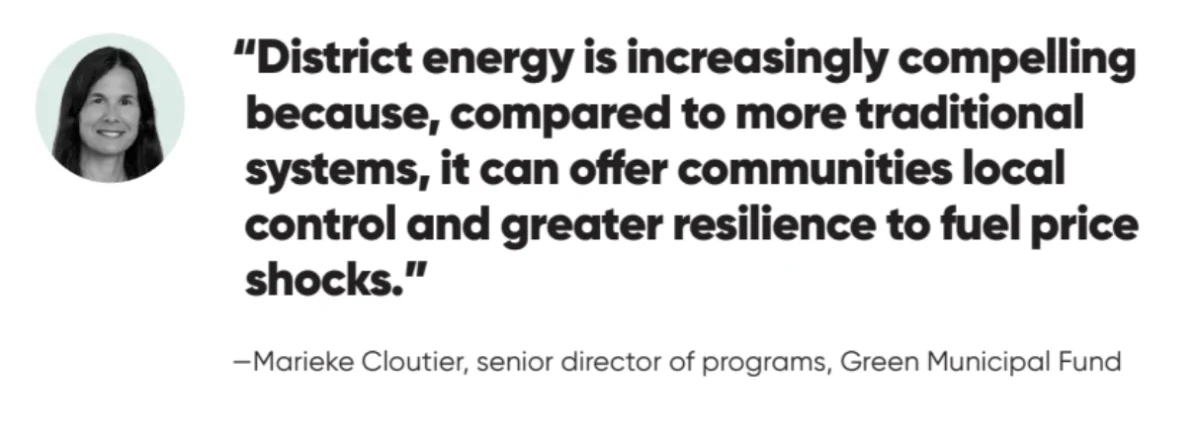
Marieke Cloutier, Senior Director of Programs at the Green Municipal Fund, emphasizes the attractiveness of these projects for long-term investors. "District energy is increasingly compelling because, compared to more traditional utility models, it can offer communities local control and greater resilience to fuel price shocks, outages, and supply disruptions," Cloutier notes. "It offers large-scale, net-zero investment opportunities with strong returns and efficient transaction costs."
The success of the GMF’s initial support is evident in the subsequent capital flight to the project. Markham’s system eventually attracted more than $270 million in additional capital from institutions including the Canada Infrastructure Bank (CIB) and the Canadian Imperial Bank of Commerce (CIBC). This 15-to-1 leverage ratio demonstrates how public "seed" money can unlock massive private sector participation in green infrastructure.
Comparative Global Landscape and Domestic Potential
Despite the success in Markham, Canada as a whole remains behind international benchmarks. In parts of Northern and Eastern Europe, as well as in major Asian metropolises, district energy is the standard rather than the exception. In Denmark, for example, over 60% of households are connected to district heating networks, many of which utilize waste heat from industrial processes.
However, Canadian momentum is building. Beyond Markham, other municipalities are seeing the fiscal and environmental rewards of shared energy. In Yellowknife, Northwest Territories, a district energy system utilizing biomass has the potential to save the city up to $160,000 annually in heating costs while significantly reducing reliance on imported heating oil.
Gerard MacDonald, Principal at Reshape Infrastructure Strategies in Vancouver, argues that the shift toward centralized thermal networks is a matter of public interest. "District energy is one of the smartest ways to decarbonize buildings," MacDonald says, "because it cuts emissions with a lot less electricity than you would if you went at it building by building."
Technological Innovation: Harnessing Heat from the Unconventional
One of the most compelling aspects of the Markham model is its ability to integrate unconventional energy sources. The city is currently commissioning a new facility that will extract warmth from a large sanitary sewer line running adjacent to a plant facility. Using industrial heat pumps and a heat exchanger, the system will capture the ambient heat from wastewater—energy that would otherwise be wasted—and pump it back into the district network to heat homes and offices.
This move toward "circular" energy—where waste from one urban process becomes the fuel for another—is a hallmark of modern district energy. It provides a hedge against volatile fossil fuel prices and reduces the overall load on the provincial electricity grid, which is increasingly strained by the electrification of transport and home heating.
Broader Impact and Implications for Canadian Urbanism
The implications of Markham’s success extend far beyond the city limits of York Region. As Canadian cities grapple with the dual challenges of a housing crisis and climate change, district energy offers a path forward that aligns density with sustainability.
- Energy Security and Resilience: Centralized systems are inherently more robust against extreme weather events. Whether facing ice storms or heatwaves, district energy plants are built to industrial standards with redundant power sources. This minimizes the risk of widespread outages that can occur when individual building systems fail.
- Economic Stability: By reducing the "electricity peak" through thermal storage and high-efficiency heat pumps, district energy helps keep utility rates stable for all users. It prevents the need for costly grid upgrades that would be required if every building switched to individual electric baseboard or heat pump systems simultaneously.
- Long-term Investment Certainty: As Peter Ronson points out, "Once you connect buildings to district energy systems, they’re typically connected forever." This creates a stable, utility-scale asset that provides predictable returns, making it an ideal target for pension funds and other institutional investors looking for ESG-compliant (Environmental, Social, and Governance) opportunities.
As Markham enters its third decade of district energy operations, it stands as a testament to the power of long-term municipal planning. What began as a strategic pivot in 1999 has evolved into a multi-hundred-million-dollar asset that protects the environment, serves the public interest, and provides a scalable model for the rest of the country. For Canadian municipalities looking to navigate the complexities of the energy transition, the pipes beneath Markham offer a clear direction: the future of urban energy is shared, centralized, and resilient.
