

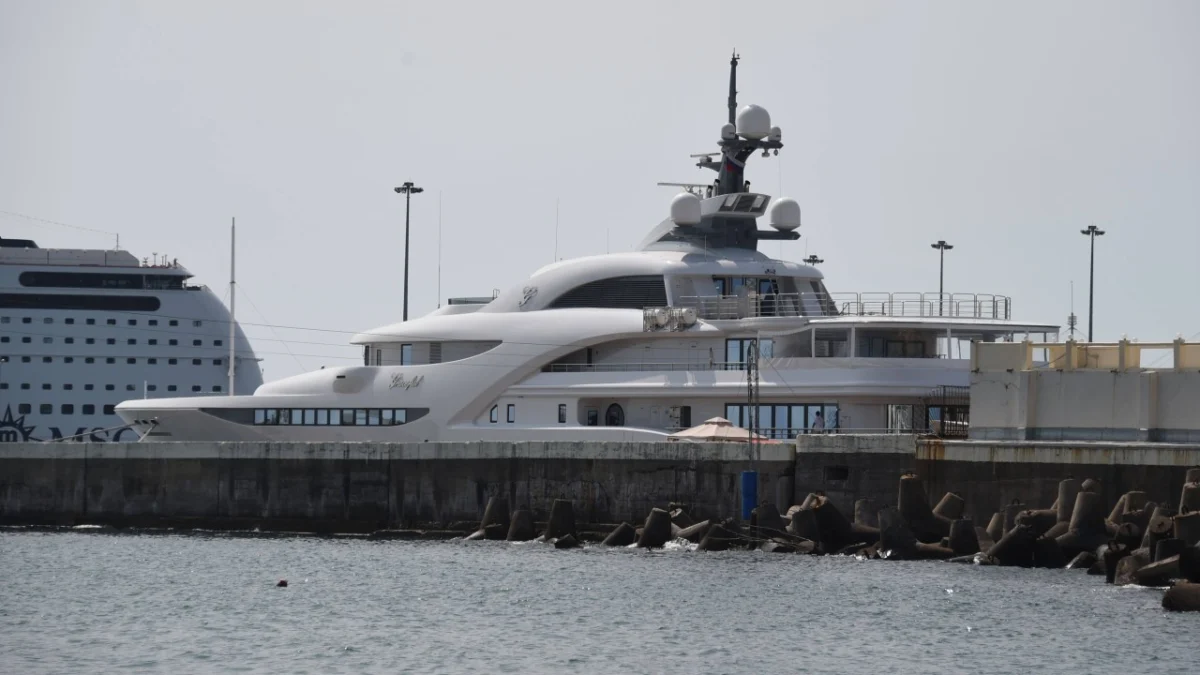
The Russian luxury superyacht Graceful, a vessel widely identified by international intelligence agencies and naval experts as part of President Vladimir Putin’s personal fleet, has made a surprise reappearance on global maritime tracking systems. According to reports from the Danish public broadcaster DR, the vessel was detected on radar for the first time in nearly four years as it navigated through the strategically sensitive waters off the northern coast of Denmark. This development marks a significant break in the vessel’s long-standing policy of "dark" navigation, where it had intentionally disabled its tracking systems to evade international scrutiny and the reach of Western sanctions.
The sighting, confirmed by data from the maritime tracking service Marinetraffic.com, indicated that the Graceful was sailing through the Danish straits on Monday. The vessel’s movement was not a solitary affair; it was accompanied by a heavy security detail consisting of two Russian warships. This high-level escort underscores the vessel’s status as a "state-interest" asset. As the flotilla moved through the European maritime corridors, it was closely shadowed by the Danish Navy and the German Coastguard, who alternated surveillance duties to monitor the group’s transit through their respective territorial waters and exclusive economic zones.
The Danish Armed Forces provided a formal statement to DR, noting that the military routinely monitors all foreign state vessels transiting the Danish straits. "The armed forces routinely monitor vessels, including foreign state vessels, transiting Danish straits and territorial waters, using the capacities designated for this purpose," the military spokesperson stated. Despite the brief window of visibility, the Graceful once again vanished from digital tracking maps by Monday evening, suggesting that the crew had once again deactivated the ship’s Automatic Identification System (AIS).
The History of the Graceful and the Great Escape of 2022
The Graceful has long been a subject of fascination and controversy. The 82-meter (270-foot) luxury yacht was built by Sevmash in Russia but underwent extensive outfitting and modifications at the Blohm+Voss shipyard in Hamburg, Germany. Valued at an estimated $100 million, the vessel features opulent amenities, including an indoor swimming pool that can be converted into a dance floor, a helipad, and a suite of high-tech security features designed to protect its high-profile passengers.
The vessel’s history of "stealth" operations began in earnest in early 2022. In the weeks leading up to the Russian invasion of Ukraine, the Graceful was undergoing scheduled maintenance and upgrades in Hamburg. On February 7, 2022—roughly two weeks before the first Russian tanks crossed the Ukrainian border—the yacht abruptly departed the German shipyard. Analysts believe the Kremlin ordered the ship to leave German waters prematurely to prevent it from being seized under the massive wave of sanctions that Western nations were preparing in response to the looming conflict.
Following its departure from Hamburg, the Graceful sought refuge in the Russian exclave of Kaliningrad. By August 2022, the vessel’s AIS transmitter was deactivated, effectively turning the yacht into a "ghost ship." For the next several years, its movements were only occasionally captured by satellite imagery or ground-level sightings by maritime enthusiasts. During this period of obscurity, the vessel reportedly underwent a name change, being rebranded as the Kosatka (Russian for "Killer Whale"), a common tactic used to obscure the identity of sanctioned assets.
Strategic Significance of the Danish Straits
The reappearance of the Graceful in the Danish straits is geographically and politically significant. The straits—comprising the Great Belt, the Little Belt, and the Sound—serve as the only natural gateways between the Baltic Sea and the North Sea. For the Russian Baltic Fleet based in Kaliningrad and St. Petersburg, these waters are a vital chokepoint.
Since the start of the war in Ukraine, the Baltic Sea has become increasingly tense. With Finland and Sweden joining NATO, the body of water is often referred to by analysts as a "NATO Lake." Consequently, any movement of Russian state-affiliated vessels, particularly those escorted by warships, triggers an immediate and robust response from regional navies. The presence of the Danish Navy and German Coastguard alongside the Graceful serves as a reminder of the heightened surveillance posture maintained by NATO members in the region.
The fact that the Graceful reactivated its AIS for a brief period while passing through these waters is a point of debate among maritime experts. Some suggest it may have been a temporary safety measure required for navigating the narrow and busy shipping lanes of the Danish straits, where "dark" navigation poses a significant risk of collision with commercial traffic. Others speculate it could be a deliberate signal of presence, a display of defiance against Western maritime monitoring.
Technical Specifications and the Shadow of Sanctions
The Graceful is not merely a luxury toy; it is a sanctioned entity. In June 2022, the United States Department of the Treasury’s Office of Foreign Assets Control (OFAC) officially designated the Graceful as "blocked property" in which President Vladimir Putin has an interest. This designation makes it illegal for any U.S. person or entity to engage in transactions involving the vessel and subjects it to seizure if it enters the jurisdiction of the United States or its allies.
The vessel’s technical capabilities allow it to operate for extended periods without docking in foreign ports. With a top speed of 18 knots and a range of 6,000 nautical miles, the Graceful is capable of transoceanic voyages. Its recent movements suggest that despite the heavy burden of international sanctions, the Russian state continues to dedicate significant resources—including naval escorts—to maintain and operate the vessel.
Data from recent refits suggests that the yacht has been equipped with specialized communication equipment similar to that found on Russian naval command ships. This has led to theories that the vessel serves a dual purpose: a luxury retreat for the Russian elite and a mobile, secure command center.
Chronology of Recent Movements and Stealth Operations
To understand the significance of the Monday sighting, one must look at the timeline of the Graceful’s operations over the last several years:
- February 2022: The Graceful flees Hamburg, Germany, just days before the invasion of Ukraine, narrowly avoiding impoundment.
- June 2022: The U.S. Treasury sanctions the vessel, identifying it as part of Putin’s personal assets.
- August 2022: The vessel deactivates its AIS signal while in the Baltic Sea, beginning a period of nearly four years of radar silence.
- 2023 – 2025: Satellite imagery periodically detects the vessel (now renamed Kosatka) in the vicinity of Kaliningrad and St. Petersburg. Reports emerge of extensive interior renovations being completed within Russian shipyards.
- June 2026: The vessel reactivates its AIS signal while transiting the northern coast of Denmark. It is escorted by two Russian warships and monitored by NATO-member coastguards.
- June 2026 (Monday Evening): The signal is once again lost as the vessel enters the North Sea, presumably heading toward the Atlantic or returning to the Arctic.
Broader Implications for Maritime Security
The movement of the Graceful is emblematic of a broader trend in Russian maritime activity. Since 2022, Russia has increasingly relied on a "shadow fleet" of tankers and state-affiliated vessels that operate with disabled tracking systems to bypass oil price caps and transport sensitive cargo. The use of luxury yachts in this manner highlights the blurred lines between private property and state assets within the Russian political system.
For European security agencies, the transit of the Graceful provides a rare opportunity to gather intelligence on the vessel’s current state and its escorting warships. The involvement of the German Coastguard and Danish Navy indicates a high level of coordination between EU and NATO partners in tracking Russian movements.
The brief "ping" on the radar serves as a reminder that despite the efforts of the Kremlin to hide its most prized assets, the combined surveillance capabilities of Western maritime powers remain formidable. However, the subsequent disappearance of the signal also highlights the limitations of civilian tracking systems like AIS when faced with a state actor determined to operate in the shadows.
As the Graceful continues its journey, likely toward the safety of Russian northern ports or perhaps a more distant, non-aligned destination, its brief appearance in Danish waters will remain a focal point for intelligence analysts. It is a tangible symbol of the ongoing friction between Russia and the West—a hundred-million-dollar "Killer Whale" navigating the treacherous waters of modern geopolitics.
