

The U.S. proxy season is reflecting sustained investor confidence in executive compensation programs, with "Say-on-Pay" (SOP) outcomes demonstrating robust shareholder support. Year-to-date data indicates a notable resilience in SOP approval rates, suggesting that a majority of investors perceive compensation packages as reasonably aligned with company performance. This trend persists even as certain compensation practices, such as the prevalence and structure of one-time equity awards, continue to evolve.
This analysis, based on an ISS-Corporate memorandum authored by Tim Sessing, Compensation & Governance Advisory Associate, and Chris Sayo, Senior Associate for Data Analytics at ISS-Corporate, highlights key dynamics shaping the current proxy season. Subodh Mishra, Global Head of Communications at ISS STOXX, provided oversight for this post.
Sustained Say-on-Pay Support Amidst Shifting Pay Practices
Say-on-Pay (SOP) outcomes, perhaps influenced by the healthy market returns observed in fiscal year 2025, have shown strong shareholder backing. For meetings held between January and June, median approval levels reached a five-year high of 93.5% for S&P 500 companies and an impressive 96.2% for the Russell 3000 index. As of early June 2026, only nine SOP proposals had failed to achieve majority support, continuing a trend of historically low failure rates in recent years. While final full-year outcomes are yet to be determined, these preliminary results underscore the enduring resilience of shareholder support for key executive compensation proposals.
However, beneath this headline strength, a more nuanced picture emerges regarding specific pay practices. Shifts in both the prevalence and structure of one-time equity awards indicate that companies are increasingly relying on these targeted compensation tools to address critical business needs. These include executive retention, managing leadership transitions, and navigating ongoing market uncertainty. Concurrently, activity related to equity plan proposals remains elevated, reinforcing the central role equity continues to play in the design of executive compensation. These combined dynamics suggest a broad, yet intricate, level of investor support for critical executive compensation elements.

One-Time Equity Grants See Uptick in Volume and Value for S&P 500
A significant trend observed this proxy season is the increase in both the prevalence and size of one-time equity awards, particularly among S&P 500 companies. While the overall volume of equity plan proposals has seen a slight decline, the deployment of these singular, often substantial, awards has risen. This suggests a strategic shift by companies, utilizing these grants to address specific compensation challenges without necessarily altering the fundamental structure of their long-term incentive plans.
Following a post-pandemic surge in 2021, when nearly 30% of Russell 3000 companies utilized one-time equity awards, a steady decline was noted through 2024, reaching a low of 25%. This period reflected a broader normalization of compensation practices after the extraordinary circumstances of the pandemic. However, year-to-date data for fiscal year 2025 reveals a reversal of this trend, with the prevalence of such awards climbing to 27%.
One-time equity awards are typically employed to address discrete compensation situations, such as ensuring executive retention or facilitating smooth leadership transitions. Despite remaining below their post-pandemic peak, the recent increase in their use indicates a heightened need for companies to manage retention and mitigate turnover concerns throughout the year.
Sizable and Targeted Equity Awards Becoming More Common in Large-Cap Companies
Further analysis reveals that most one-time equity awards remain within modest value ranges, with a significant majority falling below $5 million. However, there has been a discernible shift at the higher end of the distribution. Among S&P 500 companies, the incidence of larger one-time awards has become more frequent, especially those ranging from $5 million to $20 million.
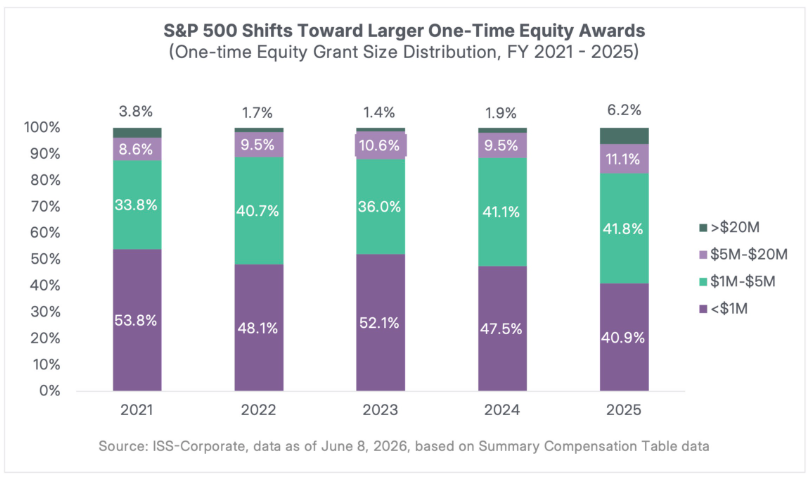
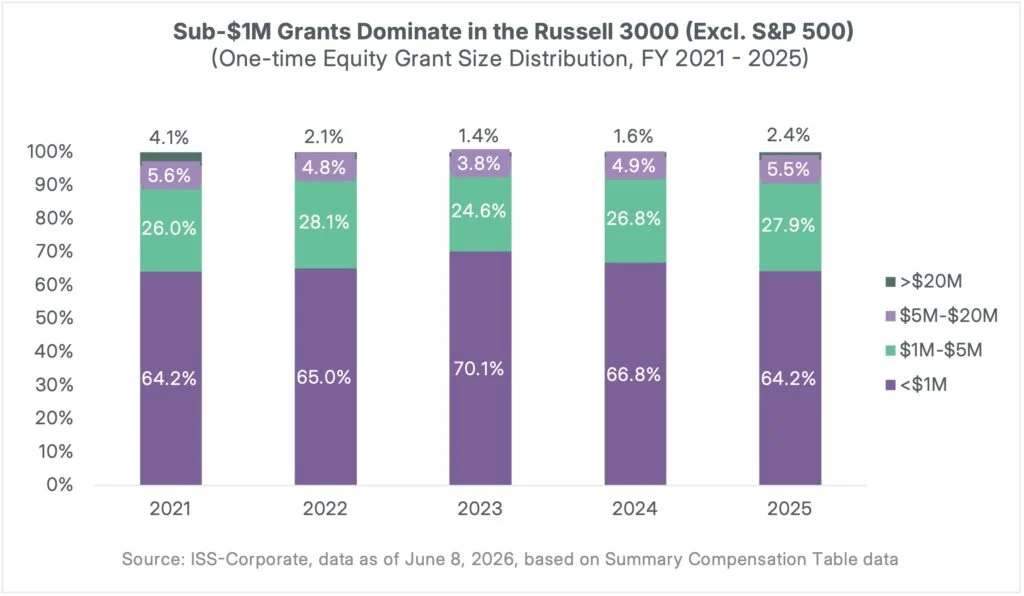
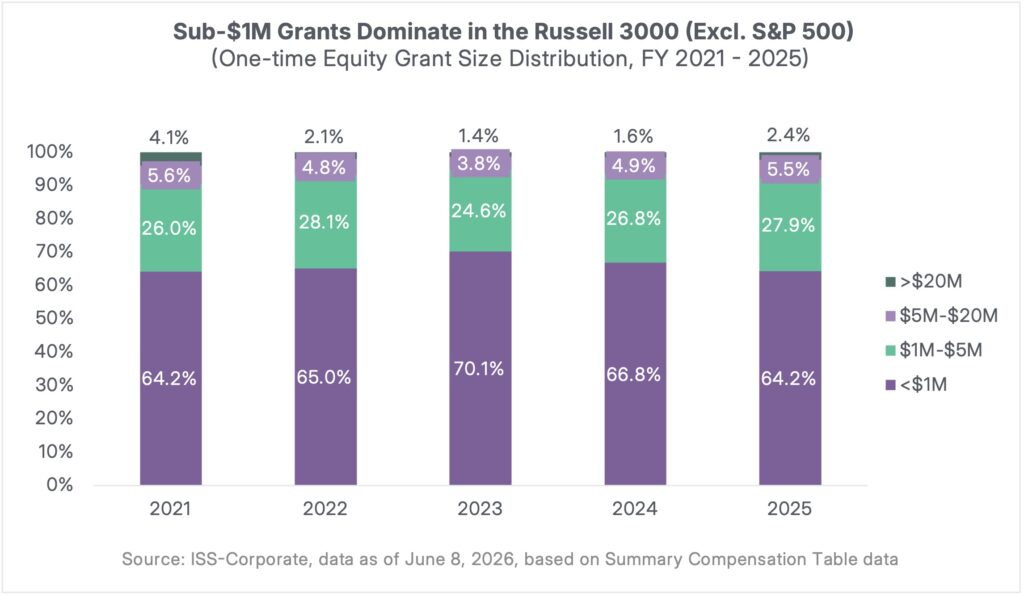
Most notably, awards categorized as "mega grants," exceeding $20 million, have seen a substantial increase in prevalence in 2025, rising by approximately 63% compared to the previous peak recorded in 2021. These substantial grants are most commonly linked to executive recruitment, critical retention efforts, or leadership transitions where securing and retaining top-tier talent is paramount. Although such mega grants remain relatively rare, their increased deployment signals a greater willingness among some large-cap corporations to leverage significant equity packages to achieve strategic objectives. In contrast, companies within the broader Russell 3000 index demonstrate a more conservative approach, with the majority of their awards concentrated below the $1 million mark and a significantly lower proportion in the highest award tiers.
Equity Plan Proposal Volume Experiences a Slight Decline
While the annual volume of equity plan proposals has remained relatively consistent in recent years, the overall activity observed in the January-to-June period of 2026 shows a slight decline. Specifically, there were 496 equity plan proposals on the ballot, representing a 3.4% decrease from the 513 proposals seen in 2025. Over the preceding five years, equity plan proposal levels had climbed, with higher activity predominantly concentrated within the broader Russell 3000 index (excluding S&P 500 constituents) before this recent dip in 2026. Conversely, equity plan proposal activity within the S&P 500, while remaining lower in absolute terms, has shown an increase this year.
This relative consistency in proposal submissions, even amidst robust equity market performance, suggests that companies are adopting a more disciplined and strategic approach to the management of their equity plans. Many corporations are maintaining a steady cadence for renewing their existing equity plans, rather than seeking significant expansions. Consequently, the overall volume of equity plan proposals is expected to remain elevated compared to historical averages, underscoring a continued reliance on equity compensation as a foundational element of executive pay design.
ISS-Corporate’s Perspective on Proxy Season Trends
The observed increase in substantial, targeted one-time equity awards this proxy season, coupled with the sustained level of equity plan activity, reinforces the view of equity as a crucial strategic compensation tool. Simultaneously, the continued strength in shareholder support for "Say-on-Pay" votes suggests that investors are exhibiting greater restraint and placing increased trust in the discretion of company boards regarding executive compensation decisions.
In this prevailing environment, it is imperative for companies to understand that strong voting outcomes do not signify an absence of ongoing investor scrutiny. As executive compensation practices continue to adapt and evolve, particularly concerning the scale and design of one-time equity awards, investor attention is likely to remain focused on the underlying rationale, transparency, and the demonstrable alignment of these decisions with the creation of long-term shareholder value.
As shareholders proceed with their "say on pay" votes throughout the proxy season, their assessments will likely center on several critical areas of executive compensation:
- Pay-for-Performance Alignment: A thorough examination of how executive pay is linked to the achievement of key financial and strategic performance metrics.
- Compensation Committee Oversight: The perceived independence and effectiveness of the compensation committee in setting and overseeing pay practices.
- Disclosure Transparency: The clarity and completeness of disclosures regarding executive pay, including the rationale for specific awards and the use of various incentive vehicles.
- Peer Benchmarking: How a company’s executive pay compares to that of its industry peers, considering factors like company size, complexity, and performance.
- Shareholder Engagement: The extent to which companies have engaged with shareholders on compensation matters and addressed investor feedback.
Collectively, these factors are expected to significantly influence shareholder support outcomes for executive compensation proposals during this proxy season. The Compensation and Governance Advisory team at ISS-Corporate is dedicated to assisting public companies by conducting comprehensive pay-for-performance risk assessments, providing detailed peer benchmarking analysis, offering expert advice on the strategic design of incentive compensation structures, and meticulously reviewing draft disclosures to ensure enhanced clarity and robust alignment with evolving investor expectations.
