

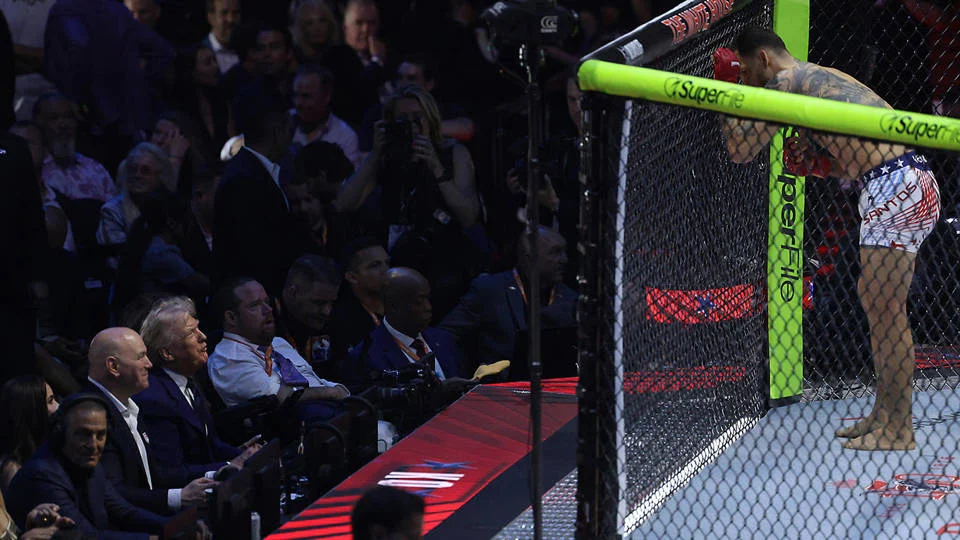
The choice of a cage as the central symbol for UFC Freedom 250, an event held on the South Lawn of the White House, ignited a complex debate about the representation of freedom and its inherent contradictions. The structure, erected, approved, illuminated, filmed, defended, and ultimately witnessed and celebrated, was President Donald Trump’s deliberate selection to embody the nation’s commitment to liberty. However, this potent imagery immediately drew comparisons to historical and philosophical concepts, prompting deeper scrutiny of its implications.
The Spectacle of Freedom: UFC Freedom 250
UFC Freedom 250, an event that merged the visceral world of mixed martial arts with a declared celebration of American freedom, took place on the iconic South Lawn of the White House. The decision to host such a high-profile sporting event in this historically significant location, particularly one centered around a symbol as contentious as a cage, was met with a mixture of enthusiasm and apprehension. The physical structure of the octagon, a hallmark of UFC bouts, was elevated from its usual sporting context to serve as the focal point of a national narrative. Its presence was not merely functional for the athletic contests but was intended to be a visual representation of the very principles the event purported to champion.
The South Lawn, a space typically reserved for diplomatic receptions, presidential addresses, and national ceremonies, became the stage for a modern gladiatorial spectacle. The juxtaposition of the venerable setting with the raw intensity of MMA created a powerful, and for some, unsettling, image. The approval process for such an event, given its unique nature and the symbolism involved, would have undoubtedly involved extensive deliberation across various government agencies, from security to public access and the logistical complexities of transforming a presidential space into a combat arena.
Echoes of Kakania: The Paradox of Symbolism
The choice of the cage as a symbol of freedom immediately evoked comparisons to Robert Musil’s seminal novel, The Man Without Qualities. Musil’s depiction of "Kakania," a fictional Austro-Hungarian empire, offers a framework for understanding societies that possess all the outward trappings of modernity – ministries, laws, newspapers, a judiciary, aristocracy, and a sophisticated bureaucracy – yet fundamentally lack a coherent sense of self or purpose. Kakania, in Musil’s critique, was a world drowning in its own complexity, an elaborate edifice incapable of articulating its core identity.
In this context, the cage on the South Lawn can be interpreted as a similar paradox. The United States, a nation founded on ideals of liberty and individual freedom, chose to represent these very ideals through a structure that, by its very definition, is designed to contain, confine, and separate. The octagon, where combatants engage in controlled aggression, is inherently a space of restriction, albeit one within which certain freedoms of action are permitted and celebrated. The act of building, approving, and illuminating this cage for a "celebration of freedom" thus presented a conceptual challenge, prompting observers to question whether the symbol accurately reflected the intended message or, instead, revealed an underlying tension within the nation’s self-perception.
The Political Context: Trump’s "Freedom" Narrative
President Donald Trump’s administration often employed a distinct brand of rhetoric that emphasized strength, national sovereignty, and a particular interpretation of freedom. This interpretation frequently involved a strong assertion of individual liberties, particularly in contrast to perceived overreach by government or international bodies. The UFC, with its emphasis on individual athletic achievement and a direct, often confrontational, style of competition, aligned with this narrative.
The choice to host an MMA event on the White House grounds, and to frame it as a celebration of freedom, was a strategic move to reinforce this political messaging. It sought to connect the president’s vision of America with a popular and energetic cultural phenomenon. The "Freedom" moniker itself was not incidental; it was a deliberate branding attempt to imbue the event with a deeper ideological significance.
However, the selection of the cage as the object to represent this freedom was a bold and potentially divisive choice. Critics argued that it highlighted a perception of freedom as being defined by its boundaries, by what is kept out or kept in, rather than by its boundless potential. It raised questions about whether this was a representation of freedom as a hard-won, defended territory, or as something inherently limited and controlled.
Supporting Data and Precedents
While UFC Freedom 250 was a unique event in its direct presidential endorsement and staging on the South Lawn, the intersection of politics and professional sports is not unprecedented. Past administrations have utilized sporting events for public relations and to connect with broader segments of the population. Presidential visits to major sporting championships, speeches at sporting venues, and the honoring of championship teams have long been part of the presidential playbook.
However, the direct sponsorship and symbolic elevation of a specific sporting structure as a representation of a core national value like freedom is a more distinctive approach. The UFC itself has a substantial economic footprint. As of the early 2020s, the UFC has consistently been a major player in the global combat sports market, with annual revenues in the hundreds of millions of dollars. Its events attract millions of viewers worldwide, indicating a significant cultural reach that can be leveraged for political messaging. The organization’s global brand recognition made the choice of UFC as a partner a potentially effective way to project an image of American strength and cultural influence.
Chronology and Timeline of Related Events (Inferred)
While specific details regarding the planning of UFC Freedom 250 are not fully public, a plausible timeline can be inferred:
- Early 2026: Initial discussions likely began between White House staff and UFC representatives regarding a potential collaboration. The idea of a "celebration of freedom" event, possibly tied to a significant American holiday or anniversary, would have been conceived.
- Spring 2026: The concept of hosting the event on the South Lawn would have been proposed and vetted. This would involve high-level security assessments, logistical planning, and obtaining necessary approvals from various government departments. The specific symbolism of the cage would have been a key point of discussion and decision-making.
- Late Spring/Early Summer 2026: Preparations for the physical construction of the octagon and related infrastructure on the South Lawn would have commenced. This would include ensuring compliance with all regulations and security protocols. Public announcements regarding the event and its unique venue would have been made.
- June 17, 2026: UFC Freedom 250 takes place on the South Lawn. The event is filmed, broadcast, and observed by attendees and a global audience. The cage is the central visual element.
- Post-Event Analysis: Media coverage, political commentary, and public discourse would emerge, analyzing the event’s success, its symbolism, and its political implications. Comparisons to historical and philosophical concepts, such as Musil’s Kakania, would likely gain traction in these analyses.
Reactions and Statements (Inferred)
Given the nature of the event, a range of reactions would have been anticipated and likely observed:
- White House Officials and Supporters: Would have lauded the event as a successful demonstration of American strength, freedom, and the vibrancy of its culture. They would have emphasized the positive aspects of the UFC, such as athletic discipline, competition, and the entrepreneurial spirit. Statements would likely have focused on the "celebration of freedom" aspect, downplaying any controversial symbolism.
- UFC Management and Fighters: Would have expressed pride in being part of such a prestigious event, highlighting the opportunity to showcase their sport on a global stage and in a historic location. They might have framed the cage as a symbol of fair competition and the pursuit of excellence within established rules.
- Political Opponents and Critics: Would have expressed skepticism and criticism, questioning the appropriateness of the venue and the symbolism of the cage. They might have argued that it was a misrepresentation of freedom, a spectacle that trivialized important national values, or an attempt to co-opt a popular cultural event for political gain. Concerns about the security implications and the potential disruption of the South Lawn’s traditional use would also have been voiced.
- Cultural and Academic Commentators: Would have engaged in deeper analysis, drawing parallels to historical precedents and philosophical concepts, much like the reference to Musil. They would have explored the semiotics of the cage and its implications for understanding American identity and its relationship with freedom.
Broader Impact and Implications
The hosting of UFC Freedom 250 on the South Lawn, with its symbolically charged cage, has several potential implications:
- Redefinition of Presidential Engagement: The event signifies a potential shift in how presidents engage with popular culture and utilize national symbols. By directly integrating a high-octane sporting event into the presidential landscape, it blurs the lines between statecraft and entertainment, and between traditional notions of diplomacy and modern cultural projection.
- Symbolic Contradictions in National Discourse: The inherent tension between the cage as a symbol of confinement and freedom as an ideal of liberation raises questions about the coherence of the nation’s self-representation. It highlights the ongoing debate about the nature of freedom itself – whether it is defined by its limits or by its absence of them. This could fuel further discussions about the perceived contradictions within American society and its governing principles.
- Cultural Soft Power and National Identity: The use of the UFC, a globally recognized brand, to project an image of American freedom and strength speaks to the evolving nature of soft power. It suggests a strategy of leveraging popular culture and spectacle to influence international perceptions and reinforce a particular narrative of national identity. The success or failure of this strategy would depend on how widely the symbolism resonates and is interpreted.
- The Politicalization of Sport: The event underscores the increasing intersection of politics and professional sports. When sporting venues become stages for political messaging and sporting symbols are elevated to represent national values, it can lead to heightened polarization and a more complex relationship between citizens, their entertainment, and their government.
In conclusion, UFC Freedom 250 on the South Lawn, with its central symbol of a cage, represents a significant moment in the intersection of politics, culture, and symbolism. It is an event that, while ostensibly a celebration of freedom, invites profound reflection on the nature of that freedom, the methods used to represent it, and the enduring paradoxes that can emerge when powerful symbols are deployed in the complex arena of national identity and political discourse. The ghost of Musil’s Kakania seems to linger, a reminder that the most elaborate displays can sometimes obscure a fundamental uncertainty about what is truly being represented.
