

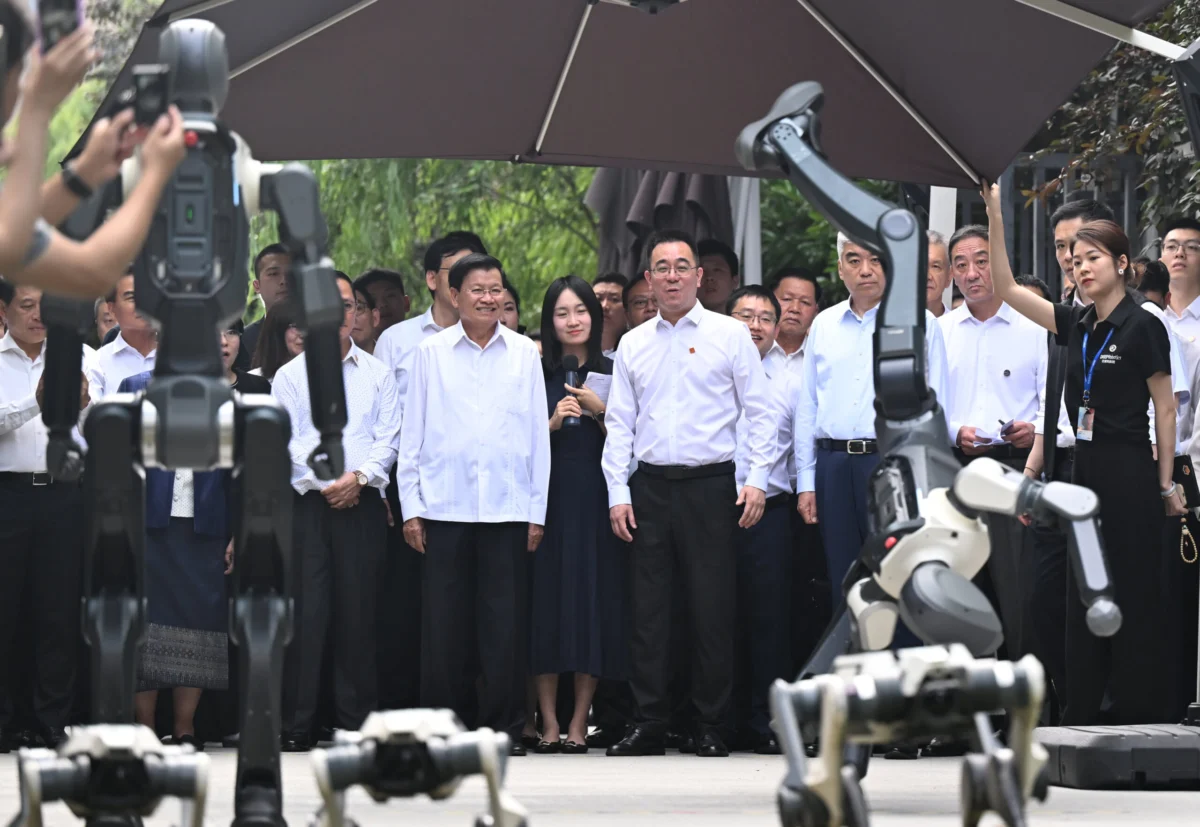
HANGZHOU, CHINA – June 02: General Secretary of the Lao People’s Revolutionary Party Central Committee and Lao President Thongloun Sisoulith observes a performance by the DR02 humanoid robot at Deep Robotics in Hangzhou, Zhejiang Province, China, on June 2, 2026. Wang Gang | China News Service | Getty Images.
The once-unfettered flow of capital into China’s burgeoning tech startup ecosystem has encountered a significant regulatory roadblock this past month, signaling a potential recalibration of Beijing’s approach to fostering innovation. In a swift succession of events, a Chinese city government initiated an inquiry into the financial entanglements of companies with Dreame Technology, a prominent maker of robotic vacuum cleaners, while the State Council, China’s cabinet, unveiled comprehensive new rules designed to intensify oversight of the nation’s vast 23 trillion yuan ($3.4 trillion) private fund industry. These developments, occurring within hours of each other, underscore the delicate equilibrium Beijing is striving to maintain as it aims to challenge the technological dominance of the United States. While the central government actively channels funds to bolster its tech ambitions, concerns are mounting over the adequacy of existing safeguards and market mechanisms to prevent the widespread misallocation of these substantial resources.
This regulatory tightening represents Beijing’s effort to rein in a co-investment model that local authorities have increasingly embraced in recent years as a strategy to attract businesses and stimulate regional economic development. According to Dan Wang, China Director at Eurasia Group, local governments have frequently engaged in a competitive "race to outspend one another" in strategically important sectors. This competitive fervor, she notes, has often led to considerable fiscal waste and has introduced growing credit risks for the central government, which ultimately bears the burden of systemic financial stability.
The pivot by Chinese local governments away from land financing—a revenue source that has experienced a dramatic decline since the property market crisis of the early 2020s—towards equity finance marks a significant strategic shift. By deploying state capital and establishing government guidance funds, these authorities have sought to acquire stakes in promising startups, viewing capital gains from these investments as a potential new stream of fiscal income. This shift has been further influenced by the withdrawal of many Wall Street-linked U.S. funds from China in recent years, largely attributed to escalating geopolitical tensions. This exodus has created an opening for domestically-denominated yuan funds to fill the investment gap. However, a key challenge in this new paradigm is the inherent limitation of local officials in evaluating investment projects with the same rigor as professional investors. As a result, they are often prone to concentrating their investments in a few favored companies, thereby exposing public finances to significant risk should these ventures falter.
Dreame Technology Under the Microscope
Dreame Technology, a company that has rapidly ascended to become the world’s largest robotic vacuum cleaner manufacturer by sales in the first quarter of 2026, according to research consultancy IDC, has also established a strong and growing presence in European and American markets. However, the company’s ambitions extend far beyond domestic floor care solutions. In a manner reminiscent of the aggressive expansion strategies adopted by certain other Chinese startups, Dreame, since its inception in 2017, has fostered the creation of nearly a thousand affiliated enterprises. These ventures span a diverse range of sectors, including electric vehicles, smartphones, humanoid robots, bubble tea franchises, and even satellite networks. Founder Yu Hao, in a bold declaration in January 2026, articulated his vision of building an ecosystem that would "become the first $100 trillion company in human history."
This ambitious and wide-ranging expansion has recently attracted significant regulatory scrutiny. In Jiangsu province, a major hub for electronics manufacturing in China, a city government has reportedly instructed local companies to conduct a thorough audit of their financial exposure to Dreame-linked entities. This audit is expected to cover the scale of investments, fiscal outlays, and ongoing business operations, as reported by state-backed media. Adding to the pressure on the company, Yu Hao’s social media account on Weibo was suspended, effectively silencing the outspoken founder’s ability to make widely disseminated comments, according to state-linked media reports.
CNBC’s requests for comment from the State Council, the Changzhou municipal government, and Dreame Technology itself remained unanswered at the time of publication.
A significant portion of Dreame’s expansive growth appears to have been fueled by state capital. Its Sky Factory Venture Capital Fund reportedly manages 41.6 billion yuan in assets, with approximately 80% of this capital originating from industrial funds provided by local governments in cities such as Suzhou and Xiamen, according to state-backed media. Furthermore, nearly all of its 29 investment funds are understood to involve local state-owned capital, with their reach extending across more than ten cities. The complexity of these financing layers has also prompted action from industry bodies. The Asset Management Association of China, this month, issued a call for greater transparency, requiring enhanced disclosure when a fund allocates more than 90% of its assets to a single investment vehicle.
The "Patient Capital" Conundrum
This intricate financial structure reflects a broader strategy employed by China to fund its industrial development. Local authorities have been actively encouraged to deploy "guidance funds" as a form of "patient capital"—investments designed to back startups in technologically uncertain and long-horizon fields, providing them with the time necessary for sustained growth. However, this model, according to Tilly Zhang, an industrial policy analyst at Gavekal Dragonomics, inevitably incentivizes companies to strategically align themselves with government priorities to secure funding.
In contrast to the United States, which typically channels support to technology companies indirectly through procurement contracts, grants, and tax incentives, Chinese governments at various levels directly acquire equity stakes. This approach places public money at risk of valuation fluctuations, exit challenges, and governance issues. Consequently, it intensifies the pressure on companies to deliver results, even in ventures that carry inherent risks. A significant portion of this capital originates from state-linked funds that are drawn to the technology sector not necessarily due to deep technical expertise or investment acumen, but rather due to its political expediency.
Local governments, Zhang explains, are often "not professional enough to distinguish between credible ones from opportunistic ones." She points to a cautionary example from 2021, where a loss-making semiconductor project in Wuhan resulted in a fiscal cost of approximately 15 billion yuan for the government. Research conducted by Rhodium Group has highlighted that Chinese local governments have established thousands of such funds over the past decade, frequently leading to duplicated investments and considerable capital wastage. Official figures indicate that by the end of 2025, China had established over 2,100 government guidance funds with a targeted capital pool exceeding 11 trillion yuan. Bob Chen, a Shanghai-based investor in a renminbi-denominated fund, draws a parallel, stating, "Singapore has Temasek. In China, every level of government has its own Temasek," referring to Singapore’s sovereign wealth fund.
The State Council’s new guidelines directly address this model by advocating for "strict control over the establishment of new government investment funds." The rules explicitly prohibit counties and districts from initiating new funds without prior approval from higher governmental authorities. Chen elaborates that these regulations effectively centralize oversight at the city and provincial levels.
The "Spray and Pray" Approach and its Consequences
Despite its inherent flaws, the state equity-investing model has yielded notable successes and has been instrumental in the rapid ascent of several of China’s leading technology firms. Hefei province’s early strategic investments in electric vehicle manufacturer Nio and chipmaker CXMT have positioned the city as a prominent example of successful government venture investing.
Smaller cities that missed out on the initial waves of investment in semiconductors and core artificial intelligence technologies have been actively seeking the next significant growth sector. "They are eager to develop good companies but not in a position to win national-strategic hard-tech projects like chips," Chen observes. "So they went looking in the consumer tech sub-theme. Dreame was handing them exactly what they wanted."
Yuen Yuen Ang, a professor of political economy at Johns Hopkins University, characterizes China’s innovation drive as a "spray and pray" approach. This strategy, she explains, generates enormous output but is characterized by a high failure rate, with success measured not by efficiency but by the emergence of a few truly dominant players. The Dreame episode, Ang suggests, represents a familiar pattern within the Chinese policy cycle: a mobilization towards a national priority, tolerance for significant manipulation of targets and wastage, followed by a course correction.
As Beijing tightens its regulatory grip, lower-tier governments are likely to feel the immediate impact. If equity investment is curtailed at the county level, Chen posits, "there won’t be many other levers left for local governments to drive investment." This regulatory shift signals a potential rebalancing of the innovation landscape in China, emphasizing more controlled and targeted investment strategies over broad-based, government-driven capital deployment. The implications for future tech ventures and the overall trajectory of China’s industrial policy are significant and will likely unfold over the coming years.
