


The prevailing narrative surrounding Canada’s economic performance has reached a fever pitch, with policymakers, central bankers, and media commentators sounding the alarm over a perceived crisis in labor productivity growth. This "productivity emergency," as characterized by senior officials at the Bank of Canada, is frequently framed as a failure of the Canadian economy to keep pace with the United States. However, a deeper examination of the underlying data suggests that this national obsession may be built on a foundation of ambiguous statistics, misleading international comparisons, and a narrow definition of economic success that ignores the broader drivers of human well-being.
As the debate intensifies, a growing cohort of economists and civil society organizations is arguing that the standard policy prescriptions—lowering taxes, reducing regulations, and pursuing unfettered free trade—have failed to deliver the promised prosperity. Instead, they suggest that the focus on Gross Domestic Product (GDP) per capita as the ultimate barometer of success is a "zombie idea" that distracts from structural challenges such as income inequality, environmental degradation, and the erosion of public services.
The Architecture of the Productivity Alarm
The current discourse is heavily influenced by a conventional economic dogma that links national prosperity almost exclusively to labor productivity—defined as the volume of output produced per hour worked. In March 2024, Bank of Canada Senior Deputy Governor Carolyn Rogers delivered a landmark speech titled "Time to break the glass: Fixing Canada’s productivity problem," in which she argued that Canada’s inability to match U.S. efficiency levels constituted a national emergency.
This sentiment is echoed frequently in the editorial pages of major national newspapers. The typical argument follows a predictable trajectory: rising government deficits necessitate either painful spending cuts or tax hikes. To avoid these "hard choices," proponents argue that the government must "reignite growth" by incentivizing business investment through deregulation and the removal of inter-provincial trade barriers.
However, critics such as Canadian economist Jim Stanford and Nobel laureate Joseph Stiglitz have long argued that GDP per capita is an insufficient proxy for national well-being. They contend that while productivity is a useful metric for measuring factory-level efficiency, it fails to account for the complexities of a modern, service-oriented economy.
The Technical Ambiguity of Economic Data
One of the primary challenges in the productivity debate is the inherent uncertainty of the data itself. Measuring productivity in a resource-based and service-heavy economy like Canada’s is notoriously difficult. Unlike manufacturing, where output can be measured in physical units, the "output" of the service sector—which includes healthcare, education, and social services—is often measured by the cost of inputs, making productivity gains appear stagnant by definition.

Furthermore, the choice of statistical tools can radically alter the economic narrative. For example, to determine "real" GDP, economists must adjust nominal figures for inflation. The choice between using a Consumer Price Index (CPI) or a Producer Price Index (PPI) as a deflator is critical. Some analyses have shown that simply switching the price index used for calculations can transform a decade-long decline in Canadian productivity into a modest gain.
Misleading international comparisons also fuel the sense of crisis. A 2014 report from Statistics Canada highlighted that when adjustments are made for terms of trade, resource prices, and investment income, Canadian growth in real income per capita between 2002 and 2012 actually outperformed that of the United States. This suggests that the "gap" between the two nations is often a reflection of different economic structures rather than a fundamental failure of Canadian labor.
A Comparative Analysis: The European Model vs. the American South
The obsession with matching U.S. productivity levels often ignores the social costs associated with the American economic model. While the U.S. often boasts higher GDP per capita, this is frequently driven by a higher proportion of expensive private services and a lack of social safety nets.
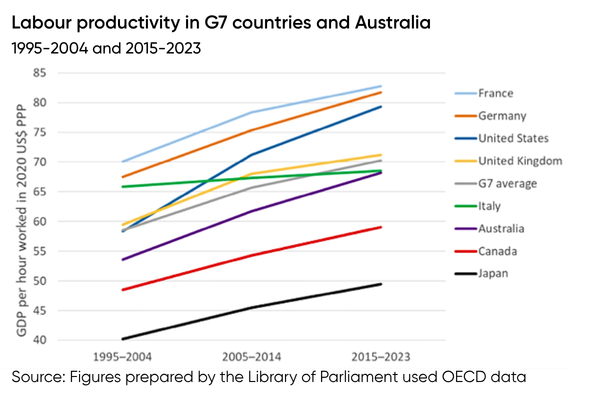
When looking at global productivity leaders, countries like France and Germany consistently rank near the top of the G7 in labor productivity per hour worked. These nations maintain high levels of productivity despite having higher tax rates, more robust labor protections, and significantly more vacation time than their North American counterparts.
Conversely, regions with aggressive anti-union policies and low-tax environments, such as the state of Alabama, often suffer from deep rural poverty, frequent hospital closures, and low-wage economies. This comparison suggests that "improving the investment climate" through deregulation does not automatically lead to higher living standards for the average citizen.
Chronology of the Neoliberal Shift and the Decoupling of Wages
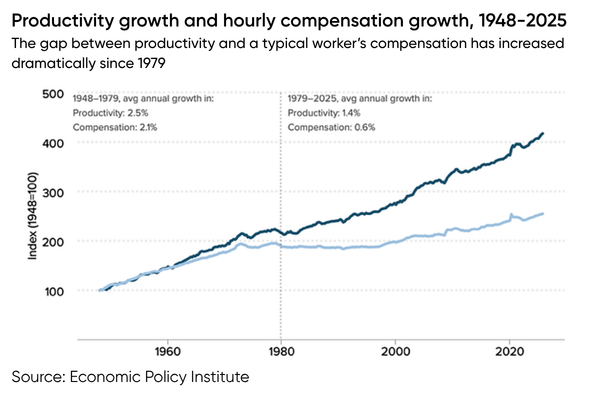
To understand the current impasse, it is necessary to examine the historical trajectory of productivity and compensation. From the post-World War II era until the late 1970s, productivity growth and real wage growth in North America moved in tandem. As workers became more efficient, their paychecks grew accordingly.
This relationship began to decouple in the early 1980s, coinciding with the rise of neoliberal economic policies championed by leaders like Ronald Reagan in the U.S. and Brian Mulroney in Canada. These policies—characterized by the weakening of labor unions, the reduction of top-tier income tax rates, and the privatization of state assets—successfully boosted productivity in some sectors, but the resulting wealth was increasingly concentrated at the top of the income distribution.
In Canada, this trend has manifested as a "branch plant" economy. Because a significant portion of the manufacturing sector is foreign-owned, major research and development (R&D) decisions and high-value investments are often made at head offices in the U.S. or Europe, leaving Canadian subsidiaries to focus on lower-value assembly or resource extraction.
The Fiscal Impact of Tax Erasure
A significant part of the "we can’t afford it" narrative stems from decades of aggressive tax cutting. Proponents of the productivity-first model argue that lower taxes are essential to attract investment. However, research suggests this has created a massive revenue vacuum.
A study from Queen’s University examined the impact of federal income tax cuts (both personal and corporate) implemented between the late 1990s and 2015. The researchers calculated that the "lost" revenue to the federal government in the year 2016 alone was approximately $94 billion. In Quebec, a similar report estimated that tax cuts since the late 1980s have resulted in an annual revenue loss of $12 billion.
These figures represent funds that could have been used to address the very issues currently hampering the economy: crumbling infrastructure, an aging population, and the urgent need for a green energy transition. The argument that Canada lacks the resources to fund public services is, therefore, a policy choice rather than an economic inevitability.
Beyond GDP: The G15+ Initiative and New Metrics of Success
In response to the limitations of GDP-centric thinking, new movements are emerging to redefine how national progress is measured. In 2022, a coalition of 15 civil society organizations in Quebec launched the "G15+" initiative. This "Beyond GDP" framework utilizes approximately 70 different indicators grouped into 10 thematic areas to provide a holistic view of societal health.
These indicators include:
- Economic Dimensions: Income inequality, household debt, and job security.
- Social Dimensions: Access to healthcare, educational attainment, and housing affordability.
- Environmental Dimensions: Greenhouse gas emissions, biodiversity loss, and resource depletion.
The G15+ data is updated annually and is increasingly being used by municipal and provincial bodies to guide policy. Advocates argue that extending this model nationwide would force a more honest conversation about whether economic growth is actually translating into a better quality of life for Canadians.
The Reality of Planetary Boundaries
Finally, the relentless pursuit of growth must eventually confront the physical limits of the planet. A recent report from the Potsdam Institute for Climate Impact Research warned that human economic activity has already breached seven of the nine "planetary boundaries" necessary to maintain a stable environment. These include climate change, biodiversity loss, and land-system change.
The traditional economic orthodoxy suggests that higher growth is the only way to solve these crises. However, a growing number of ecological economists suggest that a "steady-state" or low-growth economy may be the only sustainable path forward. This would involve shifting the focus from producing more goods to redistributing existing wealth, expanding public services, and improving the quality of life through non-material means.
Conclusion: Reframing the National Conversation
The "productivity panic" serves a specific political agenda, one that prioritizes capital mobility and corporate profitability over social cohesion and environmental stability. By framing the debate as a desperate race to catch up with the United States, policymakers avoid addressing the structural flaws of the Canadian economy, such as its reliance on low-value resource exports and the dominance of protected oligopolies in the telecom and grocery sectors.
If the goal of the Canadian economy is to provide high-quality employment, foster innovation, and ensure a sustainable future, the nation must look beyond the narrow confines of GDP per capita. Challenging the productivity mantra is not an admission of failure, but a necessary step toward imagining an economic system that serves the people and the planet, rather than the other way around.
