

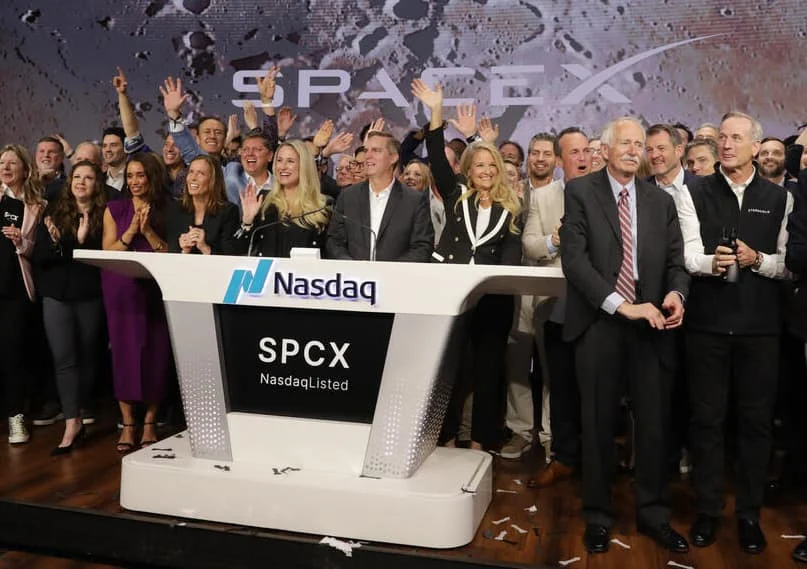
The initial euphoria surrounding SpaceX’s highly anticipated public debut has begun to wane, as shares experienced a significant pullback, eroding nearly all gains for the average investor who purchased stock in the open market following its June 12th, 2026, listing on the Nasdaq. The celebrated IPO, marked by a ceremonial bell-ringing attended by SpaceX leadership, including CEO Elon Musk, at the Nasdaq MarketSite, had initially propelled the company’s valuation to unprecedented heights, briefly nearing a staggering $3 trillion. However, a sharp reversal in market sentiment has brought the stock back to earth, underscoring the inherent volatility of high-growth technology and aerospace equities post-listing.
On Thursday, June 20th, shares of SpaceX closed down 3.6%, settling just under $184.98 a share. This significant daily decline follows a week of increasing pressure, culminating in a 20% retreat from its intraday peak of over $225 reached on Tuesday, June 18th. For many market participants, particularly those who entered the market in the immediate aftermath of the IPO frenzy, this correction has been a sobering experience. The stock’s five-day volume-weighted average price (VWAP), a crucial metric for traders gauging the average price a security has traded throughout a period weighted by volume, now stands at $181.71 a share. This figure strongly suggests that the typical post-IPO buyer is now approximately breaking even, with many facing paper losses depending on their specific entry point.
A Highly Anticipated Public Debut
The journey to SpaceX’s public offering was paved with years of groundbreaking innovation and market anticipation. Founded by Elon Musk in 2002 with the audacious goal of making life multi-planetary, SpaceX has fundamentally reshaped the aerospace industry. Its achievements include pioneering reusable rocket technology with the Falcon 9 and Falcon Heavy, dramatically reducing the cost of space launches; developing Starlink, a rapidly expanding satellite internet constellation aiming to provide global broadband access; and advancing the Starship program, a fully reusable super heavy-lift launch vehicle designed for deep space missions to the Moon and Mars. These ambitious projects, coupled with Musk’s visionary leadership, had cultivated an almost mythical status for the company in private markets, where its valuation had steadily climbed, attracting significant capital from institutional investors and venture capitalists.
For years, the question of when SpaceX would go public lingered, with Musk often stating that an IPO would only occur when the company’s operations, particularly Starlink, achieved predictable revenue and cash flow. The decision to list in June 2026 signaled to the market that the company felt it had reached this critical juncture, ready to face the scrutiny and demands of public ownership. The initial public offering was priced at a robust $135 per share, a valuation that reflected not only its current operational success but also the immense future potential investors ascribed to its diverse portfolio of aerospace and telecommunications ventures. Demand for the IPO was unprecedented, with institutional investors, hedge funds, and a growing cohort of retail investors clamoring for allocations.
The IPO Timeline: From Soar to Stabilize
- June 12th, 2026 (Friday): SpaceX officially lists on the Nasdaq under the ticker symbol "SPCX." The IPO price is set at $135 per share. Trading commences with immediate and intense buying pressure, pushing the stock significantly above its offering price.
- June 13th, 2026 (Monday): The first full trading day sees continued momentum. The stock builds on its initial gains, reflecting strong investor confidence and the market’s enthusiasm for a truly disruptive technology company. Volumes are exceptionally high as both institutional and retail investors vie for positions.
- June 14th, 2026 (Tuesday): SpaceX shares reach their zenith, soaring to an intraday high exceeding $225 per share. At this peak, the company’s market capitalization briefly pushes towards the $3 trillion mark, placing it among the most valuable companies globally and eclipsing many established giants. This day marks the peak of the post-IPO rally, fueled by a combination of speculative buying, short covering, and genuine long-term investment interest.
- June 15th, 2026 (Wednesday): The first signs of profit-taking emerge. While the stock remains well above its IPO price, the frenetic pace of buying begins to subside. Investors who bought early or received IPO allocations start to lock in substantial gains, contributing to a slight downtick in the share price.
- June 16th, 2026 (Thursday): A more pronounced correction takes hold. SpaceX shares fall by 3.6%, closing just under $184.98. This single-day drop signifies a significant shift in market sentiment, with the stock now having retreated approximately 20% from its Tuesday peak. The VWAP for the five-day trading period ending Thursday highlights that the average open-market buyer is now at or near their breakeven point. This brings the stock back to levels last seen on its second day of trading, Monday, June 13th.
The Retail Investor’s Experience: A Mixed Bag
While the recent pullback has erased gains for many who bought on the open market, the experience for retail investors who participated in the IPO itself has been notably different. Platforms like Robinhood, Fidelity, and SoFi had offered their users access to the SpaceX IPO, a growing trend aimed at democratizing investment opportunities traditionally reserved for institutional players. However, due to overwhelming demand, most individual investors received only a fraction of the shares they requested – in some cases, just one or a handful of shares. These allocations, purchased at the initial $135 offering price, mean that these retail investors are still sitting on substantial paper profits, even after the recent market correction. For them, the recent volatility is less about losing money and more about watching their initial gains moderate. This stark contrast highlights the advantage of securing shares at the IPO price versus chasing the stock in the highly volatile post-debut trading environment.
Reassessing Valuation: Fundamentals vs. Hype
The swift reversal in SpaceX’s share performance underscores a fundamental tension in the market: the battle between speculative enthusiasm and cold, hard fundamentals. The initial surge post-IPO was undoubtedly driven by a potent mix of factors: brand recognition, Elon Musk’s cult following, the allure of space exploration, and the scarcity of truly transformative public companies in the aerospace sector. Many analysts had cautioned that the rapid ascent to a near $3 trillion valuation, placing it in the league of companies like Apple and Microsoft, might be difficult to sustain without a clear, immediate pathway to commensurate profitability.
Market analysts and institutional investors have now begun a more rigorous reassessment of SpaceX’s valuation multiples. While its revenue streams from launch services (Falcon 9, Falcon Heavy) and Starlink subscriptions are growing rapidly, the capital expenditures required for Starship development, Starlink constellation expansion, and future lunar/Martian missions are immense. Questions around long-term profitability, competition from other space ventures (both private and national), and regulatory hurdles are becoming more prominent in investor discussions.
"The initial rally was a classic case of FOMO – Fear Of Missing Out – combined with genuine excitement for a generational company," commented Dr. Lena Sharma, a senior equity analyst at Zenith Capital, in a recent market note. "However, the market eventually demands a tangible connection between future growth prospects and current valuation. A 20% correction post-peak is not uncommon for highly anticipated tech IPOs; it’s often a necessary recalibration as investors move from pure speculation to a more grounded assessment of financial models and operational execution risks."
Another factor contributing to the pullback could be broader market sentiment, particularly within the technology sector. While not a pure tech stock, SpaceX often trades with similar dynamics due to its innovative nature and high growth potential. A general softening in the wider tech market, driven by concerns over interest rates or macroeconomic indicators, could amplify profit-taking in high-valuation growth stocks like SpaceX.
Broader Implications and Future Outlook
The SpaceX IPO and its subsequent volatility offer several key takeaways for the broader market and the future of disruptive technology companies seeking public capital.
Firstly, it reinforces the enduring power of brand and vision, capable of driving extraordinary investor enthusiasm. However, it also serves as a potent reminder that even the most innovative companies are not immune to market corrections and the eventual demand for fundamental justification of their valuations.
Secondly, the experience of retail investors highlights both the opportunities and the risks of democratized IPO access. While those who secured allocations at the IPO price remain profitable, the sharp decline for open-market buyers underscores the importance of diligent research and understanding market dynamics before chasing momentum. Brokerage platforms may need to further educate their users on post-IPO volatility and the difference between primary and secondary market participation.
Thirdly, for other privately held space technology companies eyeing a public listing, SpaceX’s journey will be closely watched. While the initial demand for SpaceX was overwhelming, the subsequent correction might temper expectations for sky-high valuations and immediate, uninterrupted growth post-IPO. It could encourage a more conservative approach to pricing and a greater emphasis on demonstrating clear paths to profitability and sustainable cash flows before seeking public investment. Companies like Blue Origin or Sierra Space, if they consider an IPO in the future, will undoubtedly learn from SpaceX’s market reception.
Looking ahead, the long-term trajectory of SpaceX will depend less on short-term stock fluctuations and more on its continued execution of its ambitious roadmap. The company’s fundamental mission — making humanity multi-planetary and providing global connectivity — remains unchanged. While the stock may face continued volatility as the market digests its true value, the underlying technological advancements and market opportunities for SpaceX are still formidable. Investors will be keenly watching upcoming milestones, such as further Starship test flights, expansion of the Starlink subscriber base, and new launch contracts, as these will ultimately dictate the company’s long-term performance and justify its place as a leader in the new space economy. The current market action might be best viewed as a necessary consolidation phase, allowing the market to find a more stable equilibrium for a company that continues to push the boundaries of human endeavor.
— CNBC’s Chris Hayes and Deena Zaidi contributed to the story.
