

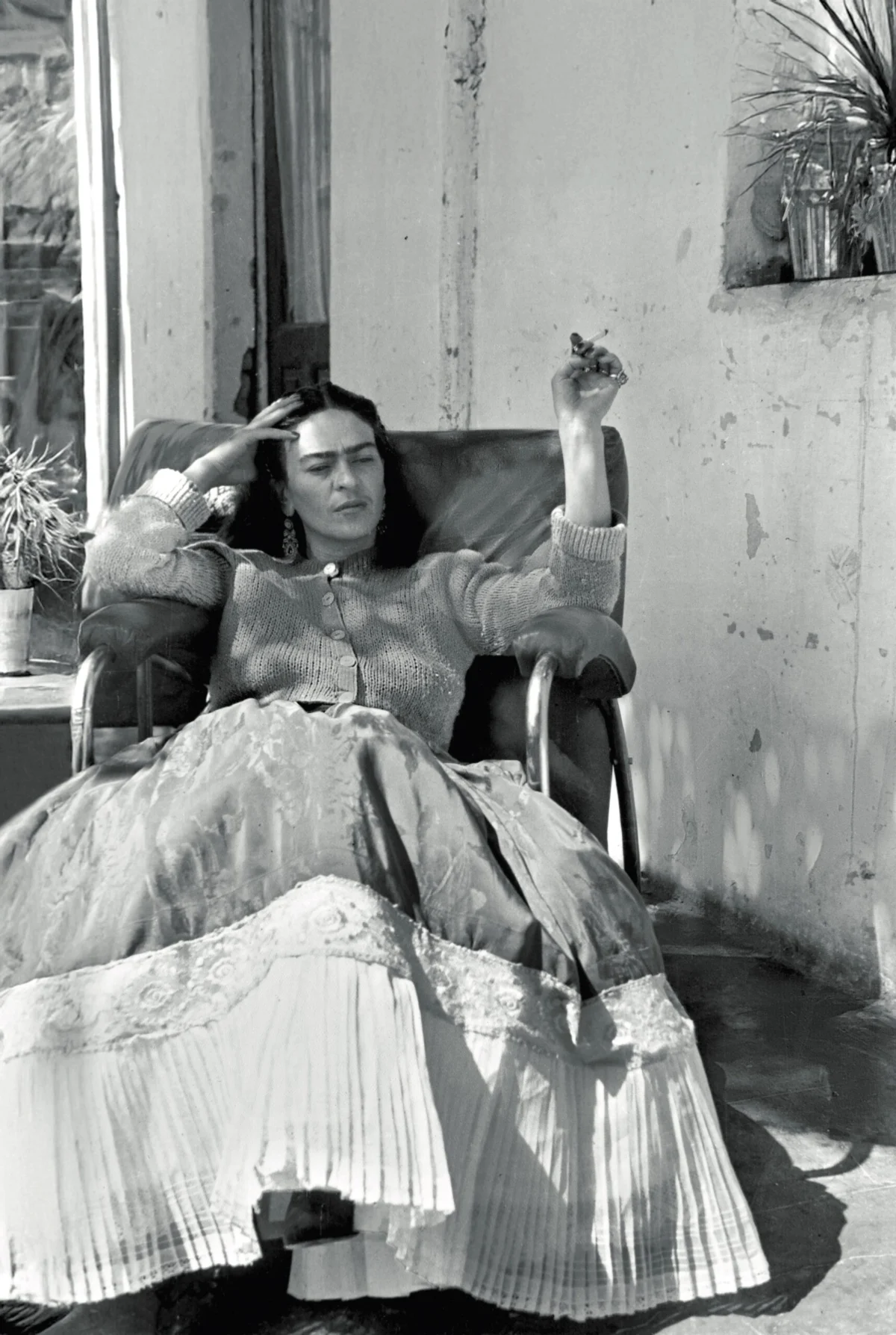
The legacy of Frida Kahlo has long been a study in contradictions, oscillating between the profound agony depicted in her canvases and the vibrant, commercialized "Fridamania" that has turned her likeness into a global commodity. For decades, the mythologizing of Kahlo has often flattened her complex identity, reducing the revolutionary painter to a series of recognizable motifs: the unibrow, the floral crown, and the Tehuana dress. However, a significant cultural shift is underway as her direct descendants work to reclaim the narrative of Frida the human being. This movement is anchored by the release of a new volume from Rizzoli, titled Casa Kahlo: Frida Kahlo’s Sanctuary, a book that serves as both a historical record and an intimate companion to the namesake museum that opened in Mexico City last year. Written by the artist’s family—specifically her grandniece Mara Romeo Kahlo and her descendants Mara de Anda and Frida Hentschel—the work provides a necessary recontextualization of Kahlo’s life, moving away from the "cult of suffering" to highlight the domestic joy, family ties, and daily rituals that defined her private world in Coyoacán.

The Evolution of the Kahlo Sanctuaries
While the world is familiar with Casa Azul (The Blue House), the residence where Kahlo was born and later died, the narrative has expanded to include the nearby Casa Kahlo. For nearly 70 years, Casa Azul has served as the primary pilgrimage site for fans, having been converted into a museum shortly after Kahlo’s death in 1954. In contrast, Casa Kahlo remained a private, active residence for the Kahlo family until as recently as 2021. The transition of this private home into a public museum has led to the discovery of a wealth of previously unseen artifacts, including personal correspondence, family recipes, and candid photography that challenge the traditional, tragic portrayal of the artist.
The family’s decision to open this secondary sanctuary stems from a desire to showcase the "hidden Frida." In the process of archiving the home’s contents, researchers uncovered ephemera that paint a vivid picture of a woman deeply engaged with her community and kin. Unlike the curated halls of Casa Azul, Casa Kahlo offers a glimpse into the artist as an aunt and a sister. It was here that she doted on her niece Isolda and nephew Antonio, sealed letters to her sister Cristina with lipstick kisses, and sought refuge during her many periods of physical convalescence. The new museum and its accompanying book emphasize that while Kahlo’s art was a vessel for pain, her home was a vessel for life.

A Chronology of the Kahlo Estates
The history of the Kahlo family’s presence in Coyoacán is intertwined with the architectural and political evolution of Mexico City. To understand the significance of these spaces, one must look at the timeline of their acquisition and use:
- 1904: Guillermo Kahlo, a German-born photographer and Frida’s father, builds Casa Azul on a 0.2-acre plot. He moves in with his wife, Matilde Calderón, and their elder daughters.
- 1907: Frida Kahlo is born in Casa Azul on July 6.
- 1925: A near-fatal bus accident leaves an 18-year-old Frida with a broken spinal column, collarbone, ribs, and pelvis. During her long recovery in her bedroom at Casa Azul, she begins to paint.
- 1929: Frida marries Diego Rivera. Rivera eventually pays off the mortgage on Casa Azul, ensuring the property remains in Frida’s name.
- 1930: Matilde Calderón, Frida’s mother, purchases the property that would become Casa Kahlo, located just blocks away from the Blue House.
- 1931–1933: While living in San Francisco and Detroit for Rivera’s mural commissions, Frida sends funds back to Mexico to renovate her parents’ new home.
- 1934: The couple returns to Mexico and settles into a modernist twin-house complex in San Angel, designed by architect Juan O’Gorman.
- 1940: Following a brief divorce and remarriage, Frida and Diego move back to Casa Azul permanently.
- 1940s–1950s: Frida frequently retreats to Casa Kahlo to stay with her sister Cristina and her nieces and nephews, maintaining a small, private studio in the basement.
The Architectural Influence of Juan O’Gorman
Beyond the family homes in Coyoacán, the functionalist studios in the San Angel neighborhood represent a pivotal moment in Kahlo’s life. Designed by the visionary architect Juan O’Gorman—a close friend of the couple—these structures were radical for their time. The complex consisted of two distinct concrete cubes connected by a narrow bridge. Rivera’s studio was larger and painted red and white, while Frida’s was a smaller, vibrant blue, echoing the color of her childhood home.

These studios were not merely residences but workspaces designed to foster creative independence while maintaining a tether between the two artists. The San Angel period was one of intense productivity for Kahlo, though it was also a time of significant personal upheaval. The stark, industrial lines of O’Gorman’s architecture stood in sharp contrast to the lush, traditional gardens of Coyoacán, reflecting the tension between Kahlo’s avant-garde political leanings and her deep-rooted connection to Mexican folk tradition.
Reclaiming the Human Narrative Through Family Archives
The Rizzoli publication is significant because it bypasses the academic and commercial gatekeepers that have dominated Kahlo’s legacy for decades. Mara Romeo Kahlo, the artist’s grandniece, notes in the book’s introduction that for the family, Frida was never a "brand." Instead, she was the relative who sang while playing the guitar, told bawdy jokes to lighten the mood, and shared a profound, often tearful bond with her sisters.

The archives revealed at Casa Kahlo include evidence of Frida’s role as an educator. In 1943, she began teaching at the arts school La Esmeralda. As her health declined, she moved her classes to her home. Her students, affectionately known as "Los Fridos," became an extension of her family. This period highlights a facet of Kahlo often ignored: her dedication to the next generation of Mexican artists and her role as a mentor during a time when she was undergoing dozens of surgeries.
Supporting Data: The Physicality of Kahlo’s Reality
To understand the sanctuary of the home, one must understand the physical constraints Frida faced. Throughout her life, Kahlo underwent approximately 23 surgeries, many of them on her spine and right leg. The domestic spaces were modified to accommodate her needs. In Casa Azul, a mirror was famously installed on the underside of her four-poster bed’s canopy, allowing her to paint her iconic self-portraits even when she was unable to sit up.

The domesticity of her life also extended to her "menagerie." Kahlo and Rivera were known for their love of animals, which served as both companions and subjects for her art. At various times, their homes were filled with:
- Spider monkeys: Including Fulang-Chang, who appeared in several paintings as a symbol of the children she could not have.
- Xoloitzcuintlis: Ancient Mexican hairless dogs that connected her to her indigenous heritage.
- Amazon parrots and parakeets: Which often perched on her shoulders as she painted.
- Deer, ducks, and tortoises: Creating a self-sustaining ecosystem within the garden walls.
This connection to nature and the "granja" (farm) atmosphere of her homes provided a vital counterweight to the sterile environments of the hospitals where she spent so much of her time.

Broader Impact and Cultural Implications
The opening of Casa Kahlo and the release of the new family-penned book come at a time when the ethics of celebrity legacy are under intense scrutiny. The "Fridamania" phenomenon has often been criticized for ignoring Kahlo’s radical communist politics and her critiques of American capitalism. By focusing on the "sanctuary" of the home, the descendants are attempting to re-ground her legacy in the specific cultural and familial soil from which it grew.
Industry analysts suggest that this move toward "intimate history" is a response to a saturated market. When an artist’s face is everywhere, the art itself can begin to lose its potency. By inviting the public into the private rooms where she lived, ate, and interacted with her family, the Kahlo estate is attempting to restore the "aura" of the artist—a term coined by philosopher Walter Benjamin to describe the unique presence of a work of art in time and space.

Furthermore, the preservation of Casa Kahlo as a museum ensures that the architectural heritage of Coyoacán is protected against the rapid gentrification facing Mexico City. The neighborhood remains a bastion of the "Mexicanidad" movement, and the Kahlo properties serve as the anchor for this cultural identity.
Conclusion: Long Live Life
In her final days at Casa Azul in 1952, bedridden and in significant pain, Frida Kahlo produced one of her most enduring works: a still life of vibrant watermelons. Across the red flesh of the fruit, she inscribed the words "Viva la Vida"—Long Live Life. It is this spirit that the new book and museum seek to honor. By moving past the flattened image of the icon and into the lived reality of the woman, the Kahlo family provides a more honest, multifaceted portrait of an artist who found beauty in the mundane and strength in the sanctuary of her home. Casa Kahlo stands not just as a museum of an artist, but as a testament to the endurance of a family legacy that refused to be erased by the passage of time or the weight of global fame.
