

In its ongoing "Meet a VC" series, the National Venture Capital Association (NVCA) recently featured Will Borthwick, a distinguished General Partner at BOLD Capital Partners. This interview provided an insightful look into Borthwick’s unique trajectory from traditional finance to the vanguard of deep technology investment, highlighting BOLD Capital’s distinctive thesis centered on "exponential technologies" – innovations poised to fundamentally reshape human capabilities and societal paradigms. The discussion underscored the evolving nature of venture capital, emphasizing the critical role of comprehensive founder support and the profound optimism driving investments in humanity’s most ambitious frontiers.
From Financial Foundations to Frontier Investing
Will Borthwick’s journey to the heart of venture capital is marked by a diverse and rigorous financial background, a path that stands in contrast to the often entrepreneurial roots of many VCs. His career began within the venerable halls of the Federal Reserve, an institution synonymous with macroeconomic stability and monetary policy. This early experience provided him with a foundational understanding of global financial systems and the intricate mechanics of economic influence. Following his tenure at the Fed, Borthwick transitioned into the demanding world of investment banking, where he honed his skills in financial analysis, deal structuring, and market dynamics. This phase exposed him to a broad spectrum of corporate finance, preparing him for increasingly complex transactions. The subsequent move to private equity saw him engaging in large-scale buyouts of established technology companies, an experience that offered deep insights into the operational complexities, strategic growth drivers, and valuation methodologies of mature tech enterprises.
However, approximately eight and a half years ago, Borthwick made a pivotal shift, joining BOLD Capital Partners. This move was not merely a career progression but a philosophical alignment with a team composed of former entrepreneurs and seasoned investors, united by a singular, audacious thesis: investing in "exponential technologies." This concept, distinct from linear technological improvement, describes innovations whose capabilities are not merely additive but multiply at an accelerating rate. As Borthwick articulates, "Things that were infeasible eighteen months ago become feasible today, and the question becomes how to use that shift to solve a really big and impactful problem." This perspective reflects a profound belief in technology’s power to address humanity’s grand challenges, encapsulated by the firm’s overarching ambition: "How do you fundamentally move the needle to make humanity better?"
BOLD Capital’s Vision: Investing in the Impossible
BOLD Capital Partners, co-founded by visionary entrepreneur and author Peter Diamandis alongside Robert Herjavec and Marc Portney, was established with a clear mandate to back ventures at the intersection of technological breakthrough and societal impact. Diamandis, known for his work with the XPRIZE Foundation and Singularity University, has long championed the idea of exponential technologies as drivers of abundance. This philosophical underpinning deeply informs BOLD’s investment strategy, which actively seeks out companies pushing the boundaries of what is currently imaginable.
The firm’s portfolio vividly illustrates this ambition, spanning areas that might once have been relegated to science fiction. Investments include companies developing stratospheric drones, designed for applications ranging from high-altitude internet connectivity to environmental monitoring and disaster relief. These platforms leverage advancements in materials science, autonomous flight, and renewable energy to achieve unprecedented endurance and operational flexibility. Another bold venture involves de-extinction initiatives, harnessing breakthroughs in genetic engineering and synthetic biology to potentially revive species like the woolly mammoth. While controversial, these projects underscore the exponential progress in biotechnology and its potential to restore ecosystems or unlock new biological insights.
Furthermore, BOLD invests in the burgeoning field of humanoids and advanced robotics, recognizing the transformative potential of intelligent machines to augment human labor, provide care, and operate in hazardous environments. These endeavors draw on rapid advancements in artificial intelligence, sensor technology, and mechatronics. The portfolio also features numerous companies focused on AI-enabled hardware, integrating artificial intelligence directly into physical devices to create smarter, more adaptive, and efficient systems across various industries, from manufacturing to healthcare. Each of these investments reflects Borthwick’s conviction that the confluence of exponential technological progress and visionary entrepreneurialism holds the key to addressing global challenges and improving the human condition.
The Evolving Landscape of Venture Capital: A Decade of Transformation
Borthwick’s tenure in venture capital has coincided with a period of unprecedented transformation within the industry. When he first entered the field, venture capital was, as he describes it, a "small, cottage, bespoke, artisanal industry." Investment rounds, particularly at the early stages, were significantly smaller. A Series A funding round of $15 million to $20 million was considered substantial. However, the past decade has witnessed an explosion of capital flowing into the ecosystem, fundamentally altering its scale and dynamics. Today, Borthwick notes, " $150 million Series As are part of the conversation," reflecting a dramatic increase in both the size of investment rounds and the overall capital deployed.
This surge in capital has been driven by several factors: sustained low-interest rates, a proliferation of institutional investors seeking higher returns, the success stories of tech giants, and the increasing complexity and capital intensity required to develop deep technologies. According to data from the NVCA and PitchBook, venture capital fundraising in the U.S. alone has consistently reached new highs in recent years, with billions of dollars being poured into startups annually. For instance, total U.S. VC investment surged from around $50 billion in the early 2010s to well over $300 billion in peak years like 2021, before a recent re-calibration. This influx has intensified competition among VCs, led to higher valuations, and necessitated a more sophisticated approach to due diligence and portfolio management. While it has enabled groundbreaking innovation, it has also raised questions about market efficiency and the sustainability of certain valuation models.

Borthwick’s observations underscore another critical shift: the growing realization that building a truly impactful company is "incredibly hard." The rapid scaling of companies like Facebook and Snapchat from nascent ideas to multi-billion-dollar entities might have created an illusion of ease. However, the reality of navigating market fit, technological hurdles, team building, and competitive pressures reveals the immense difficulty of creating a "generational company." This understanding reinforces BOLD’s commitment to not just identifying promising technologies but also rigorously vetting the entrepreneurial teams behind them.
Beyond the Check: The "Marriage" of VC and Founder
In an industry often caricatured by quick meetings and large checks, Borthwick offers a nuanced and profoundly human perspective on the role of a venture capitalist. He firmly asserts that venture capital "isn’t a fancier broker-dealer collecting a fee on the wire. It’s what happens after." For BOLD Capital, an investment signifies a deep, enduring commitment, which Borthwick likens to a "marriage — not a date or a fling. We get in the bunker with you through thick or thin."
This philosophy stems from a recognition of the inherent loneliness and immense pressure associated with being a founder. The CEO, in particular, bears the ultimate responsibility, making decisions that can determine the fate of the company and the livelihoods of its employees. In this high-stakes environment, the role of the VC extends far beyond mere capital allocation. It encompasses active, hands-on support, including strategic advice, facilitating crucial introductions to customers and executive talent, and providing emotional ballast. "Whether it’s a shoulder to cry on or a person to scream at, that’s an important part of the role," Borthwick emphasizes. This hands-on, empathetic approach transforms the VC from a passive investor into an "operator-investor," someone who leverages their own entrepreneurial and operational experience to actively guide and support portfolio companies.
This model is particularly vital in the deep tech sector, where development cycles are often longer, technical challenges are more formidable, and market adoption can be slower. Founders in these areas require not just funding, but also strategic partners who understand the complexities of bringing truly novel technologies to market. The "operator-investor" approach aligns the interests of the VC and the founder, fostering a collaborative partnership built on trust and shared vision, thereby increasing the probability of navigating the myriad challenges inherent in building groundbreaking companies.
Advocating for Innovation: Bridging the Understanding Gap
Borthwick also highlights a critical need for greater understanding between the venture capital community, policymakers, and the broader public. He identifies two key areas where prevailing perceptions often diverge from reality. Firstly, regarding founders, he wishes policymakers and observers would better appreciate the extraordinary difficulty of building a company. Founders, he argues, are fundamentally driven by a desire to "change the world in an impactful way. It comes from a place of good." They are not merely profit-seekers but often idealists committed to solving significant problems. The roadblocks they frequently encounter, from regulatory hurdles to bureaucratic complexities, often feel unnecessary and counterproductive to their mission. Borthwick passionately contends that technology is the primary engine of human progress, and entrepreneurialism is the indispensable force that builds it.
Secondly, the popular "cartoon version" of venture capitalists – often depicted as detached figures making quick decisions and large investments with minimal ongoing engagement – is far from the truth, according to Borthwick. He reiterates that VCs, particularly those in firms like BOLD Capital, are deeply engaged, often acting as "operator-investors." They bring their own entrepreneurial insights and operational experience to bear, working alongside founders rather than merely providing capital. This distinction is crucial for fostering a policy environment that supports innovation, rather than hindering it through misinformed regulation or a lack of appreciation for the venture ecosystem’s integral role in economic growth and technological advancement. Effective policymaking requires recognizing VCs not just as financial intermediaries, but as active participants in the innovation economy, investing not only capital but also expertise and sustained support.
The Optimistic Horizon: A Future of Enhanced Human Capability
Despite the inherent uncertainties of the global landscape, exacerbated by a hyper-connected information environment that amplifies every challenge, Will Borthwick remains profoundly optimistic about humanity’s future. His optimism is rooted in what he perceives as an undeniable, long-term trajectory toward the "democratization of capability." He frames this progression through a compelling historical lens: two decades ago, sophisticated computing power required expensive, proprietary server racks. Then came the advent of cloud computing, offering on-demand access to vast computational resources, democratizing infrastructure. Today, with the rapid evolution of artificial intelligence and mobile technology, "intelligence on demand is in the palm of our hands."
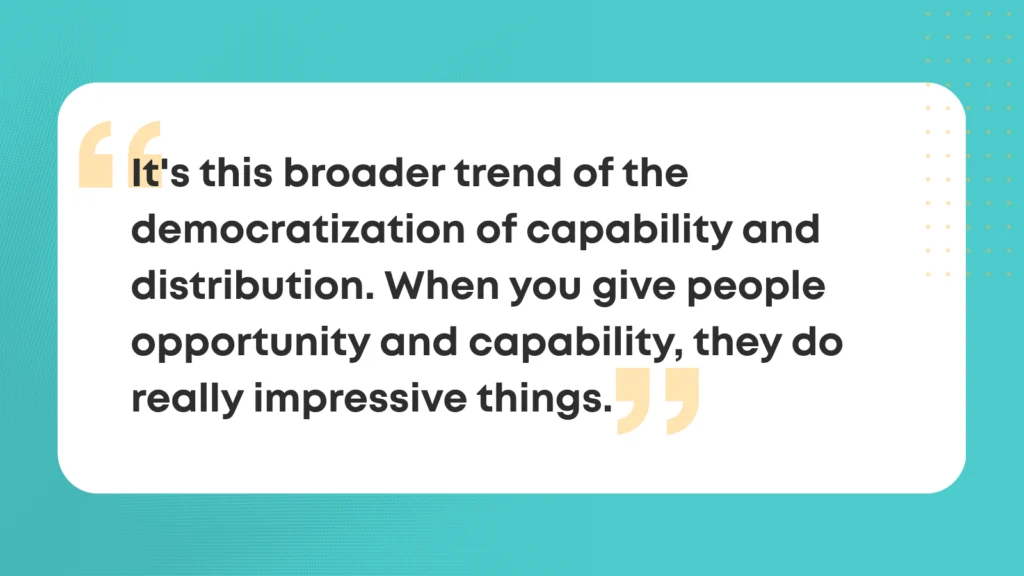
This continuous expansion of accessible tools and capabilities empowers individuals and small teams to achieve feats once reserved for large corporations or governments. "When you give people opportunity and capability, they do really impressive things," Borthwick asserts. He envisions a future where this trend only accelerates: "And it’s only going to get better tomorrow, and a year from now, and five years from now. It’s like we have superpowers – and our superpowers just keep getting stronger." This profound belief in human ingenuity, amplified by exponentially advancing technology, is the core driver of his engagement with the venture ecosystem.
This unwavering optimism is what keeps Borthwick at the investment table, actively seeking out and nurturing the next generation of exponential technologies. The companies BOLD Capital backs are not merely developing new products; they are constructing the foundational infrastructure of what humanity will be capable of next. From extending human longevity to enabling interstellar travel, from solving climate change to eradicating disease, the promise of exponential technologies holds the potential for unprecedented progress. Borthwick’s perspective offers a powerful counter-narrative to prevalent anxieties about technological disruption, instead highlighting the immense potential for human betterment when vision, capital, and relentless innovation converge. His insights provide a compelling case for the continued investment in, and societal understanding of, the ventures poised to define our collective future.
