

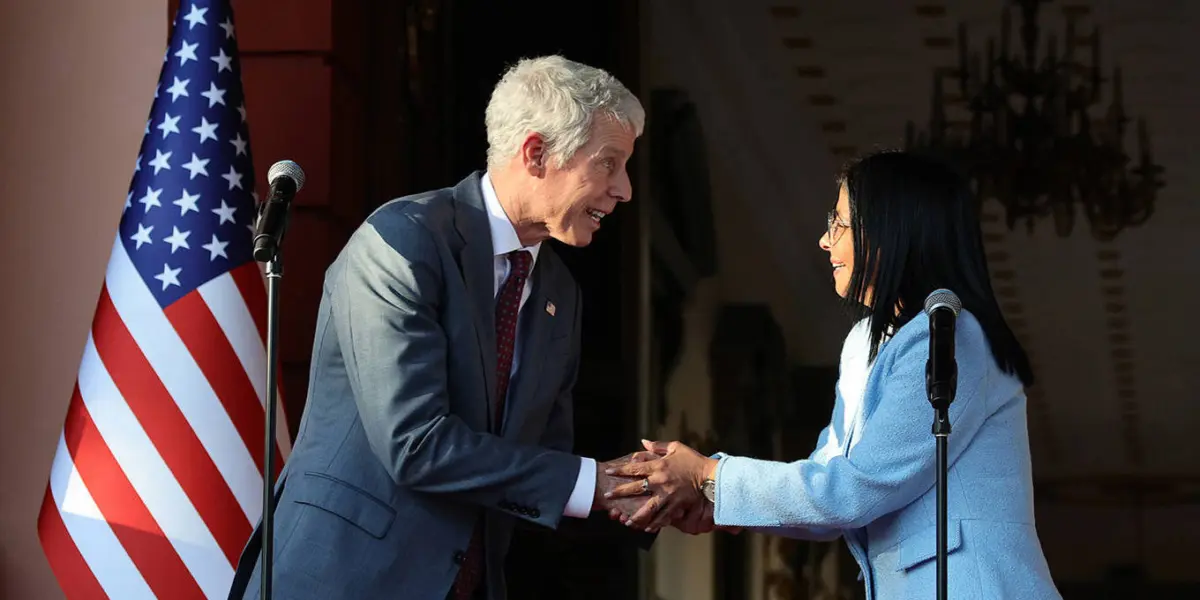
Venezuela’s aspirations for a democratic transition are increasingly imperiled as the United States consolidates control over its vast oil reserves. This strategic maneuver, involving billions in potential US and foreign investment, risks bolstering the existing Chavista regime and creating a powerful incentive for future American administrations to preserve the current political landscape, effectively undermining the very democratic ideals the US claims to champion.
The dramatic removal of Venezuelan President Nicolás Maduro earlier this year, culminating in his incarceration in a New York jail, initially sparked widespread jubilation among Venezuelans both within the country and in the diaspora. After 27 years of Chavista rule, the prospect of genuine regime change appeared tangible. However, as observers have pointed out, deposing an autocrat does not automatically dismantle the deeply entrenched authoritarian infrastructure that sustained his power. This complexity is further amplified when the architect of this removal is perceived by some as an aspiring authoritarian figure with his own questionable financial dealings.
The Shifting Sands of Venezuelan Politics and US Intervention
The ouster of Maduro marked a seismic shift in Venezuelan politics, a nation long grappling with economic collapse, hyperinflation, and political repression. The Chavista movement, initiated by Hugo Chávez in 1999, promised social revolution and economic sovereignty, channeling oil revenues into social programs. However, under Maduro, these promises devolved into widespread corruption, mismanagement, and the erosion of democratic institutions. The country witnessed a mass exodus of its population, with millions seeking refuge from dire living conditions and political persecution.
The United States, under previous administrations, had imposed a series of sanctions aimed at pressuring Maduro’s government to relinquish power and allow for free and fair elections. These sanctions, however, had a devastating impact on Venezuela’s already struggling economy, exacerbating the humanitarian crisis. The recent, more direct intervention—removing Maduro from power and placing him in custody—represents a significant escalation of US policy, moving beyond sanctions to direct action.
The Oil Factor: A Geopolitical Chessboard
Venezuela possesses some of the world’s largest proven oil reserves, a resource that has historically been the lifeblood of its economy and a significant factor in global energy markets. The US interest in Venezuela’s oil wealth is not new. For decades, American oil companies had a substantial presence in the country, and the geopolitical implications of controlling this vital resource have always been a consideration in US foreign policy.
The current strategy appears to be centered on leveraging US influence to secure access to and control over these oil assets. This could involve facilitating foreign investment, potentially from US-aligned entities, to revitalize Venezuela’s dilapidated oil infrastructure. The stated aim might be to stabilize the Venezuelan economy and ensure a reliable supply of oil to global markets. However, critics argue that such a strategy could inadvertently strengthen the very elements that perpetuated the authoritarian system, including elements within the military and state-controlled oil companies that have been historically linked to corruption and political patronage.
Background: A Legacy of Political Turmoil
The path to Maduro’s removal is paved with decades of political instability. Following Chávez’s death in 2013, Maduro inherited a nation already facing economic headwinds. His presidency was marked by increasing authoritarianism, with opposition leaders frequently jailed or exiled, and electoral processes widely criticized for lacking transparency and fairness. International bodies and human rights organizations have consistently documented human rights abuses under his rule.
The Venezuelan opposition, fragmented for years, saw a renewed sense of hope with the prospect of external intervention. However, the complexities of post-autocratic transitions are notoriously challenging. Without robust democratic institutions, independent judiciaries, and a free press, even the removal of a strongman can lead to a power vacuum or the emergence of new forms of authoritarian control.
Supporting Data and Economic Realities
Venezuela’s oil production, once one of the highest in the world, has plummeted in recent years. According to the Organization of the Petroleum Exporting Countries (OPEC), Venezuela’s crude oil production fell to an average of around 600,000 barrels per day in recent years, a stark contrast to the over 3 million barrels per day it produced in the late 1990s. This decline is attributed to a combination of underinvestment, sanctions, and mismanagement.
The potential for US and foreign investment to revive this sector is substantial. However, the flow of such capital is heavily dependent on the political and economic stability of the country, as well as the perceived security of those investments. If the US strategy prioritizes securing oil assets over fostering genuine democratic reform, it could create a scenario where economic interests become intertwined with the perpetuation of a political system that may not be accountable to its citizens.
Inferred Reactions and Stakeholder Perspectives
Venezuelan Opposition Leaders: While many within the Venezuelan opposition likely welcomed Maduro’s removal, there may be growing concerns about the nature of US involvement. Some may fear that economic interests could overshadow democratic aspirations, leading to a situation where a new leadership, even if not directly Chavista, remains beholden to external economic forces and lacks true autonomy.
Regional Neighbors: Countries bordering Venezuela have borne the brunt of the refugee crisis and economic instability. They would likely welcome any signs of stability and economic recovery but would also be wary of any geopolitical maneuvering that could further destabilize the region or create new power imbalances. Their reactions would depend on whether the US approach prioritizes humanitarian concerns and democratic governance or simply resource control.
International Oil Companies: Companies that previously operated in Venezuela or have an interest in its oil sector would be closely watching developments. The prospect of renewed investment could be attractive, but they would likely demand clear legal frameworks, guarantees against expropriation, and a stable political environment, which remains uncertain.
US Political Analysts: Within the US, there would be diverse reactions. Supporters of the intervention might point to the removal of a perceived dictator and the potential for economic revival. Critics, however, would likely raise concerns about the long-term implications for Venezuelan democracy, the potential for entrenching US influence in a way that resembles neo-colonialism, and the ethical considerations of prioritizing resource control over human rights and self-determination.
Broader Impact and Implications: A Precarious Future
The current trajectory suggests a complex interplay between US foreign policy objectives, Venezuela’s immense oil wealth, and the fragile prospects for democratic governance. If the US prioritizes securing access to oil and facilitating investment without a robust commitment to democratic institution-building, the outcome could be a Venezuela that is economically stabilized but politically still under a form of authoritarian control, albeit perhaps with different faces in power.
This scenario could create a perverse incentive for future US administrations. If significant US investment becomes tied to the Venezuelan oil sector, any move towards genuine, potentially disruptive, democratic reform that could jeopardize those investments might be viewed with apprehension by powerful economic interests and subsequent administrations. This could lead to a de facto US endorsement of the status quo, effectively making the US an architect of Venezuela’s continued political stagnation, despite the initial purported aim of liberation.
The long-term implications are profound. A Venezuela that remains politically unreformed, even if its economy shows signs of recovery due to foreign investment, could continue to be a source of regional instability. The fundamental issues of human rights, political freedoms, and accountability would remain unaddressed. Furthermore, such a situation could set a dangerous precedent for US intervention in other resource-rich nations, prioritizing economic interests over the organic development of democratic societies.
The narrative of liberating Venezuela from autocracy is a powerful one. However, the unfolding reality suggests that the pursuit of its oil wealth by the very power that orchestrated the regime change may be inadvertently forging a new chain, one that could bind Venezuela’s future to the economic and geopolitical interests of the United States, at the expense of its own democratic aspirations. The coming months and years will reveal whether the US approach will foster true self-determination for Venezuela or simply reconfigure its economic dependency under a new guise.
