

U.S. manufacturers entered August with a palpable sense of guarded relief, a sentiment reflecting a potential turning point after a challenging July. Following a period of considerable turbulence that saw the year-ahead outlook for manufacturing CEOs plummet to its lowest point of the year, the sector is now exhibiting encouraging signs of recuperation. Improving demand and a perceptible easing of geopolitical and domestic tensions are providing chief executive officers with reasons to believe that the most difficult economic headwinds of the year may have abated.
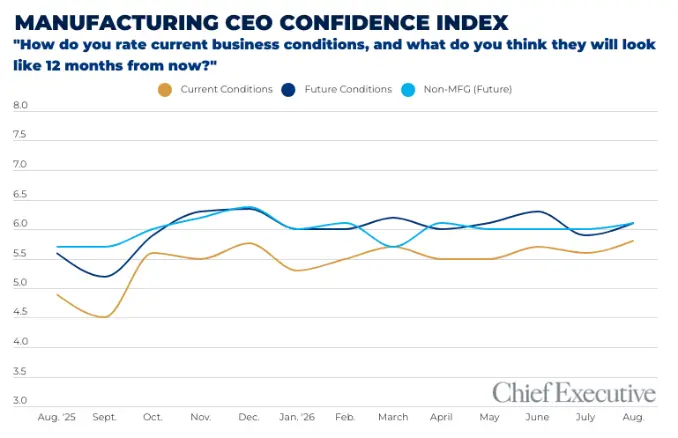
This shift in sentiment is vividly captured in Chief Executive’s latest CEO Confidence Index, a survey conducted on August 4th and 5th among 285 U.S. CEOs. The findings reveal that manufacturers are rating current business conditions at an average of 5.8 out of 10, on a scale where 1 signifies "Poor" and 10 represents "Excellent." This represents a significant 4 percent improvement over July’s figures, pushing current confidence levels beyond the 5.5 to 5.7 range where they had been persistently hovering since February. This sustained period of middling confidence indicated a sector treading water, awaiting a catalyst for renewed optimism.
The outlook for the year ahead has also seen a welcome uptick. Manufacturers’ forecasts for the next 12 months climbed to 6.1 out of 10, a modest but meaningful increase from July’s 5.9. This figure is particularly noteworthy as July’s forecast had represented the lowest recorded for 2026, signaling a deep concern among leaders about future prospects. The August gain partially reverses the 7 percent decline experienced in July and brings the sentiment of manufacturing CEOs into alignment with their non-manufacturing peers, who also reported a 6.1 out of 10 forecast for the year ahead. This convergence suggests a broader, sector-wide recalibration of expectations.
Key Drivers of Renewed Confidence
When probed about the specific factors contributing to their improved outlook, manufacturers overwhelmingly cited increasing demand as a primary driver. This renewed consumer and business appetite for manufactured goods signals a potential rebound in industrial activity.
"Demand is increasing, we are an automation company positioned well for success, and geopolitics is settling down," stated the CEO of a small-sized industrial manufacturer headquartered in Ohio. This sentiment encapsulates the dual relief of stronger market pull and a less volatile global environment. The Ohio-based executive’s perspective highlights the critical interplay between market demand and the broader geopolitical landscape, suggesting that a more stable international arena can directly translate into improved business conditions.
Other executives are anchoring their future confidence in the expectation that domestic volatility will soon subside. Andrew Ly, CEO of the large-sized consumer manufacturing firm Ly Brothers Corp., expressed a common sentiment: "Political noise will calm down either way after [the] midterm elections. Politicians will need to get back to focus on the real issues." This anticipation of a post-election period offering greater policy clarity and a return to substantive economic debate underscores a desire for predictable operating environments, which are crucial for long-term investment and strategic planning.
Several executives also pointed to the ongoing reshoring activity within the United States and robust order backlogs as significant contributors to their renewed confidence in investment and planning horizons. The trend of bringing manufacturing operations back to domestic soil, driven by a variety of factors including supply chain resilience concerns and government incentives, is providing a tangible boost to the sector. Furthermore, strong order backlogs suggest that manufacturers have a substantial pipeline of work, offering a degree of revenue certainty.
Beyond demand and geopolitical stabilization, some manufacturers noted improving margins after a prolonged period of pressure. Persistent inflation and rising input costs had significantly eroded profitability for many firms. The ability to pass on some of these costs or to achieve greater operational efficiencies, leading to margin expansion, is a welcome development that bolsters financial health and investor confidence.
Lingering Concerns and Economic Outlook
Despite the overall positive trend in confidence, the August survey also revealed persistent challenges and a more nuanced view of the broader economic landscape. Many CEOs continue to highlight the detrimental impact of tariff policies and regulatory inconsistency.
Dan Nibe, CEO of LBS Bookbinding, a mid-sized industrial manufacturer, articulated these concerns: "Tariffs are holding the economy back, inflation is squashing the U.S. consumer – but the job market remains strong." This statement encapsulates a common dichotomy: while specific policy choices and inflationary pressures pose significant hurdles, a robust labor market provides a foundational strength to the economy, preventing a more severe downturn. The resilience of the job market, characterized by low unemployment rates and steady wage growth, continues to be a crucial buffer against broader economic contraction, even as other factors exert downward pressure.
Economic Outlook Diverges: Growth Forecasts Cool Amidst Shifting Recession Fears
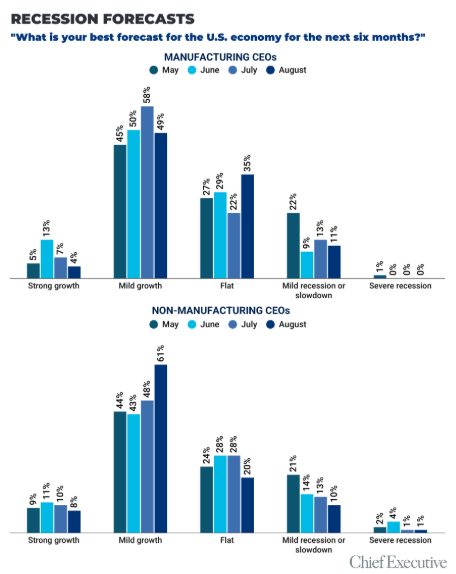
While overall CEO confidence has improved, their bullish expectations for the U.S. economy have notably cooled in August. Only 53 percent of manufacturing CEOs now forecast some form of economic growth over the next six months, a significant decrease from the 65 percent who held this view in July. This decline in growth optimism is largely attributable to a sharp increase in the proportion of manufacturers forecasting flat economic conditions. This segment grew by an alarming 59 percent month-over-month, rising from 22 percent to 35 percent. This indicates a growing segment of the manufacturing sector is bracing for stagnation rather than expansion.
Several CEOs attributed this hesitancy to predict growth to persistent inflationary conditions. Tim Zimmerman, CEO of Mitchell Metal Products, a mid-sized industrial manufacturing firm, stated, "Inflationary factors are leading to rapid and sustained price increases, which are squeezing our margins severely and pricing some of our products out of the market." This real-world impact of inflation demonstrates how rising costs can not only erode profitability but also directly affect market competitiveness by making products less affordable for consumers and businesses. The inability to consistently absorb or pass on these costs creates a precarious balance for many firms.
Conversely, fears of a recession appear to be gradually easing within the manufacturing sector. Only 11 percent of manufacturers are forecasting any kind of recessionary conditions, down from 13 percent in July. This slight decrease in recessionary sentiment, while still a concern for a notable portion of the sector, suggests that the immediate threat of a widespread economic contraction is perceived to be diminishing.
Interestingly, non-manufacturing sectors have moved in the opposite direction regarding economic growth forecasts. A significantly higher proportion, 69 percent, are now forecasting growth over the next six months, a sharp increase from 58 percent in July and the highest share recorded since May. This divergence highlights a potential differential in how manufacturing and service-based economies are perceiving and experiencing the current economic climate. Non-manufacturers also saw their recession fears ease, with the same proportion forecasting a slowdown as in the previous month.
International Exposure Creates a Bifurcated Outlook
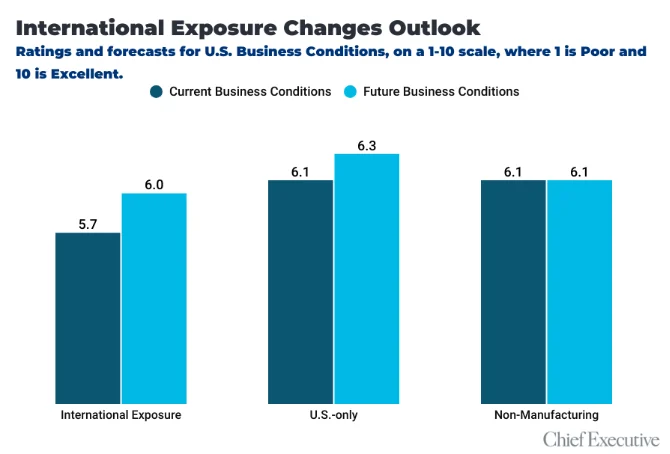
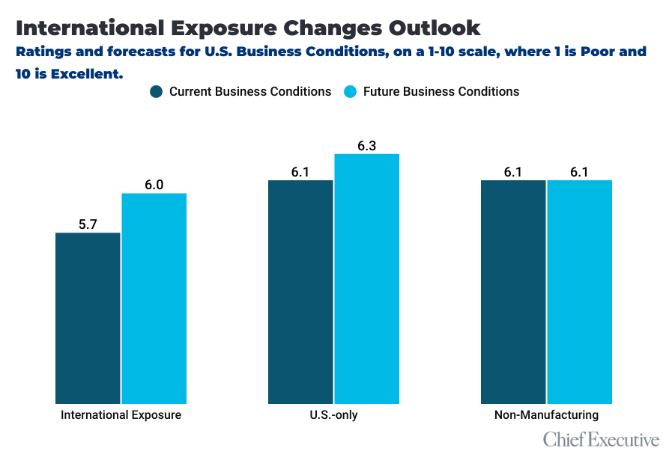
A persistent divergence in sentiment between manufacturers with significant international exposure and those solely focused on domestic operations continues to shape the sector’s overall outlook. Manufacturers operating on a global scale rated current business conditions at an average of 5.7 out of 10. In contrast, their domestic-exclusive counterparts reported a far more optimistic rating of 6.1 out of 10. This gap suggests that international complexities are presenting unique challenges that are not being experienced to the same degree by companies primarily serving the U.S. market.
Chris Boyd, CEO of Antebellum Manufacturing, a mid-sized consumer firm with U.S.-exclusive operations, offered a compelling explanation for this disparity, citing a phenomenon often referred to as "trade inversion." Boyd explained, "Tariffs on primary aluminum have driven the cost for aluminum more for domestic manufacturers than the 50 percent tariff on derivative products… imports are winning." In simpler terms, some manufacturers are being penalized more heavily by tariffs on the raw materials and intermediate goods they import than they are protected by tariffs on the finished products they export or compete with. This creates an uneven playing field where imported components become cheaper than domestically sourced ones, even for companies producing within the U.S.
Both domestically focused and internationally exposed manufacturers anticipate improvement over the next 12 months. However, U.S.-exclusive CEOs remain more optimistic about the future, forecasting business conditions to reach 6.3 out of 10 by this time next year. This compares to a slightly more conservative 6.0 forecast from internationally exposed firms. This persistent domestic-global gap throughout much of 2026 underscores the outsized impact that uncertainty surrounding trade policy, geopolitical volatility, and ongoing supply chain disruptions have had on firms with extensive global footprints. These external factors create a more complex and less predictable operating environment for companies with international operations.
Corporate Forecasts Remain Volatile
At the company level, manufacturers’ forecasts for their own businesses present a mixed picture in August, continuing a trend of month-to-month fluctuations. This volatility suggests that many CEOs are still struggling to formulate consistent and reliable long-term plans in the current unpredictable economic environment. The inability to establish a stable outlook can hinder strategic investments in capital expenditures, research and development, and workforce expansion, potentially impacting future growth and competitiveness. The granular data on corporate forecasts, while not detailed in the provided snippet, typically includes metrics such as expected revenue growth, capital expenditure plans, and hiring intentions. The lack of consistent positive trends in these areas indicates that while aggregate confidence may be rising, translating that into concrete, long-term business strategies remains a challenge.
About the CEO Confidence Index
Since its inception in 2002, Chief Executive Group has been diligently polling hundreds of U.S. CEOs across organizations of all types and sizes to compile the influential CEO Confidence Index data. This index serves as a crucial barometer, tracking the confidence levels in both current and future business environments. It is meticulously constructed based on CEOs’ direct observations of various economic and business components, offering invaluable insights into the sentiment and strategic outlook of the nation’s top business leaders. For more comprehensive information about the index and its historical data, readers are encouraged to visit ChiefExecutive.net/category/CEO-Confidence-Index/. This resource provides a deep dive into the methodologies, past findings, and broader trends that have shaped the landscape of American business leadership over two decades.
