

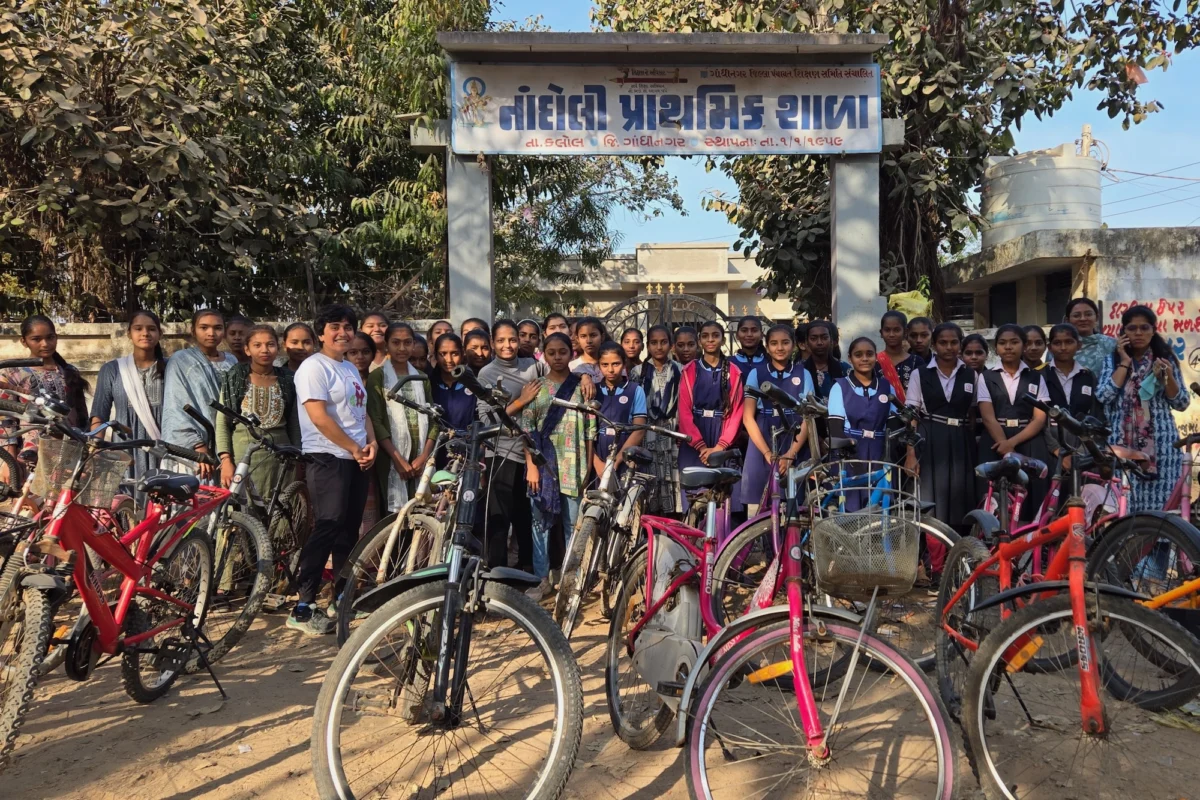
In the heart of rural India, where the paved roads often end and the journey to a classroom begins, a quiet revolution is unfolding on two wheels. Pragnya Mohan, recognized as India’s most decorated triathlete, has pivoted from the competitive world of international sports to address one of the most persistent socio-economic hurdles in the Indian subcontinent: the gender gap in secondary education. Through her initiative, Ek Beti, Ek Cycle (EBEC)—translated as "One Daughter, One Cycle"—Mohan is spearheading a mission to ensure that one million Indian girls complete their high school education by the end of the decade. By refurbishing discarded bicycles and placing them in the hands of students in underserved regions, the program is dismantling the barriers of distance, cost, and traditional gender norms.
The Crisis of Distance and the Gendered Dropout Rate
The educational landscape in rural India is marked by a sharp decline in female enrollment as students transition from primary to secondary school. While elementary schools are often located within the immediate vicinity of a village, high schools are frequently situated in larger hubs, sometimes up to 10 kilometers (over six miles) away. According to data cited by educational researchers, approximately 58 percent of girls in rural India do not complete their secondary education.

The reasons for this dropout rate are multifaceted but deeply rooted in logistics and economics. In many public school systems, while tuition, books, and uniforms are provided free of charge, the cost of the daily commute remains the responsibility of the family. In rural households, where every rupee is carefully accounted for, the monthly expenditure of 1,000 to 1,300 Indian rupees (approximately $12 to $15 USD) for private transport or rickshaws is often prohibitive.
Furthermore, traditional gender norms play a decisive role in mobility. While families may permit boys to travel long distances independently, safety concerns and cultural expectations often restrict girls’ movement. Without a reliable and safe way to reach distant schools, many girls are withdrawn from the education system once they finish their village-level schooling, effectively ending their prospects for higher education and professional careers.
From Athlete to Advocate: The Genesis of EBEC
Pragnya Mohan’s commitment to this cause is rooted in her own upbringing in Ahmedabad, Gujarat. Despite the challenges of balancing rigorous athletic training with academics, Mohan was able to travel 10 kilometers every morning for swimming sessions and school, thanks to a second-hand bicycle passed down from her sibling. This early experience of mobility provided the foundation for her career as a professional triathlete and a qualified Chartered Accountant, illustrating the transformative power of independent transport.

In November 2023, Mohan launched the first pilot of Ek Beti, Ek Cycle. The initiative began with a grassroots approach, with Mohan and her team campaigning door-to-door in Ahmedabad to solicit bicycle donations. The logic was simple: thousands of bicycles sit idle in urban households as children outgrow them or transition to motorized transport. By collecting, refurbishing, and redistributing these assets, EBEC could create a circular economy model that serves a profound social purpose.
A Sustainable Operational Model: Refurbishment and Training
The success of EBEC relies on a strategic partnership with MYBYK, India’s largest bicycle-sharing platform. This collaboration ensures that donated bicycles are not merely handed over in their current state but are professionally refurbished to ensure safety and longevity. Once restored, the bikes are transported to rural primary and secondary schools across the state of Gujarat.
The program’s implementation is a collaborative effort with local educators:

- Identification: School administrators identify girls who are most at risk of dropping out, particularly those transitioning to secondary school who face the longest commutes.
- Commitment: To receive a bicycle, students must commit to a multi-day workshop (usually lasting three to five days).
- Skill Acquisition: These workshops, led by EBEC volunteers, teach the girls how to ride with confidence, navigate road safety, and perform basic maintenance.
The inclusion of maintenance training is a critical component of the program’s sustainability. Mohan notes that the students often display "jugaad"—a Hindustani term for innovative, thrifty problem-solving. Girls have been observed customizing their bikes with baskets, ropes, and cloth strips to better carry their heavy school bags, and they frequently take the lead in repairing tires or adjusting chains, reducing the need for external technical support.
Psychological Transformation: Beyond Transportation
While the primary goal of EBEC is to improve school attendance, the secondary effects on the participants’ psyche are equally significant. For many of these girls, a bicycle represents their first taste of independent agency. "The bicycle is not just transport," Mohan explains. "It becomes a tool for independence, access, and confidence."
Feedback collected from teachers three months after the distribution of bicycles highlights several key improvements:

- Consistency: A marked increase in daily attendance and a reduction in tardiness.
- Physical Health: Improved stamina and a surge in interest in school sports and extracurricular activities.
- Classroom Engagement: Teachers report that the confidence gained from mastering a bicycle often translates into more vocal participation in academic settings.
The program also fosters a sense of community. Faster learners often stay behind after workshops to assist their peers, and former participants frequently return to mentor the next "wave" of cyclists. This peer-to-peer model makes the initiative increasingly self-sufficient, allowing EBEC to scale without a massive influx of permanent staff.
Scaling the Mission: Challenges and Future Expansion
After successfully impacting nearly 1,200 girls across Gujarat over the past two and a half years, EBEC is now entering its next phase of growth. The organization is expanding into Pune, a major city in the neighboring state of Maharashtra. However, scaling an initiative across India’s diverse landscape requires significant adaptation.
Unlike the relatively flat terrain of Ahmedabad, Pune is characterized by hilly inclines. This geographic shift necessitates a change in hardware; while single-speed bikes are easier to maintain in flat regions, the Pune expansion will require bicycles with multiple gears. Furthermore, Mohan is exploring the procurement of new bicycles alongside the refurbished fleet to meet the ambitious target of reaching one million girls by 2030.

The expansion also brings cultural and logistical challenges. In some regions, the primary hurdle is the poor quality of rural roads, while in others, it is the social stigma associated with girls cycling in public spaces. To combat this, EBEC relies on the existing credibility of local schools. By letting teachers and principals lead conversations with parents, the program builds the necessary trust to overcome traditional resistance.
Data-Driven Impact and Institutional Support
To ensure the program’s long-term efficacy, EBEC has partnered with the School of Public Health at Ahmedabad University. This collaboration aims to quantify the changes in the girls’ physical health, stamina, and academic performance. By providing empirical data on the link between mobility and educational outcomes, Mohan hopes to attract larger institutional partners.
The organization is currently in discussions regarding potential government collaborations. Such a partnership would provide the infrastructure needed to move beyond regional pockets and implement a national-scale program. Additionally, Mohan is seeking corporate social responsibility (CSR) partnerships with education and sports organizations to provide further opportunities for the girls, such as vocational training or athletic scholarships.

The Broader Socio-Economic Implication
The mission of Ek Beti, Ek Cycle aligns with broader global objectives, including the United Nations Sustainable Development Goal 4 (Quality Education) and Goal 5 (Gender Equality). In the context of India’s economy, the benefits of keeping one million girls in school are staggering. According to various World Bank studies, every additional year of secondary education for a girl significantly increases her future earning potential and reduces the likelihood of early marriage and poverty for the next generation.
By providing a simple, low-tech solution—the bicycle—Pragnya Mohan is addressing a high-stakes systemic failure. As the organization celebrates its second anniversary, the momentum is clearly building. For Mohan, the goal of reaching one million girls is not a distant dream but an inevitable milestone. "It’s just a matter of when, not if," she asserts. Through the steady rotation of pedals and the determination of rural students, the path to education in India is becoming shorter, one bicycle at a time.
