


Twelve, a prominent California-based carbon transformation company, has announced the successful acquisition of a credit facility totaling up to $45 million to bolster its operations and facilitate the expansion of its pioneering clean fuels infrastructure. This strategic financing is designated to refinance the construction facility of Twelve’s AirPlant One facility, located in Moses Lake, Washington, while simultaneously providing the necessary capital for continued site development and increased production capacity. As the aviation industry faces mounting pressure to decarbonize, this capital infusion represents a critical pivot for Twelve as it transitions from the construction phase of its first commercial-scale asset to a period of sustained operational growth and technological scaling.
The financing was led by Endurance Capital and Nomura, with the latter serving as the joint bookrunner and administrative agent. The move underscores a growing confidence among institutional lenders in the viability of power-to-liquid (PtL) technologies, which are increasingly viewed as the gold standard for long-term decarbonization in hard-to-abate sectors like commercial aviation.
The Technological Foundation: Carbon Transformation at Scale
Founded in 2015 by Dr. Etosha Cave, Dr. Kendra Kuhl, and Nicholas Flanders, Twelve has spent nearly a decade refining a process that essentially mimics photosynthesis but at an industrial speed and scale. The company’s proprietary technology utilizes a specialized CO2 electrolyzer to break down carbon dioxide and water, recombining them into the building blocks of essential chemicals and fuels.
The primary outputs of this process are E-Jet, a power-to-liquid sustainable aviation fuel (SAF), and E-Naphtha, a synthetic chemical feedstock. Unlike traditional biofuels, which often rely on agricultural waste, fats, or oils—resources that are limited by land use and food security concerns—Twelve’s E-Jet is produced using only captured CO2, water, and renewable electricity. This "power-to-liquid" approach allows for a virtually limitless supply of feedstock as long as carbon capture and renewable energy sources are available.
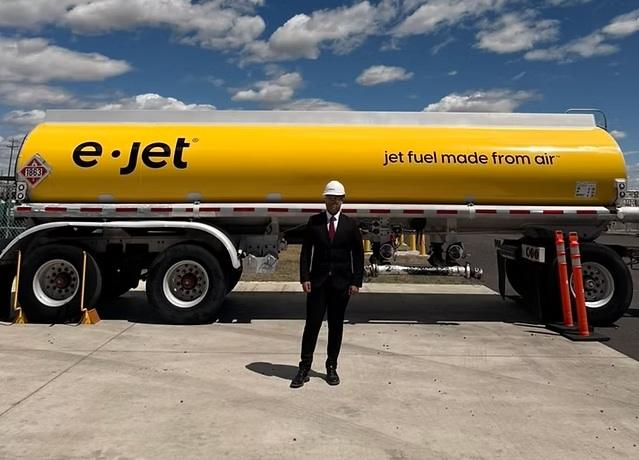
According to Twelve’s internal data, E-Jet fuel has the potential to reduce lifecycle greenhouse gas emissions by up to 90% compared to conventional petroleum-based jet fuel. Furthermore, because the process produces water and oxygen as its only significant byproducts, the environmental footprint of the manufacturing process itself is remarkably low.
AirPlant One: A Milestone in American Clean Energy
The financing specifically targets AirPlant One, which Twelve recently launched as the first commercial-scale facility in the United States dedicated to producing E-Jet fuel. Situated in Moses Lake, Washington, the plant benefits from the region’s robust hydroelectric infrastructure. By utilizing 100% hydropower, Twelve ensures that the "power" component of its power-to-liquid process is carbon-neutral, maximizing the overall emissions reduction of the final product.
AirPlant One is not merely a fuel refinery; it is a proof-of-concept for a new circular carbon economy. In addition to aviation fuel, the facility produces E-Naphtha. This synthetic building block is a drop-in replacement for petroleum-derived naphtha, used extensively in the production of plastics, textiles, and various consumer goods. By decoupling the production of these materials from fossil fuel extraction, Twelve is positioning itself as a diversified player in the broader green chemistry market.
The transition of AirPlant One to commercial operation is a significant de-risking event for the company. Nicholas Flanders, Co-Founder and CEO of Twelve, emphasized that the new credit facility is a direct result of the plant’s proven operational status. Flanders noted that the capital would be immediately deployed to scale hydrogen production capacity at the site, which is a critical precursor for the Fischer-Tropsch synthesis used to create complex hydrocarbons from CO2.
Financial Strategy and Institutional Support
The $45 million credit facility represents a sophisticated layer of Twelve’s capital stack. By refinancing construction debt into an operating credit facility, Twelve is optimizing its balance sheet and lowering its cost of capital. This is a common trajectory for successful "First-of-a-Kind" (FOAK) climate tech projects, which often face high interest rates during the risky construction phase before securing more favorable terms once the asset is operational.

The involvement of Nomura and Endurance Capital highlights the maturing relationship between the cleantech sector and global financial institutions. Alain Halimi, Managing Director at IPB Nomura, stated that the financing is aimed at "funding what’s next," acknowledging that Twelve has already cleared the primary hurdle of proving its technology works at scale. For Nomura, this partnership aligns with a broader institutional commitment to backing technologies that facilitate the global energy transition.
Chronology of Twelve’s Evolution
The journey to AirPlant One and the current financing round has been marked by steady technical and financial milestones:
- 2015: Twelve is founded at Stanford University, focusing on the development of an electrochemical reactor that can transform CO2.
- 2018-2020: The company moves from lab-scale prototypes to pilot projects, securing early-stage venture capital and government grants to refine its electrolyzer technology.
- 2021: The company rebranded from Opus 12 to Twelve and announced major partnerships with brands like Mercedes-Benz and Procter & Gamble to create CO2-based car parts and detergents.
- 2022: Twelve announces its focus on the aviation sector, launching E-Jet and securing a memorandum of understanding with major airlines and corporate partners like Microsoft and Shopify.
- 2023: Construction begins on AirPlant One in Moses Lake, Washington, marking the transition to commercial-scale manufacturing.
- 2024 (September): Twelve officially transitions AirPlant One to commercial operation and secures the $45 million credit facility to refinance debt and expand hydrogen production.
Contextual Analysis: The SAF Market and Regulatory Tailwinds
The aviation industry is responsible for approximately 2-3% of global carbon dioxide emissions. Because battery technology and hydrogen combustion are currently insufficient for long-haul commercial flights due to energy density limitations, SAF is widely regarded as the only viable pathway for the industry to reach its net-zero goals by 2050.
The International Air Transport Association (IATA) has estimated that SAF could contribute around 65% of the reduction in emissions needed by aviation to reach net zero. However, current global production of SAF meets less than 1% of the total jet fuel demand. This massive supply-demand gap creates a lucrative opportunity for companies like Twelve that can provide a scalable, high-integrity alternative to fossil fuels.
Regulatory frameworks in both the United States and Europe are further accelerating this market. In the U.S., the Inflation Reduction Act (IRA) provides significant tax credits for SAF production (under Section 45Z) and carbon capture (under Section 45Q). These incentives make domestic production of synthetic fuels more competitive with traditional kerosene. In Europe, the ReFuelEU Aviation initiative mandates that fuel suppliers ensure a minimum share of SAF at EU airports, starting at 2% in 2025 and rising to 70% by 2050, with specific sub-mandates for synthetic fuels (e-fuels) like Twelve’s E-Jet.

Implications and Future Outlook
The successful financing of AirPlant One has implications that extend far beyond Twelve’s balance sheet. It serves as a signal to the broader market that carbon transformation technology is ready for project-level debt financing, a necessary step for the massive infrastructure build-out required to meet global climate targets.
Twelve’s focus on increasing hydrogen production at the Moses Lake site suggests that the company is looking to maximize the efficiency of its carbon-to-fuel conversion. Hydrogen, produced via electrolysis of water, is the "energy carrier" that allows captured CO2 to be transformed into liquid fuel. By scaling this component, Twelve can increase the throughput of AirPlant One, improving the facility’s margins and proving the economic viability of the power-to-liquid model.
Looking ahead, Twelve’s roadmap likely involves the development of "AirPlant Two" and subsequent facilities, potentially located near concentrated sources of industrial CO2 or in regions with surplus renewable energy. The company’s ability to turn an environmental liability (CO2) into a high-value commodity (SAF and E-Naphtha) places it at the center of the emerging circular economy.
As Twelve continues to scale, the industry will be watching closely to see how the company manages the operational complexities of a full-scale refinery. However, with $45 million in new capital and a fully operational plant in Washington, Twelve has moved past the "valley of death" that claims many cleantech startups, positioning itself as a leader in the race to decarbonize the skies.
