

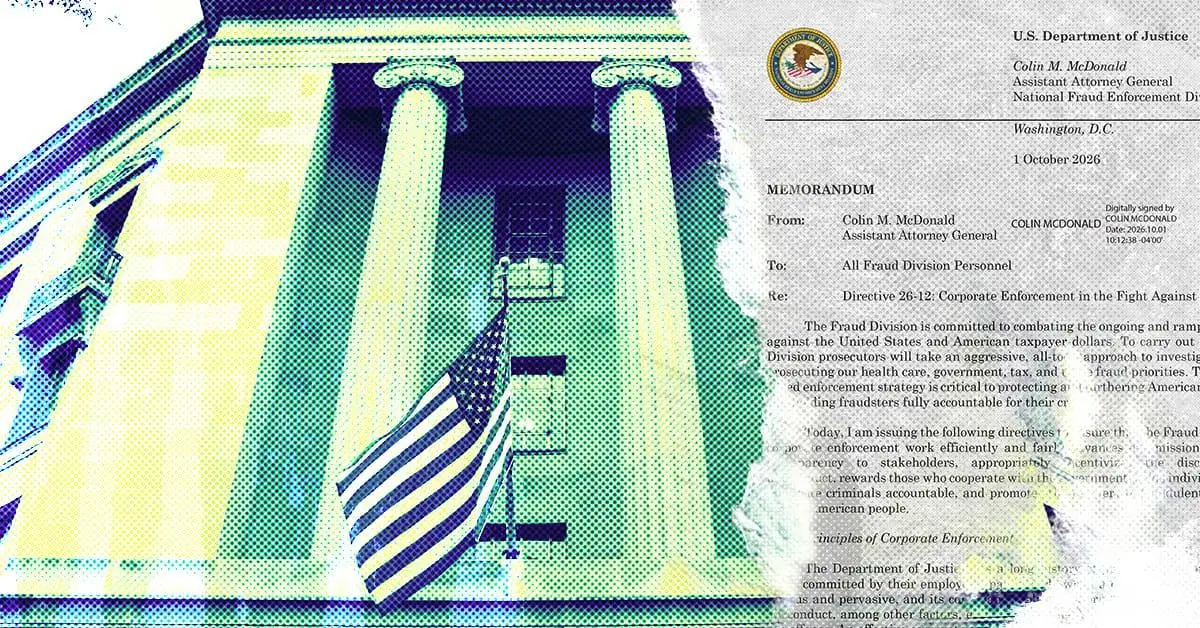
The United States Department of Justice’s newly established National Fraud Enforcement Division has released its most comprehensive public guidance to date for corporate fraud prosecutors, outlining a detailed framework for decision-making in corporate enforcement actions. This directive, issued by Assistant Attorney General Colin McDonald, provides prosecutors with ten key factors to meticulously consider when determining whether to pursue charges against a corporation, negotiate a plea agreement, or otherwise resolve a corporate case. The memo also mandates that all corporate cases within the division be reviewed by its dedicated Corporate Enforcement Section and signals an intensified focus on whistleblower incentives, potentially reshaping corporate compliance strategies nationwide.
The creation of the National Fraud Enforcement Division earlier this year, largely through the consolidation of units previously housed within the DOJ’s Criminal Division, sparked considerable interest due to the overlapping responsibilities with existing departments. However, the recent directive from McDonald offers a clear articulation of the division’s operational priorities and prosecutorial philosophy, aiming to bring greater consistency and transparency to corporate enforcement.
Experts in corporate compliance and white-collar defense suggest that while existing compliance programs may not require radical overhauls, this guidance necessitates a strategic reassessment of potential enforcement risks. Companies are advised to focus their efforts on areas highlighted by the memo and the division’s establishment, particularly those involving federal programs, government funding, and international trade.
"For companies with those touchpoints, the memo provides a useful roadmap of the conduct DOJ intends to scrutinize," Carla Baumel, a trial litigator at Robins Kaplan and former Assistant U.S. Attorney in the District of Minnesota, told Corporate Compliance Insights. This sentiment underscores the importance of aligning internal compliance efforts with the DOJ’s stated priorities.
A central tenet reinforced by the memo is the imperative for compliance programs to be more than just paper policies. The DOJ will continue to scrutinize the practical implementation of these programs, examining how companies identify, escalate, investigate, and respond to misconduct. "The new memo does not create a new compliance standard; it reinforces the existing message that DOJ will look beyond written policies to how a company identifies, escalates, investigates and responds to misconduct," stated Allen Slaughter, counsel at Robins Kaplan and a former federal prosecutor.
Fleshing Out the Enforcement Framework
The October 1st directive builds upon priorities initially outlined by Assistant Attorney General McDonald in August, which identified corporate misconduct as one of the division’s five core focus areas. While the August announcement offered a broad overview, the subsequent memo provides concrete factors for prosecutorial consideration, particularly within the division’s priority sectors: healthcare, government programs and procurement, revenue evasion, and international trade, which encompasses issues such as forced labor and tariffs.
Prosecutors are instructed to assign "great weight" to several factors when resolving corporate cases. These include the extent to which management was aware of or involved in alleged schemes, and whether the company actively attempted to conceal misconduct from government agencies or auditors. The memo also emphasizes the severity of harm, considering factors such as threats to American safety or security, significant financial detriment to taxpayer-funded programs, damage to multiple government programs, and schemes that divert funds to foreign adversaries or involve immigration offenses.
The directive introduces specific quantitative thresholds, signaling areas of particular concern. Conduct lasting at least three years, spanning at least three federal districts, or impacting at least 25 victims or causing at least $25 million in losses are identified as significant indicators for heightened scrutiny. However, legal experts caution against interpreting these figures as absolute "safe harbors."
"Companies should not mistake those numbers for safe harbors," Baumel warned. "The memo expressly describes the factors as non-exhaustive and preserves prosecutorial judgment. A scheme involving $24 million or lasting 35 months does not suddenly become insignificant. The thresholds give companies greater visibility into what DOJ considers significant – and should help compliance teams identify matters that warrant immediate escalation."
Slaughter further advised that the memo’s priorities should be understood by exposure, not solely by industry. "The practical exercise for compliance teams is… to identify where the company touches federal funds, federal programs, government revenue or the movement of goods into the United States," he explained. "Where those connections exist, the directive provides a fairly direct indication of both the conduct DOJ is targeting and the circumstances likely to elevate misconduct into a corporate enforcement matter."
Jacqueline Kelly, a partner at Boies Schiller Flexner and former federal prosecutor in the Southern District of New York, noted that the memo’s emphasis on prioritizing investigations from their inception, rather than solely on their resolution, could lead to a more focused corporate docket for the division. "This can be expected to affect the types of investigations that get opened at all, which legally have a low bar to initiate," Kelly observed. "We can expect this will result in fewer corporate investigations being opened."
The Imperative of Timely Disclosure
While the new memo does not fundamentally alter the rules governing self-disclosure of misconduct, it significantly amplifies the incentive for companies to ensure their disclosure mechanisms are robust and responsive. The National Fraud Enforcement Division is bound by the DOJ’s department-wide Corporate Enforcement Policy (CEP), which was introduced in March and offers the potential for declination of charges for companies that voluntarily self-disclose, fully cooperate, and engage in timely remediation, absent aggravating circumstances.
Two key elements within the DOJ’s strategy warrant particular attention: the increasing use of data analytics and the explicit instruction within the memo to develop enhanced whistleblower incentives.
The memo highlights the division’s proactive approach, noting its capacity to generate leads and initiate both corporate and individual investigations "at a rapid pace." This capability is bolstered by new resources, advanced technology, and sophisticated data analytics employed through its National Fraud Detection Center, established in April.
Furthermore, Assistant Attorney General McDonald has directed division leaders to design policies and programs specifically aimed at encouraging whistleblowers to report credible fraud information to the government. Crucially, these incentives are intended to extend even to individuals who may have participated in the misconduct themselves. The precise nature of these new incentives remains to be detailed.
The combined impact of advanced data analytics and expanded whistleblower incentives heightens the probability that the government will become aware of corporate misconduct independently, potentially before a company has the opportunity to self-disclose. This is a critical consideration under the CEP, as voluntary disclosure typically earns credit only if the DOJ was unaware of the wrongdoing. The policy’s exception for whistleblowers applies when an internal report is made, followed by a prompt self-report to the DOJ within 120 days. However, if an insider bypasses internal reporting and goes directly to the government, this window of opportunity for the company to receive credit for self-disclosure effectively closes. A review of enforcement actions by Corporate Compliance Insights earlier this year revealed that companies have frequently forfeited voluntary disclosure credit because a whistleblower, a press report, or a parallel investigation preempted their own disclosure.
"The details of that program have not yet been announced, but a company investigating potential misconduct has even less reason to assume it is the only one that knows about it," Baumel commented. Slaughter concurred, noting that additional incentives for reporting "could make the existing race for voluntary-disclosure credit even more difficult."
This intensified environment places a premium on the internal mechanisms for surfacing and addressing potential problems. Companies must ensure these systems are fully operational and effective before issues arise. "Compliance teams should examine whether significant allegations reach the right decisionmakers quickly and whether they can investigate them efficiently," Baumel advised. "Written policies only go so far. Companies need processes that allow them to investigate serious issues and make informed disclosure decisions quickly."
Jenelle Beavers, a managing director with Alvarez & Marsal Disputes and Investigations, emphasized the need for companies to revisit their whistleblower programs. "Firms should also revisit their whistleblower programs to ensure that they are robust, easily accessible to their employees and that information learned is processed and evaluated in a timely manner," she stated.
The Evolving Landscape of DOJ Enforcement
Assistant Attorney General McDonald’s October 1st memo represents a significant development in a series of rapid organizational changes within the DOJ this year. The genesis of the National Fraud Enforcement Division was announced by the White House in January, with Colin McDonald’s confirmation by the Senate following in March. An April DOJ memo formalized the transfer of key units from the Criminal Division, including the Health Care Fraud Unit, the Market, Government and Consumer Fraud Unit, and the Tax Section, into the new division. The division’s formal establishment via regulation occurred in August, coinciding with the renaming of the Criminal Division’s Fraud Section, historically a central hub for corporate criminal enforcement, to the White Collar and Corporate Enforcement Section.
This reorganization has involved the reallocation of personnel as well as functional responsibilities. McDonald’s August memo indicated that the National Fraud Enforcement Division would comprise approximately 500 attorneys and staff by late August, drawn from various DOJ components and U.S. Attorneys’ offices, with plans for further growth. In contrast, the Criminal Division’s former Fraud Section had around 200 lawyers in 2025. Consequently, other divisions within the DOJ have experienced staff reductions. For instance, the Criminal Division’s market integrity unit lost attorneys to the new division, and its Foreign Corrupt Practices Act (FCPA) unit, which saw a decrease in prosecutors from 32 in 2024 to 22 in 2025, also transferred some personnel to the healthcare and government fraud units now housed within the National Fraud Enforcement Division.
The Criminal Division retains its own corporate enforcement unit, meaning the DOJ now operates with two distinct groups undertaking similar work, including the evaluation of compliance programs and the oversight of corporate resolutions. While the department-wide CEP is intended to mitigate inconsistencies, Slaughter expressed a nuanced concern: "a more pressing question may be whether the two corporate-enforcement groups may develop different practical approaches within that common framework."
The implications of the memo’s directive for a seven-day inventory of ongoing corporate investigations remain subject to interpretation. Slaughter cautioned against drawing parallels to past DOJ reviews, such as the pause in FCPA enforcement last year which led to numerous case closures. "The better inference is that DOJ wants immediate visibility into its corporate docket," he suggested. "That could result in some cases being accelerated, narrowed, coordinated, redirected or closed, but it could just as readily result in additional resources being assigned to matters that fit the division’s priorities."
Civil fraud enforcement under the False Claims Act remains under the purview of the DOJ’s Civil Division. While the April memo provided a 120-day period for the DOJ to recommend whether non-criminal functions should be integrated into the new division, no outcome had been announced as of last month. "What we are already seeing is greater coordination across civil and criminal enforcement," Baumel observed. "For now, companies should prepare for parallel proceedings."
Regardless of the ultimate structure of the National Fraud Enforcement Division, Slaughter emphasized that the foundational principles for compliance teams remain unchanged. "The durable elements are familiar: effective internal controls, escalation, investigation, documentation, remediation and the ability to respond promptly when serious misconduct is identified," he concluded.
