

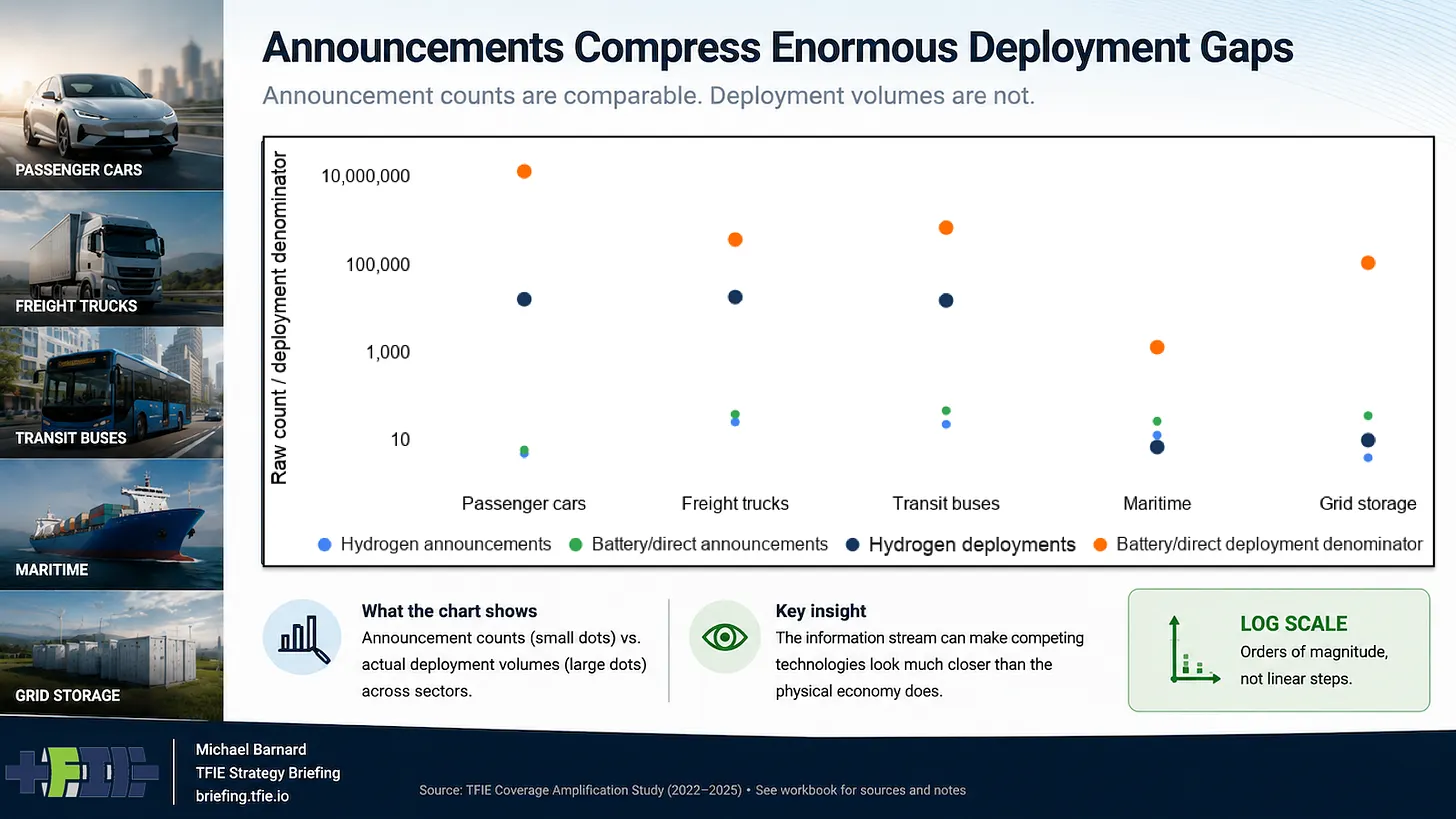
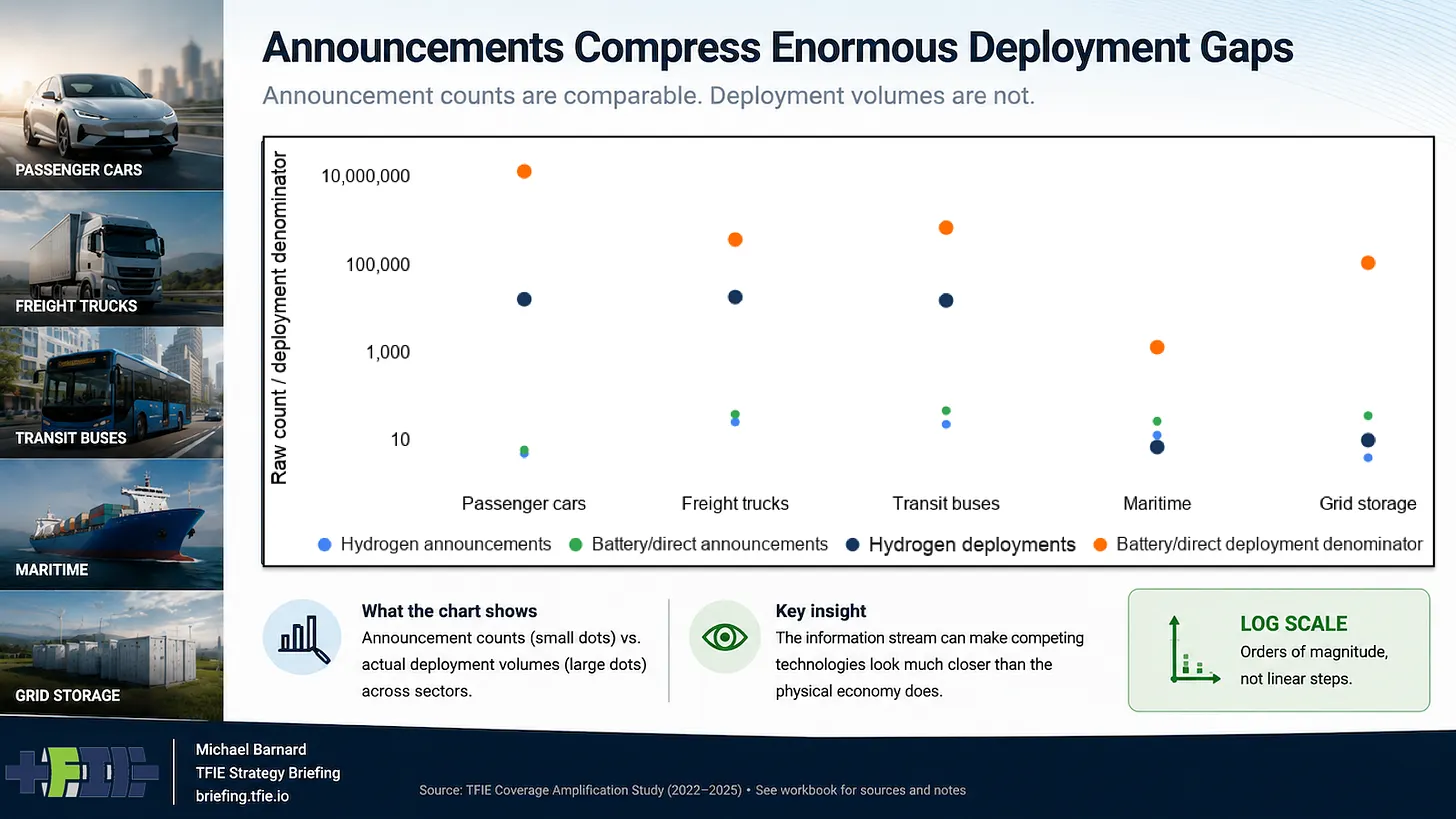
Hydrogen and electrification occupy surprisingly similar amounts of attention despite radically different levels of physical deployment, creating a distorted perception of the global energy transition. While the information stream suggests a neck-and-neck race between fuel cells and battery-electric technologies, a rigorous analysis of market data reveals a massive chasm between narrative density and industrial reality. From 2022 through 2025, the volume of corporate announcements and media reports regarding hydrogen milestones has remained disproportionately high, often masking the fact that direct electrification has already achieved a level of commercial maturity and scale that hydrogen has yet to approach.
The discrepancy begins with the sheer volume of media "milestones." A bounded register of positive news events across both sectors between 2022 and 2025 shows that battery-related announcements outnumbered hydrogen announcements by a ratio of only 1.8 to one—206 for batteries versus 114 for hydrogen. To a casual observer or a policymaker scanning headlines, this suggests that hydrogen is a substantial parallel pathway, trailing slightly but remaining a peer competitor to batteries. However, when these figures are compared against "physical denominators"—the actual number of vehicles on the road, ships on the water, or megawatts on the grid—the illusion of parity evaporates.
The Disparity in Heavy Transport and Transit
The freight and transit sectors provide the most striking examples of this narrative-deployment gap. In the realm of heavy-duty trucks, the announcement ratio remains remarkably close, at approximately 1.5 to one in favor of battery-electric vehicles (BEVs). However, the operational data tells a different story. By the end of 2025, China—the world’s leader in logistics electrification—boasted a fleet of roughly 366,000 electric heavy trucks. In contrast, the number of fuel-cell heavy trucks in operation was approximately 18,000. Despite the headlines suggesting a dual-track evolution for long-haul freight, the physical deployment of battery trucks is more than 20 times greater than that of their hydrogen counterparts.
A similar pattern emerges in the public transit sector. Media tracking shows 47 battery-related milestones compared to 23 for hydrogen. Yet, the physical reality is even more lopsided. In China alone, more than 680,000 electric buses are currently in operation, providing daily service across hundreds of cities. Globally, the number of fuel-cell buses remains a niche figure, hovering around 15,000. The "narrative density" of hydrogen buses—often characterized by small-scale pilot programs in European or North American cities—creates an impression of technological readiness that is not yet backed by the same economies of scale or operational ubiquity found in the battery sector.
Maritime and Grid Storage: The Invisible Giants
The maritime industry exhibits perhaps the most extreme version of this decoupling. News announcements regarding hydrogen-powered vessels are separated from battery-powered vessel news by a factor of only two to one. However, data from DNV’s operating-fleet registry reveals a staggering difference in actual deployment. As of 2025, there are more than 1,300 battery-equipped vessels currently in service, ranging from short-sea ferries to hybrid container ships. Conversely, the global fleet of hydrogen-fueled vessels stands at just seven. In this sector, the narrative suggests a burgeoning competition, while the physical deployment ratio is nearly 185 to one in favor of electrification.
Grid-scale energy storage follows a similar trajectory of statistical inflation. The information stream recorded four genuine hydrogen-storage announcement roots compared to 36 for battery storage—a nine-to-one difference in reporting. However, the market scale comparison is almost incomparable. In 2025, the global capacity for battery-storage additions reached approximately 108,000 MW. During the same period, hydrogen storage remained largely in the demonstration phase, with approximately 10 MW of capacity. While hydrogen proponents argue that hydrogen offers superior long-duration storage, the current market for power-related storage services is being dominated by batteries at a scale of roughly 10,800 to one.
The Psychology of the News Cycle: Event vs. Market
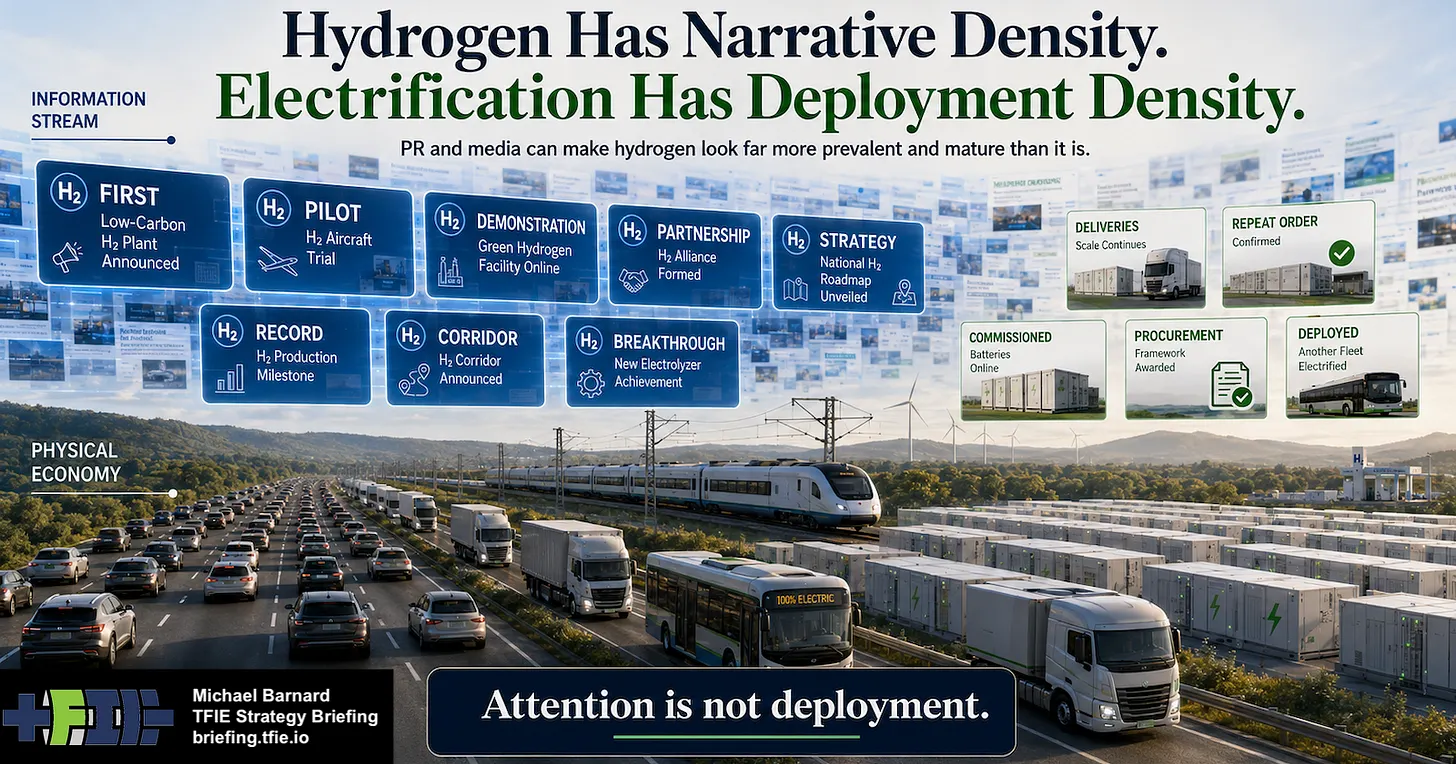
The reason for this distortion is not necessarily found in journalistic bias or corporate deception, but rather in the structural nature of news itself. Journalism is inherently organized around discrete, novel events. A "first-of-its-kind" hydrogen pilot project is, by definition, newsworthy. Conversely, the routine procurement of the 5,000th electric bus or the commissioning of yet another lithium-ion battery farm is seen as business-as-usual.
This "novelty bias" allows scarcity to sustain attention. Because hydrogen projects are relatively rare, each one—a single hydrogen train in a new country, a 10-truck pilot program, or a maritime demonstrator—receives significant coverage. Meanwhile, the massive, incremental growth of battery technology occurs through thousands of individual purchases and installations that no longer generate press releases.
A prime example of this phenomenon is the JCB Hydromax record-breaking car. This purpose-built hydrogen-combustion vehicle achieved a speed of over 406 mph at Bonneville. The event generated a massive cluster of media coverage, with 127 sources grouping around the story. While the achievement was a genuine engineering feat, its commercial denominator remained exactly one vehicle. There was no fleet, no customer utilization, and no underlying market evidence. The "exposure" multiplied, but the actual market for hydrogen combustion in passenger transport remained non-existent.
Commercial Maturity and the Scaling Ladder
To better understand the gap, analysts utilize a "commercialization ladder," a seven-stage metric ranging from initial R&D to full-scale market maturity. When analyzing the 2022-2025 sample, battery-related events averaged a score of 5.97, indicating they are firmly in the territory of scaled deployment and repeat procurement. Hydrogen events, by contrast, averaged 4.40, placing them largely in the demonstration and pilot phases.
The data shows that 82% of battery-related news events represented either scaled deployment or repeat orders from existing customers—signs of a healthy, maturing market. For hydrogen, only 40% of events fell into these categories. The majority of hydrogen news remains focused on "firsts": the first memorandum of understanding (MoU), the first prototype, or the first subsidized test run.
This distinction is critical for investors and policymakers. A successful demonstration is a valid form of evidence, but it is fundamentally different from commercial procurement. When the information stream treats these two types of events as interchangeable, it risks misallocating capital and delaying effective decarbonization strategies by chasing technologies that are still years, if not decades, away from the efficiency and cost-curves of established electric alternatives.
Chronology of the Narrative Shift (2022–2025)
The timeline of the last four years illustrates how hydrogen has maintained its narrative share despite battery dominance:
- 2022: The Policy Surge. Following the passage of the Inflation Reduction Act in the U.S. and the expansion of the European Green Deal, hydrogen announcements surged. Heavy subsidies for "Green Hydrogen" led to a wave of MoUs and theoretical project pipelines.
- 2023: The Reality Check. As interest rates rose, many large-scale hydrogen projects faced delays. However, the narrative remained buoyant through "record-breaking" demonstrations in aviation and heavy machinery, keeping hydrogen in the headlines despite slow Final Investment Decisions (FIDs).
- 2024: The Electrification Explosion. Battery prices dropped faster than anticipated, leading to the massive deployment figures seen in China’s trucking and bus sectors. While battery deployment scaled exponentially, hydrogen news focused on "hard-to-abate" sectors like shipping and steel.
- 2025: The Widening Chasm. By the end of 2025, the physical gap reached its zenith. While battery-electric cars surpassed 13 million in annual sales, hydrogen fuel-cell passenger vehicle sales remained a rounding error at 16,000.
Broader Implications and Stakeholder Reactions
The persistence of the hydrogen narrative has significant implications for global climate strategy. For the fossil fuel industry, hydrogen represents a way to repurpose existing pipeline infrastructure and maintain a role for gas (via "blue" hydrogen with carbon capture). This has led to accusations of "hydrogen washing," where the promise of a future hydrogen economy is used to justify continued investment in natural gas.

Conversely, proponents of direct electrification argue that the focus on hydrogen for light-duty transport and short-haul shipping is a distraction. They point to the "well-to-wheel" efficiency: batteries typically return 80-90% of the initial renewable energy to the wheels, whereas the process of electrolysis, compression, transport, and reconversion in a fuel cell often results in an efficiency of less than 30%.
For policymakers, the challenge is to practice "denominator discipline." This involves looking past the number of announcements and focusing on the actual units deployed and the cost per ton of CO2 averted. While hydrogen will undoubtedly play a crucial role in "hard-to-abate" sectors—such as ammonia production for fertilizer, high-heat industrial processes, and perhaps long-range aviation—the data suggests that for the majority of the transport and energy storage markets, the "race" has already been won by batteries.
In conclusion, the "narrative density" of hydrogen serves as a cautionary tale in the age of information. When news is organized around events rather than market scale, it can create a mirage of competition where one technology is already a global industrial powerhouse and the other remains a collection of promising, but isolated, experiments. Distinguishing genuine market formation from repeated publicity is now the most vital task for those navigating the complexities of the energy transition.
