

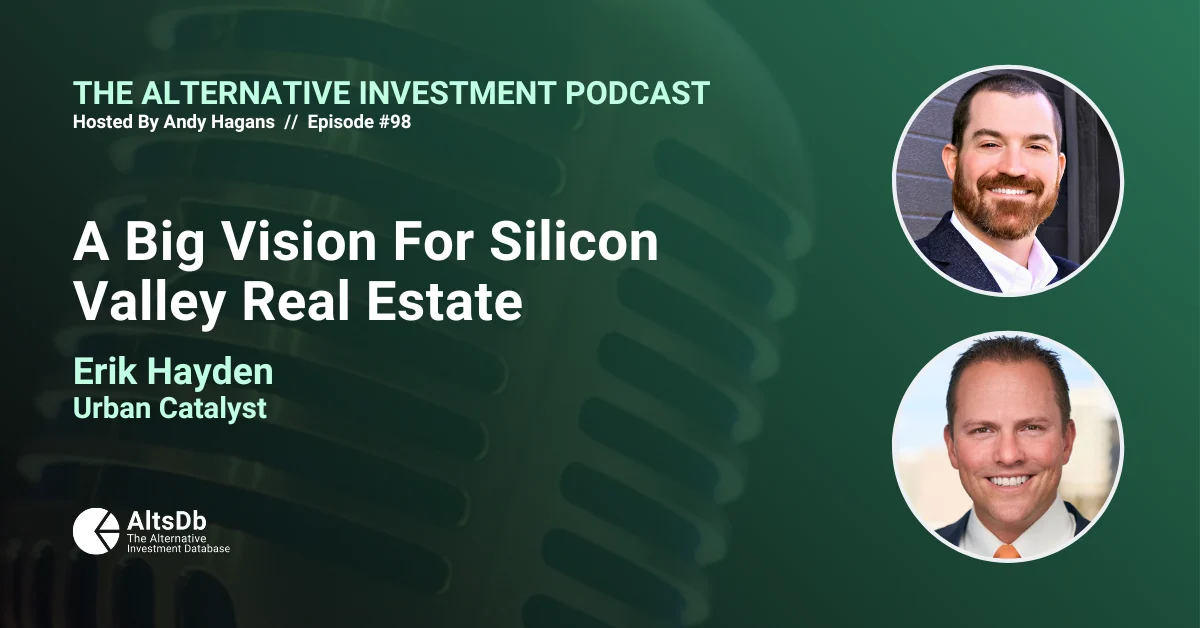
Silicon Valley, long recognized as the global epicenter of technological innovation, is demonstrating remarkable resilience and is projected to experience sustained economic growth for decades to come, challenging prevailing narratives of California real estate decline. Erik Hayden, founder of Urban Catalyst and a recognized influential figure in Silicon Valley, recently articulated this optimistic outlook, emphasizing the region’s potential for generating generational wealth for long-term real estate investors. His insights, shared during an interview on "The Alternative Investment Podcast," offer a counterpoint to widespread concerns about the state’s economic future.
Urban Catalyst, a real estate equity fund and development firm, has established a significant presence in the market through a combination of acquiring existing assets, managing properties, and undertaking ground-up development and rehabilitation projects. Hayden’s entrepreneurial journey into founding Urban Catalyst in 2018 was rooted in his extensive experience in ground-up development, particularly within the dynamic Silicon Valley landscape. He observed a pivotal shift occurring in downtown San Jose, recognizing it as the next logical expansion point for the region’s dominant tech companies.
The San Jose Renaissance: A Strategic Real Estate Play
Hayden’s strategic foresight centered on the migration of tech giants like Google, Apple, and Meta. While these companies’ global expansion is well-documented, their growth within the geographically constrained Silicon Valley necessitated a southward movement from established hubs like Palo Alto, Menlo Park, and Mountain View. As cities like Sunnyvale became increasingly built out, San Jose emerged as the prime candidate for continued development.
"If Palo Alto, Menlo Park, and Mountain View are kind of the center of the tech universe, they’re not really very big cities," Hayden explained. "So we’ve seen a lot of expansion… but in the Valley, we’ve seen the slow migration southward from that center of Silicon Valley, towards San Jose."
This observation proved prescient. In the years following Urban Catalyst’s inception, major tech firms have indeed acquired land, opened offices, and announced significant expansion plans in San Jose. This influx of corporate investment has catalyzed a wave of development in the downtown core.
Opportunity Zones: A Tax Advantage, Not the Primary Driver
Urban Catalyst’s strategy was significantly enhanced by the utilization of Opportunity Zones, a federal program designed to incentivize investment in economically distressed communities through tax benefits. While the company has achieved considerable success in fundraising within this framework, Hayden clarified that the decision to focus on San Jose was driven by its inherent real estate potential, not solely by the presence of Opportunity Zones.
"We wanted to be in San Jose, and San Jose was also an Opportunity Zone, and we became an Opportunity Zone fund, and it’s been working out pretty great for us," Hayden stated. "It wasn’t because it was an Opportunity Zone. It was because it was the right place to build buildings, to get returns, and to improve a city." The alignment of strategic development locations with Opportunity Zone designations provided a synergistic advantage, offering investors additional tax incentives on top of the projected returns from robust real estate development.
Entrepreneurial Vision: Building Big from the Start
Hayden’s approach to entrepreneurship and founding Urban Catalyst was characterized by a bold, large-scale vision from the outset. Unlike some entrepreneurs who build businesses incrementally, Hayden embarked on a significant undertaking from day one. This involved raising substantial seed capital, approximately $4.5 million, primarily from friends and family who believed in his established track record in development. This initial capital was crucial for covering significant startup costs, including legal fees for private placement memorandums (estimated at $300,000 for their first fund) and securing office space.
"The amount of work to build a hundred-million-dollar building or to flip a house is about the same amount of work. There’s just some extra zeros attached to the bigger buildings," Hayden commented, illustrating his philosophy of tackling large-scale projects. This perspective extends to fund management: "Raising a $20 million fund and successfully deploying it or raising a $200 million fund, or even a $2 billion fund, it’s the same amount of work, and it’s just more zeros attached to it."
Disrupting Fundraising: Digital Marketing in Real Estate
Urban Catalyst also distinguished itself by adopting innovative fundraising strategies. Facing initial reluctance from traditional broker-dealers and registered investment advisors who were hesitant to invest in a first-time fund, Hayden’s team pivoted to a direct-to-investor model leveraging digital marketing. By utilizing platforms like Google, LinkedIn, and Facebook, they successfully drove potential investors to their website, generating leads and securing $50 million in their first year. This approach, a departure from the norm in real estate fund marketing, proved highly effective and has since been emulated by others in the industry.
"We raised money directly from investors. And raising money directly from investors, in our first year, we raised $50 million, and we did it through a way that a lot of folks had never tried, which, of course, is digital marketing," Hayden explained. This strategy not only generated capital but also built a powerful brand, a concept that resonates with the principles of earned media and brand equity in the financial sector.
Challenging California’s "Doom and Gloom" Narrative
Despite negative perceptions often associated with California’s political and fiscal climate, Hayden presented compelling data to counter the "doom and gloom" narrative surrounding its real estate market. He highlighted that in 2021, California’s economy, if it were an independent nation, would rank as the fourth-largest globally, surpassing Germany. Silicon Valley, in particular, experienced one of its most prosperous years in 2021, with a surge in IPOs and venture capital funding that exceeded historical benchmarks.

"The city of Menlo Park, which has 45,000 people, had more venture capital funding than the entire state of Texas," Hayden noted, underscoring the region’s economic might. While acknowledging that some residents have relocated, he pointed out that California’s population has historically grown, with recent declines being marginal and offset by international immigration, attracted by the state’s climate and economic opportunities.
San Jose: An Expensive but Dynamic Housing Market
The housing market in Silicon Valley, particularly San Jose, is characterized by extreme costs. San Jose was recently ranked as the most expensive large city in the U.S. and fourth globally, with median home prices between $1.6 and $1.7 million. This scarcity is exacerbated by a significant mismatch between job creation and housing development; for every six jobs created, only one housing unit has been built over the past three decades. This severe housing shortage drives up construction costs, as a limited local workforce struggles to meet demand.
"We don’t have enough people that can afford to live here that build buildings," Hayden elaborated. "So when we get busy, there just aren’t enough people to build the buildings. And that’s what drives up the cost."
Urban Catalyst’s Development Pipeline: Diversification and Strategic Location
Urban Catalyst’s current Opportunity Zone Fund II features four diverse projects in downtown San Jose:
- Echo: A high-rise development comprising approximately 400 multi-family units.
- Icon: A substantial 500,000-square-foot office building.
- Keystone Hotel: A 172-key Marriott Townplace Suites.
- Gifford Place: A senior living facility offering assisted living and memory care services.
The company’s success in obtaining approvals for all eight of its projects across its two funds is a testament to its development expertise and strategic approach, particularly in navigating California’s complex regulatory environment. Hayden specifically praised the City of San Jose’s planning and economic development department for their proactive and supportive stance on urban development, especially within the downtown core, which is well-equipped with infrastructure and transit.
The "Icon" office building, in particular, is strategically positioned to benefit from Google’s massive "Downtown West" campus development. This ambitious $19 billion, 10-year project, slated to become Google’s largest global campus, encompasses 7 million square feet of office space and 6,000 residential units. Urban Catalyst’s proximity to this development is expected to generate significant positive synergy.
Addressing the Office Market’s Future
While the broader market has expressed concerns about the future of office spaces, Hayden remains cautiously optimistic about Silicon Valley’s office sector. He notes that even during the pandemic, the region maintained a strong office market, with robust transaction volumes and record prices. Although rents have seen minor adjustments and vacancy rates have slightly increased, major tech companies continue to sign substantial leases.
Hayden also pointed out that recent widespread media coverage of tech layoffs has not significantly impacted Silicon Valley’s overall employment landscape. Despite high-profile cuts at companies like Zoom, Meta, and Google, the number of layoffs in the region represents a small fraction of the total jobs created during the pandemic. Furthermore, unemployment rates remain low, and larger tech firms appear to be consolidating operations within Silicon Valley rather than undertaking massive regional reductions.
"The companies here have only laid off, like, 5% of the total amount of folks that they hired during the pandemic," Hayden stated, highlighting the resilience of the local labor market. "Our unemployment rate is now at 2%… We actually have more jobs now than we had six months ago, despite all the layoffs and headlines."
Expanding Horizons: Delaware Statutory Trusts (DSTs)
Urban Catalyst is also diversifying its investment offerings with the launch of a Delaware Statutory Trust (DST) product, focusing on an industrial property in Dallas, Texas. This move expands the company’s platform beyond its core focus on Opportunity Zones and Silicon Valley development.
"Delaware Statutory Trust, I mean, it fits right in our wheelhouse. Tax-advantaged real estate. That is what we do here at Urban Catalyst," Hayden explained. The DST, an income-producing, stabilized asset in Dallas, offers a lower risk profile compared to ground-up development, with built-in rent increases through a 10-year lease featuring a 3% annual escalation. This strategic choice aims to provide investors with consistent returns and a clear exit strategy. The Dallas-Fort Worth metroplex was selected for its strong population growth, status as a major industrial market, and proximity to a major freight cargo airport, meeting Urban Catalyst’s criteria for quality assets in "boom towns."
A Vision for Long-Term Wealth Creation
Erik Hayden’s perspective underscores a strategic approach to real estate investment that prioritizes long-term growth, innovation, and a deep understanding of market dynamics. By leveraging the inherent strengths of Silicon Valley, embracing innovative fundraising and development strategies, and carefully selecting high-growth markets, Urban Catalyst aims to facilitate generational wealth creation for its investors, challenging conventional narratives and demonstrating the enduring potential of well-positioned real estate.
For those interested in learning more about Urban Catalyst’s strategies and investment opportunities, the company’s website, urbancatalyst.com, serves as a comprehensive resource.
