

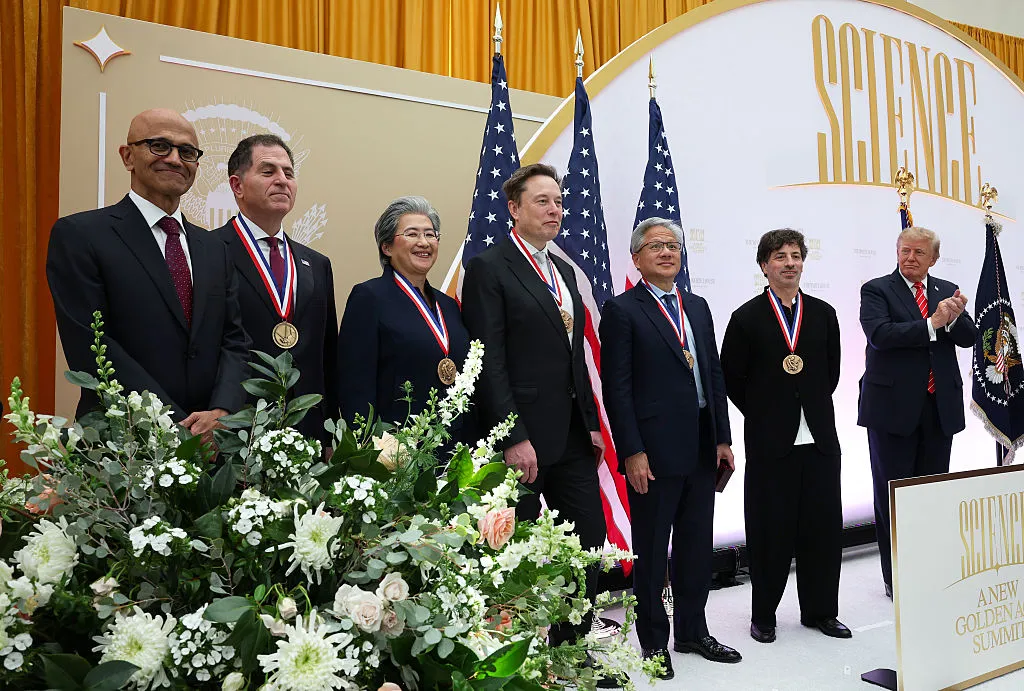
In a ceremony high in both symbolic and political significance, President Donald Trump presented the nation’s highest scientific and technical honors to a group of the world’s most influential technology executives on Thursday. The event, held during the inaugural Golden Age of American Innovation Summit, saw the conferral of the National Medal of Science and the National Medal of Technology and Innovation upon leaders from the semiconductor, aerospace, artificial intelligence, and software sectors. Among the recipients were Elon Musk, Jensen Huang, Sergey Brin, and Lisa Su, who received the National Medal of Science, while Michael Dell and Satya Nadella were honored with the National Medal of Technology and Innovation.
The ceremony, held in the East Room of the White House, marks a pivotal moment in the administration’s relationship with Silicon Valley. President Trump characterized the honorees as the architects of a new era of American dominance, stating that their contributions have helped "pioneer an incredible future for America." He emphasized a vision of American exceptionalism in the global tech race, asserting that because of the breakthroughs led by these individuals, the United States "will always be on top" and that "no one else can compete with us."
The Honorees and Their Contributions to American Industry
The selection of recipients reflects the administration’s focus on the "trinity" of modern technology: artificial intelligence, high-performance computing, and space exploration.
Jensen Huang, the CEO of Nvidia, was recognized for his role in the "AI Revolution." Under his leadership, Nvidia has transitioned from a niche graphics card manufacturer to the backbone of the global AI infrastructure. His work on GPU-accelerated computing is now the industry standard for training large language models and driving the computational power required for modern machine learning.
Dr. Lisa Su, Chair and CEO of AMD, received the National Medal of Science for her transformative leadership in the semiconductor industry. Her tenure at AMD is widely regarded as one of the most successful turnarounds in corporate history, pushing the boundaries of high-performance computing and adaptive silicon. Her inclusion highlights the administration’s strategic emphasis on domestic chip design and the "CHIPS" initiatives aimed at securing the microelectronics supply chain.
Elon Musk, whose portfolio includes SpaceX, Tesla, and xAI, was honored for his contributions to aerospace and renewable energy. The award specifically noted SpaceX’s achievements in reusable rocketry, which have drastically reduced the cost of access to space and re-established American autonomy in orbital launches.
Sergey Brin, co-founder of Alphabet (Google), was recognized for his foundational work in search technology and his more recent explorations into "moonshot" projects that push the limits of computer science and biology.
In the category of Technology and Innovation, Michael Dell, founder of Dell Technologies, was cited for his decades of work in democratizing access to personal computing and enterprise infrastructure. Satya Nadella, CEO of Microsoft, was honored for his leadership in cloud computing and the integration of AI into global productivity software, a move that has redefined the corporate landscape over the last decade.
Financial Contributions and Political Context
The awards have drawn scrutiny from political analysts and watchdog groups due to the significant financial ties between the recipients and the current administration. According to data compiled by The New Republic, the individuals and companies represented on the stage have collectively donated nearly $6 billion to various efforts tied to President Trump and his administrative priorities.
The nature of these contributions varies across the spectrum of the honorees. Microsoft and Alphabet, the parent company of Google, reportedly made substantial donations to the president’s inauguration fund and contributed to the refurbishment of the White House ballroom. Advanced Micro Devices (AMD) reportedly contributed to a pro-Trump Super PAC during the previous election cycle.
Perhaps the most significant financial commitment came from Michael and Susan Dell, who pledged $6.25 billion to help fund "The Trump Accounts." This administration-led initiative is designed as a national savings and investment program for American children, intended to provide a financial foundation for the next generation of citizens. The scale of this pledge has been described by some as a new model of public-private partnership, while others view it as a deepening of the ties between the executive branch and the nation’s billionaire class.
The Paradox of Policy: The H-1B Suspension
The ceremony was not without its internal contradictions, particularly regarding the administration’s stance on high-skilled labor. Satya Nadella, an immigrant who rose to lead one of the world’s most valuable companies, received his medal just as the administration announced an indefinite suspension of Microsoft’s participation in the H-1B visa program.

The H-1B program is a critical tool for U.S. technology firms, allowing them to hire specialized foreign workers in fields where there is a perceived domestic talent shortage. The administration’s decision to suspend Microsoft from the program—reportedly as part of a broader "America First" labor policy—highlights the tension between the government’s desire to celebrate tech innovation and its commitment to restrictive immigration and labor practices. Industry analysts suggest that while the medals celebrate individual achievement, the underlying policy shifts may create long-term challenges for the very companies these leaders represent.
Chronology of the Golden Age of American Innovation Summit
The summit began on Wednesday with a series of closed-door briefings involving the honorees, Cabinet members, and Department of Defense officials. The discussions reportedly centered on the "National AI Strategy" and the acceleration of the "Space Force" initiatives.
On Thursday morning, a roundtable discussion titled "Securing the Silicon Frontier" was held at the Eisenhower Executive Office Building. Dr. Lisa Su and Jensen Huang provided insights into the global semiconductor shortage and the steps necessary to move manufacturing back to U.S. soil.
The main event commenced at 3:00 PM PDT in the East Room. Following a brief musical performance by the United States Marine Band, President Trump delivered a 20-minute keynote address outlining his vision for the "Golden Age of American Innovation." He then personally draped the medals around the necks of each recipient.
Following the ceremony, a gala dinner was held for the honorees and approximately 200 guests, including leaders from the venture capital community and the heads of several national laboratories.
Broader Economic and Geopolitical Implications
The awarding of these medals is widely seen as a geopolitical signal. By elevating the leaders of the AI and semiconductor industries, the Trump administration is signaling to global rivals—most notably China—that the United States intends to maintain a firm grip on the "high ground" of 21st-century technology.
The focus on "The Trump Accounts" and the Dell family’s $6.25 billion pledge also suggests a shift in how the administration intends to fund social programs. By leveraging the wealth of the tech sector for domestic savings programs, the administration is attempting to create a legacy of "entrepreneurial governance." However, critics argue that this creates a "pay-to-play" atmosphere where national honors and policy influence are closely tied to philanthropic or political contributions.
From an economic perspective, the endorsement of these tech giants comes at a time when the sector is facing increasing antitrust scrutiny globally. By bestowing these awards, the President has effectively cast these companies as national champions, potentially complicating efforts by domestic or international regulators to curb their market power.
Historical Context of the National Medals
The National Medal of Science was established by Congress in 1959 and is administered by the National Science Foundation (NSF). It is intended to honor individuals who have made outstanding contributions to knowledge in the physical, biological, mathematical, or engineering sciences.
The National Medal of Technology and Innovation, established in 1980, is the highest honor the United States can confer for technological achievement. It is awarded to those who have made lasting contributions to America’s competitiveness, standard of living, and quality of life through technological innovation.
Historically, these awards have been relatively insulated from partisan politics, often awarded to academic researchers and career scientists. The 2026 ceremony represents a shift toward honoring high-profile corporate leaders, reflecting the administration’s belief that the private sector is the primary engine of scientific advancement in the modern era.
As the Golden Age of American Innovation Summit concludes, the tech industry remains divided on the administration’s approach. While the recognition of these leaders’ immense contributions is widely applauded, the backdrop of restrictive labor policies and the massive financial ties to the administration continue to spark debate over the future of the relationship between Silicon Valley and Washington D.C. For now, the recipients stand as the faces of an American tech landscape that is increasingly intertwined with the political and economic vision of the current presidency.
