


The Commonwealth of Massachusetts is currently at a legislative crossroads as state lawmakers attempt to balance the urgent need for a modernized electrical grid with the equally pressing demand for lower utility costs. Throughout the current legislative session, both the Massachusetts House of Representatives and the State Senate have advanced significant energy packages—S.3166 and H.5175—designed to overhaul the state’s energy infrastructure. While these bills contain a variety of provisions aimed at streamlining clean energy adoption, a contentious debate has emerged regarding the implementation of mandatory fixed charges on utility bills. Critics argue that these charges could inadvertently penalize low-income residents and those who have invested in energy efficiency, potentially undermining the state’s broader climate and affordability goals.
The Legislative Landscape: S.3166 and H.5175
The push for energy reform in Massachusetts comes at a time when the state faces some of the highest electricity prices in the United States. New England’s reliance on imported natural gas and the complexities of its regional wholesale market have made utility bills a significant burden for both residential and commercial consumers. In response, the House and Senate have passed competing versions of an omnibus energy bill.
The Senate’s version, S.3166, focuses heavily on "affordability" and "clean energy," emphasizing the need for flexible interconnection—a technical process that allows new energy sources, like community solar or battery storage, to plug into the grid more efficiently. On the other side, the House version, H.5175, addresses many of the same issues but includes different mechanisms for siting and permitting of energy infrastructure.

Both bills share common ground on several "smart reforms." These include:
- Modernized Residential Solar Permitting: Reducing the bureaucratic hurdles that homeowners face when trying to install rooftop solar panels.
- Retail Storage Programs: Encouraging the deployment of battery storage systems at the residential and commercial levels to manage peak demand.
- Flexible Interconnection: Allowing the grid to handle variable energy inputs from renewable sources without requiring massive, immediate infrastructure upgrades.
Despite these points of agreement, the bills are currently being reconciled in a conference committee, where the debate over "fixed charges" has become a focal point of concern for consumer advocates and the clean energy industry.
Understanding the Fixed Charge Controversy
A "fixed charge" is a flat fee applied to a utility bill regardless of how much electricity a customer consumes. Currently, the majority of an electric bill in Massachusetts is "volumetric," meaning it is based on the total kilowatt-hours (kWh) used. Under the proposed changes, a portion of the utility’s operational costs would be shifted from the volumetric rate to a mandatory fixed fee.
Proponents of fixed charges, often utility companies, argue that these fees are necessary to ensure that all customers contribute to the maintenance of the physical grid infrastructure, such as poles and wires. They suggest that as more affluent customers install solar panels and reduce their "grid-sourced" electricity, the burden of maintaining the grid falls disproportionately on those who cannot afford solar.

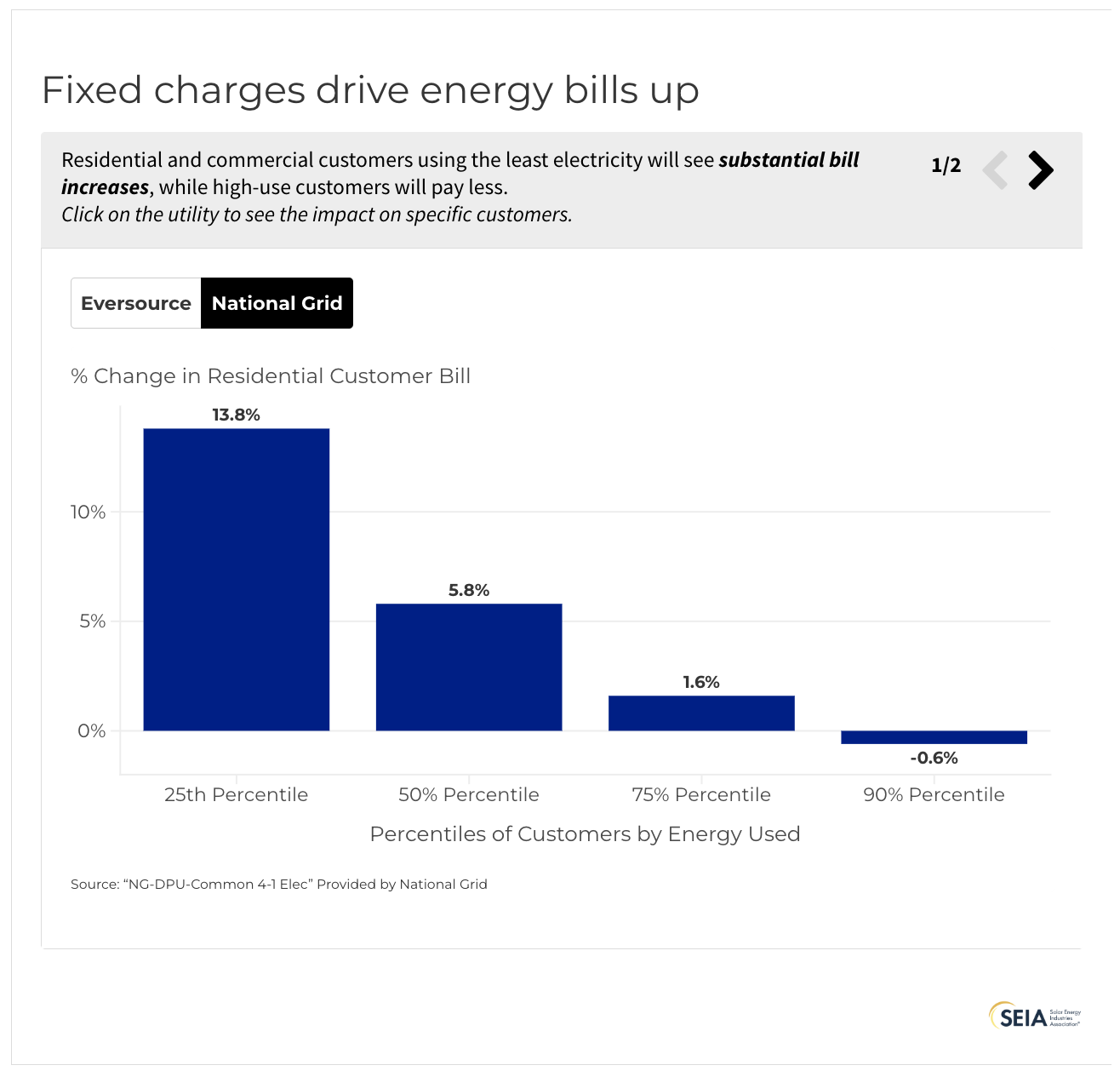
However, a broad coalition of environmentalists, low-income advocates, and the Solar Energy Industries Association (SEIA) contends that this logic is flawed. They argue that shifting to fixed charges creates a "regressive" billing structure. In this scenario, the smallest energy users—often those living in apartments, low-income households, or those who have invested heavily in energy efficiency—would see their bills rise. Conversely, the largest energy users, who typically have larger homes and higher disposable incomes, would see their total costs decrease as the per-unit price of electricity drops in favor of the flat fee.
Data Analysis: The Impact on Massachusetts Ratepayers
To understand the potential impact of these charges, analysts have looked at the customer bases of the state’s two largest utilities: Eversource and National Grid. Together, these companies serve nearly 3 million customers across the Commonwealth.
Data provided by SEIA regarding Eversource’s 1.4 million customers suggests that a shift toward higher fixed charges would result in a significant wealth transfer from low-usage households to high-usage households. According to the analysis, customers in the lowest tier of electricity consumption could see a noticeable percentage increase in their monthly bills, even if they use no electricity at all during a given period.
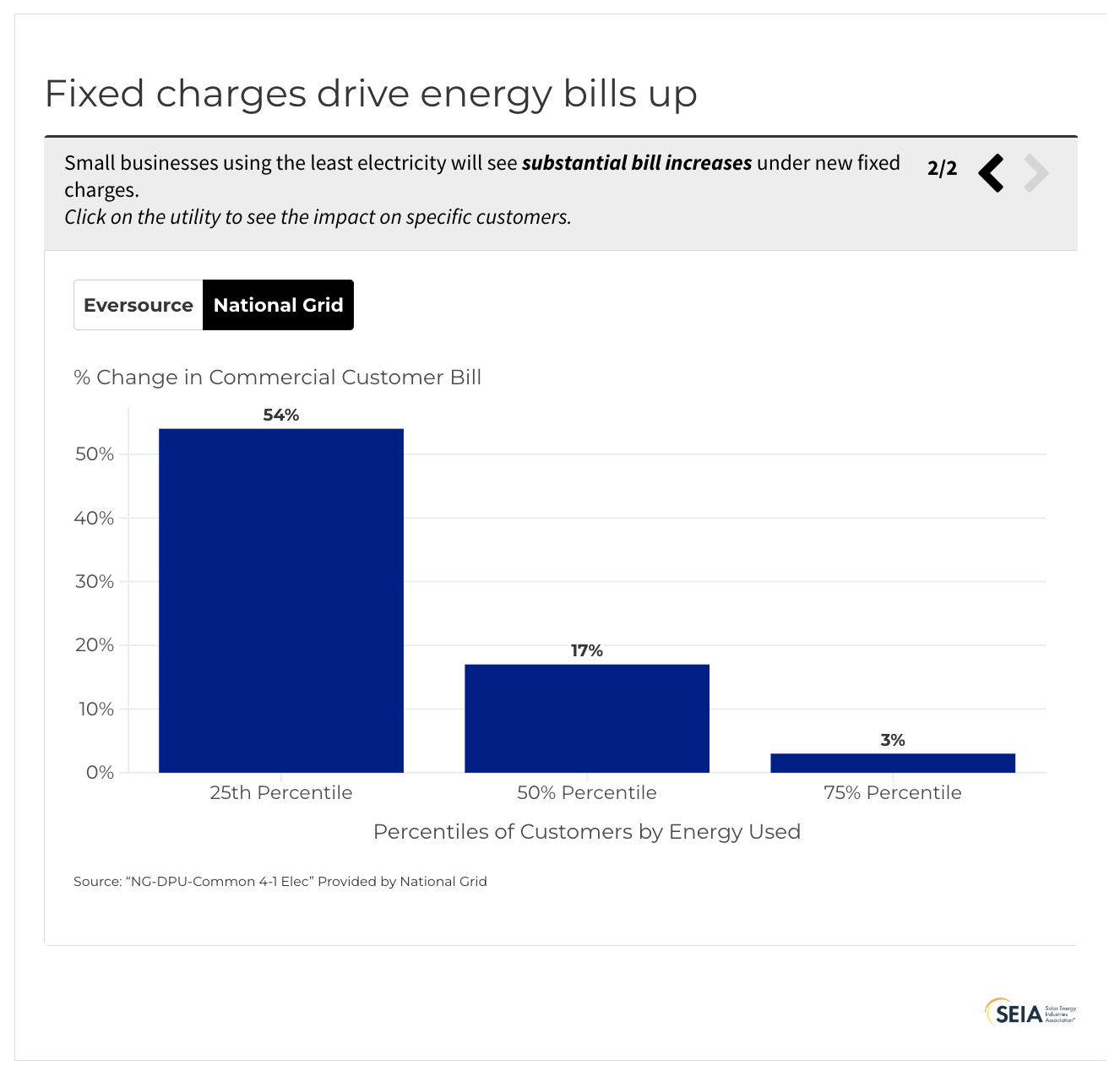
The situation is even more pronounced for National Grid’s 1.3 million residential and commercial customers. The review of National Grid’s data indicates that residential customers in the lowest usage bracket would experience an average bill increase of approximately 13.8%. Meanwhile, the "biggest users"—those with high consumption patterns—would see their bills reduced. This data suggests that the policy would effectively subsidize the energy consumption of large estates and energy-intensive businesses at the expense of energy-conscious or low-income residents.
Disincentivizing the Transition to Clean Energy
Beyond the immediate financial impact on ratepayers, fixed charges pose a strategic threat to Massachusetts’ climate goals. The Commonwealth has committed to reaching Net Zero greenhouse gas emissions by 2050. Achieving this requires a massive shift toward energy efficiency and distributed energy resources (DERs) like rooftop solar and battery storage.
When a utility bill is primarily volumetric, a customer has a strong financial incentive to reduce their consumption. Every kilowatt-hour saved through a more efficient refrigerator or a new solar array results in a direct reduction in their bill. However, when a significant portion of the bill is fixed, the "payback period" for clean energy investments increases.
If a homeowner installs a $20,000 solar system but is still forced to pay a high monthly fixed charge regardless of how much power they generate, the financial logic of the investment begins to erode. This undermines Governor Maura Healey’s recent Executive Order, which aims to accelerate the deployment of affordable and reliable solar and battery storage. Critics argue that the legislature should not pass laws that work at cross-purposes with the administration’s executive actions.
Chronology of the Regulatory Review
The debate in the legislature is occurring alongside a formal regulatory process. In late 2025, the Massachusetts Department of Public Utilities (DPU) opened a comprehensive review of all delivery charges on electric and gas utility bills. This review is intended to be a data-driven investigation into how utility rates should be structured to meet the state’s evolving needs.

- Late 2025: The DPU initiates a review of rate designs, inviting public comment.
- Early 2026: A diverse coalition, including the Low-Income Energy Affordability Network (LEAN), consumer advocacy groups, and clean energy trade associations, files comments opposing mandatory fixed charges.
- Spring 2026: The DPU acknowledges the complexity of the issue, stating it will "carefully evaluate" the impact on different customer classes before making a determination.
- Mid-2026: The House and Senate pass their respective energy bills, with the fixed charge mandate becoming a point of contention in the conference committee.
The DPU has cautioned that a legislative mandate for fixed charges would bypass the rigorous, evidence-based analysis that the department is currently conducting. By mandating the outcome before the DPU completes its study, lawmakers risk implementing a policy with unforeseen negative consequences for the state’s most vulnerable populations.
Broader Implications and Regional Context
The outcome of the Massachusetts energy bill will likely serve as a bellwether for other states in the Northeast. New England’s grid is deeply interconnected through ISO-New England, the regional grid operator. As states like New York and Connecticut also grapple with high energy costs and aggressive decarbonization targets, they are watching the Massachusetts experiment closely.
If Massachusetts successfully implements a policy that lowers costs through flexible interconnection and storage without resorting to regressive fixed charges, it could provide a blueprint for the rest of the region. Conversely, if fixed charges are mandated and lead to a backlash from low-income voters and a slowdown in solar adoption, it could stall the regional transition to a cleaner grid.
The "utility death spiral" is a term often used in energy circles to describe the phenomenon where customers leave the grid or reduce usage, forcing utilities to raise rates on remaining customers to cover fixed costs, which in turn encourages more customers to leave. While fixed charges are intended to prevent this, many energy economists suggest that a better solution lies in "decoupling" utility profits from total sales and incentivizing utilities to become partners in the clean energy transition rather than mere sellers of electricity.
Conclusion: The Path Forward for the Conference Committee
As the conference committee works to reconcile S.3166 and H.5175, the Healey Administration and legislative leaders face a critical choice. The bills already contain a wealth of positive reforms that could provide genuine relief to ratepayers. By focusing on cutting red tape for solar permitting, expanding battery storage incentives, and modernizing interconnection rules, Massachusetts can lower costs by making the grid more efficient and resilient.
The consensus among consumer advocates and clean energy experts is that the legislature should allow the DPU to finish its expert review. Rather than mandating fixed charges, the final bill could empower the DPU to consider all rate design options—including "time-of-use" rates, which charge more during peak hours and less during off-peak hours—to see which model best serves the public interest.
Ultimately, the goal of Massachusetts’ energy policy is to create a system that is clean, reliable, and, most importantly, affordable. As the final version of the bill heads toward Governor Healey’s desk, the challenge will be ensuring that the pursuit of grid stability does not come at the expense of the very residents the legislation is intended to help.
