

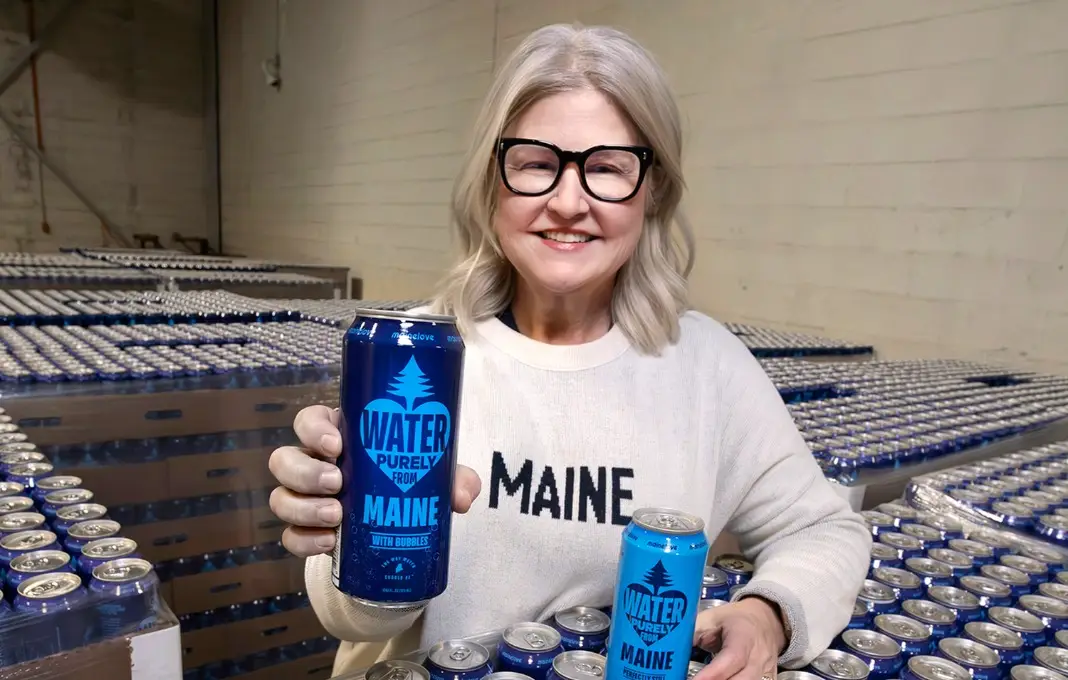
The craft beer industry in Maine, once a vibrant and growing sector, has recently faced a significant headwind: declining alcohol consumption. This downturn has left many local breweries with idle brewing capacity for days at a time, a scenario that CEO Jen Millard recognized as a significant untapped opportunity. Millard’s innovative solution, the canned water company mainelove, has not only revitalized unused brewery resources but has also created a new economic engine for the state, keeping more of Maine’s renowned water resources and their associated value within its borders.
The Genesis of mainelove: An Ingenious Partnership
Jen Millard, a proud 12th-generation Mainer, harbored a long-held desire to establish a business within her home state. The precise opportunity presented itself in early 2024 during a visit to her cousin, Frank Grondin, owner of Brickyard Hollow brewery. Observing the brewery’s quiet periods, Millard learned that production schedules often left significant downtime. This observation, coupled with her awareness of declining alcohol consumption trends impacting breweries nationwide, sparked an idea. Research revealed this was not an isolated issue; similar underutilization of brewing facilities was prevalent across Maine’s robust craft beer scene.
At the same time, Millard understood that a key differentiator for Maine’s acclaimed beers was the exceptional quality of its water, particularly from sources like Sebago Lake. This realization led to a pivotal "aha" moment: why not leverage this prime water source by canning it, thereby offering breweries a diversified revenue stream and an alternative to idle equipment? Maine boasts a high concentration of breweries drawing from this same pristine water, positioning them as a natural network of potential water producers. This insight formed the bedrock of mainelove’s "asset-light" business model.
"We’re not pretending to save the beer industry," Millard stated in a recent interview, "but we can create a new opportunity for them." This sentiment underscores the collaborative spirit behind mainelove, aiming to enhance, rather than disrupt, the existing ecosystem.
An Asset-Light Model: Efficiency and Economic Retention
mainelove’s operational model is designed for maximum efficiency and minimal capital expenditure. The company provides the proprietary drink formulas, procures the aluminum cans, and delivers these materials to its partner breweries. These breweries, in turn, utilize their idle brewing facilities to produce and can the mainelove water products, including still water, sparkling water, and a range of flavored seltzers. Following production, the finished goods are returned to mainelove’s dedicated warehouse for distribution.
A critical aspect of this partnership is adherence to stringent Good Manufacturing Practices (GMP) required for food-grade manufacturing, a standard mandated by the FDA for water as a food product. This ensures the highest quality and safety for all mainelove offerings.
Millard views this arrangement as an evolution of the breweries’ roles, transforming them into sophisticated co-packers. mainelove compensates its brewery partners on a co-pack-style rate, a model that resonates with Maine’s established cooperative traditions seen in industries like lobster and oyster harvesting. This approach allows breweries to generate income during their off-peak beer production times.
The economic advantages of this model are substantial. Canning water requires less water input compared to brewing beer, as there is no significant liquid evaporation due to boiling. This efficiency translates to cost-effectiveness and a direct contribution to maintaining and creating jobs within Maine’s beverage manufacturing sector. The core objective is to enable breweries to retain their workforce, honor the integrity of their water sources, and actively support the long-term preservation of the watershed.
A Commitment to Conservation and Community
Beyond its economic benefits, mainelove is deeply committed to environmental stewardship. A significant portion of the company’s profits is dedicated to supporting local land trusts. This commitment stems from the understanding that protecting the surrounding forests is paramount to safeguarding the health and purity of Sebago Lake and its watershed. This integrated approach—community-driven, job-creating, and environmentally conscious—defines mainelove’s unique business philosophy.
"Taken together, it is a beautiful model: community-driven, job-creating, environmentally aware—and asset-light," Millard emphasized.
Investor Appeal: Growth Without Capital Burden
From an investor’s perspective, mainelove’s asset-light structure is particularly attractive. Millard’s personal ownership of minimal equipment, beyond a forklift, and the company’s use of rented warehouse space in Westbrook, Maine, significantly reduces overhead. This strategic decision allows capital that would typically be tied up in manufacturing facilities to be redirected towards crucial growth initiatives, such as promotions, sales, and marketing—essential components for success in the competitive beverage market. This financial agility positions mainelove for rapid expansion.
Scalability and National Ambitions
The scalability of mainelove’s model is proving to be exceptionally robust. The first year of operations focused on establishing a strong distribution network within Maine, where the brand has rapidly secured placement in over 600 retail locations. The company’s reach has since expanded to five Northeastern states: Maine, New Hampshire, Massachusetts, and Vermont.
A significant expansion into Florida is slated for the fall, a market presenting a particularly compelling opportunity. Maine holds a positive brand perception in Florida, especially among seasonal residents who travel between the two regions. Furthermore, Florida faces considerable water quality challenges in many of its communities, making the proposition of high-quality, Maine-sourced water highly appealing. The ease of licensing in Florida, achieved in a single day, underscores the market’s receptiveness and the potential for substantial brand growth.
Broader Impact and Implications for Maine’s Economy
The success of mainelove has far-reaching implications for Maine’s economy and its identity. For generations, Maine has been recognized for its natural beauty and its abundant water resources, often exporting raw materials without fully capturing the associated economic value. mainelove represents a paradigm shift, transforming a natural asset into a value-added product that generates local jobs, supports local businesses, and contributes to local conservation efforts.
The model also offers a blueprint for other industries facing similar challenges. By fostering innovation and collaboration, Maine can continue to leverage its unique strengths to create sustainable economic growth. The partnership with breweries not only provides them with a vital new revenue stream but also reinforces the narrative of Maine as a source of high-quality, natural products.
As the beverage industry continues to evolve, with a growing consumer demand for healthier and more sustainable options, mainelove is strategically positioned to capitalize on these trends. The company’s commitment to quality, community, and environmental responsibility serves as a powerful differentiator, resonating with consumers and investors alike. The story of Jen Millard and mainelove is a testament to the power of innovative thinking and a deep connection to one’s home state, proving that even in the face of industry shifts, new opportunities can emerge, brewed from ingenuity and a commitment to local prosperity.
