

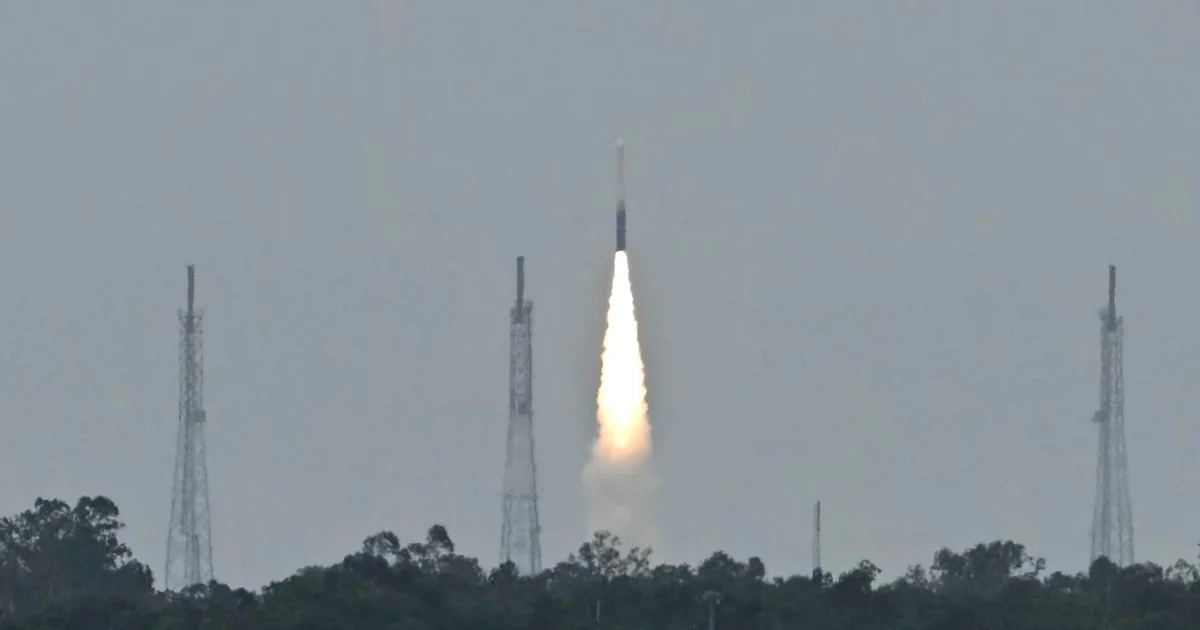
In a historic leap for India’s burgeoning aerospace sector, Skyroot Aerospace has successfully placed its Vikram-1 rocket into orbit, marking the nation’s first-ever successful orbital launch by a private-sector enterprise. The mission, executed from the Satish Dhawan Space Centre (SDSC) in Sriharikota, represents a pivotal inflection point in New Delhi’s strategic pivot toward liberalizing its space industry and securing a larger share of the multi-billion-dollar global space economy. By achieving this feat, India joins an elite group of nations—including the United States and China—that possess the capability to deploy satellites into orbit through privately developed launch vehicles.
The three-stage, 22-meter-tall Vikram-1 rocket lifted off from the second launch pad of the SDSC, piercing the atmosphere to deploy a suite of customer payloads into a precise 450-kilometer (280-mile) low-Earth orbit (LEO). This achievement follows years of intensive research, development, and testing by Skyroot Aerospace, a Hyderabad-based startup that has rapidly emerged as a frontrunner in the "NewSpace" movement. The success of Vikram-1 not only validates the technical prowess of Indian private engineers but also signals to the global market that India is ready to offer cost-effective, reliable, and rapid-response launch services for the small satellite market.
Technical Specifications and Engineering Innovation
The Vikram-1 is a sophisticated launch vehicle designed specifically to cater to the growing demand for small satellite deployments. Standing at 22 meters with a liftoff mass of approximately 20 tonnes, the rocket is a multi-stage vehicle powered by solid-fuel propulsion systems. One of the most notable features of the Vikram-1 is its extensive use of advanced materials and manufacturing techniques. The rocket’s airframe is constructed primarily from high-strength carbon-fiber structures, which significantly reduce weight while maintaining structural integrity during the high-stress phases of ascent.
Furthermore, Skyroot Aerospace has integrated cutting-edge 3D-printing technology into the production of its engines. The Vikram-1 utilizes the Raman-2 engine for its upper stage, which features a 3D-printed injector and combustion chamber. This manufacturing approach allows for a reduction in the number of parts, lower production costs, and faster turnaround times compared to traditional aerospace manufacturing.
The rocket is capable of carrying a payload of up to 350 kilograms (772 lbs) to low-Earth orbit. Beyond its primary function of satellite deployment, the Vikram-1 serves as a technology demonstrator for sustainable space operations. It is equipped with specialized robotic arms designed to test the feasibility of clearing space debris—a growing concern for international space agencies as LEO becomes increasingly crowded with defunct satellites and spent rocket stages.
The Mission Profile and Payload Diversity
The inaugural orbital mission of Vikram-1 was not merely a technical test but a fully functional commercial and symbolic endeavor. The payloads deployed into the 450km orbit included a mix of experimental equipment and cultural artifacts. Among the most unique items on board were a lab-grown diamond and a miniature 18-carat gold sculpture. These items were included to commemorate India’s long-standing national space program and to highlight the country’s advancements in high-technology manufacturing beyond the aerospace sector.
During the flight, Skyroot Aerospace confirmed that all critical systems performed within expected parameters. The test validated the rocket’s propulsion units, avionics, telemetry, guidance, navigation, and control (GNC) systems. The successful separation of the three stages and the precise injection of the payloads into their designated orbital slots demonstrate a level of mission assurance that is typically the hallmark of established national space agencies.
Skyroot celebrated the achievement on social media, with a post on X (formerly Twitter) stating: “Hello space, we have arrived!” The sentiment reflects the culmination of six years of intense labor since the company’s founding in 2018.
A Chronology of Indian Private Space Flight
The success of Vikram-1 is the result of a steady progression of milestones that began with the liberalization of the Indian space sector in 2020. Prior to this, the Indian Space Research Organisation (ISRO) held a monopoly on all space-related activities. The establishment of the Indian National Space Promotion and Authorisation Centre (IN-SPACe) as a regulatory body paved the way for private companies to utilize ISRO’s facilities and expertise.

- 2018: Skyroot Aerospace is founded by former ISRO scientists Pawan Kumar Chandana and Naga Bharath Daka with the goal of democratizing access to space.
- 2020: The Indian government announces major reforms, opening the space sector to private participation to enhance India’s share of the global space economy.
- November 2022: Skyroot completes the "Prarambh" mission, launching the Vikram-S rocket. This was a suborbital flight that reached an altitude of approximately 89.5 kilometers, proving the company’s core propulsion and avionics technologies but not entering orbit.
- Early 2024: Skyroot becomes the first Indian space-sector startup to reach a $1 billion valuation, achieving "unicorn" status following successful funding rounds from global investors.
- July 18, 2026: The successful launch of Vikram-1 marks the first private orbital mission in Indian history.
This timeline illustrates the rapid acceleration of the private sector’s capabilities, moving from company formation to orbital success in less than a decade.
Official Responses and Political Impact
The successful launch drew immediate praise from the highest levels of the Indian government. Prime Minister Narendra Modi, who has been a vocal proponent of the "Atmanirbhar Bharat" (Self-Reliant India) initiative, hailed the mission as a landmark achievement for the nation’s youth and scientific community.
“The successful launch of Vikram-1 is a moment of immense pride for India. It will encourage countless youngsters to dream bigger and innovate fearlessly,” Prime Minister Modi stated. He further emphasized that the involvement of the private sector is essential for India to become a global leader in space technology and services.
Dr. Jitendra Singh, the Union Minister of State for Science and Technology, noted that the success of Vikram-1 is a testament to the "synergy between the public and private sectors" facilitated by the government’s policy reforms. Industry experts suggest that this mission will likely trigger a surge in domestic and foreign investment into Indian space startups, as the "proof of concept" for private orbital delivery has now been firmly established.
Strategic Implications for the Global Space Economy
The global space economy is currently valued at approximately $400 billion to $500 billion, with projections suggesting it could reach $1 trillion by 2040. Currently, India accounts for roughly 2% of this market, largely through the services provided by ISRO’s commercial arm, NewSpace India Limited (NSIL). However, the Indian government has set an ambitious target to increase this share to 10% by 2030.
The emergence of private players like Skyroot Aerospace is critical to achieving this goal. By offering a dedicated launch vehicle for small satellites, Skyroot is positioning itself to compete with international firms like Rocket Lab (USA) and various Chinese private enterprises. The primary competitive advantage for Indian firms lies in their lower operational costs, driven by a highly skilled but more affordable engineering workforce and a robust domestic manufacturing supply chain.
Moreover, the successful deployment of Vikram-1 enhances India’s strategic autonomy. By diversifying its launch capabilities beyond the state-run ISRO, India ensures a more resilient and flexible space infrastructure. This is particularly important for the deployment of "constellations" of small satellites used for telecommunications, earth observation, and climate monitoring, which require frequent and cost-effective launches.
Future Outlook: Commercialization and Expansion
Following the success of this test flight, Skyroot Aerospace plans to conduct several more launches to refine the Vikram-1 platform before transitioning to routine commercial operations. The company is already developing the Vikram-II and Vikram-III, which are designed to carry heavier payloads and reach higher orbits, including Sun-Synchronous Orbits (SSO).
The integration of space debris clearance technology in the Vikram series also highlights a shift toward "responsible space-faring." As the international community discusses stricter regulations on orbital sustainability, Skyroot’s proactive inclusion of robotic arms for debris mitigation could serve as a major selling point for environmentally conscious satellite operators and government agencies.
In conclusion, the successful orbital launch of Vikram-1 is more than just a technical triumph; it is a declaration of India’s intent to lead in the new era of space exploration. By fostering a competitive private sector alongside its world-class national space program—which has already achieved records such as launching 104 satellites on a single rocket in 2017 and landing the Chandrayaan-3 craft near the lunar south pole in 2023—India is building a comprehensive and formidable space ecosystem. The journey of Vikram-1 from a startup’s vision to an orbital reality serves as a blueprint for how policy liberalization and private innovation can combine to propel a nation toward the stars.
