

The conclusion of the 2026 U.S. proxy season has brought to light significant shifts in the shareholder proposal landscape, largely influenced by the Securities and Exchange Commission’s (SEC) revised approach to no-action requests. Glass Lewis, a leading proxy advisory firm, has been diligently monitoring these developments throughout the year, and their post-season observations reveal notable trends that are reshaping how shareholders engage with companies on critical governance, environmental, and social issues.
Proposal and Exclusion Request Volumes: A Shift in Dynamics
A primary takeaway from the 2026 proxy season is the SEC’s decision, announced in November 2025, to step away from the traditional no-action relief process for shareholder proposals. This departure from precedent has had a pronounced effect on the volume of proposals reaching the ballot for shareholder votes. While overall shareholder proposal volumes have seen a multi-year decline—a trend Glass Lewis attributes to factors beyond the no-action regime, such as increased ESG scrutiny, pushback on environmental, social, and governance (ESG) initiatives, and the establishment of market norms through prior successful proposals—the SEC’s procedural shift has nevertheless buoyed the number of proposals actually going to a vote.
Data covering shareholder meetings held through June 30, 2026, indicates a significant reduction in the number of exclusion notices filed by companies. Barely half the number of such notices were filed compared to the previous year, a stark contrast to initial speculations that the SEC’s decision would grant companies "free rein" to control their annual general meeting (AGM) agendas. Issuers, it seems, have been reluctant to exclude proposals without the backing of SEC staff. This hesitancy has largely offset the reported decline in the overall number of proposals being submitted.
Despite an estimated 47% decrease in the total number of shareholder proposals filed, the number of proposals that ultimately reached the ballot for a vote experienced only a marginal decline of approximately 12.4% compared to 2025. This resilience is directly linked to the dramatic 48.5% drop in exclusion requests filed by companies during the same period. This suggests a more cautious approach by corporations, who appear to be weighing the risks of unilateral exclusion against the potential for shareholder dissent or legal challenges in the absence of SEC support.
Targeted Exclusions: A New Strategy Emerges
Further analysis by Glass Lewis reveals a strategic shift in how companies are leveraging the proposal exclusion process. Key takeaway number two highlights that issuers are increasingly targeting individual activist proponents for exclusion requests, while institutional investors and asset managers face less pushback. The composition of proponents among proposals that went to a vote remained relatively stable between 2025 and 2026. However, the pool of proponents whose proposals were specifically targeted for exclusion has changed considerably.
The data indicates a significant increase in exclusion notices directed at individual proponents, particularly at John Chevedden, a prolific filer of shareholder proposals. The proportion of exclusion notices linked to proposals submitted by this individual nearly doubled. Concurrently, the percentage of exclusion notices targeting other individual proponents saw a decline, a trend partly explained by the absence of Chris Mueller, a proponent who did not submit any proposals in 2026 after attracting 44 exclusion notices in the previous year. When proposals from Mr. Mueller are excluded from the 2025 data, the year-over-year proportion of exclusion notices targeting other individual proponents appears stable.

Conversely, exclusion notices targeting asset managers, pension funds, and mission-driven investors dropped by more than half. This suggests a potential strategy by issuers to avoid alienating large, influential institutional shareholders. However, this deference was not universally applied. While mid-season data hinted at a notable decrease in exclusions for advocacy or religious organizations, particularly those perceived as "anti-ESG," full-season data did not entirely bear this out. Exclusion notices targeting advocacy groups saw only a modest 3% decrease from 2025, and proposals from "anti-ESG" proponents actually increased as a proportion of the total, mirroring the overall rise in submissions from these groups. This indicates a nuanced approach where companies might be more selective in their exclusions, potentially prioritizing targets that pose less systemic risk to their shareholder relations.
The Shifting Sands of Proposal Topics
The 2026 proxy season also witnessed a significant evolution in the thematic focus of shareholder proposals that successfully made it onto the ballot. A major drop-off in compensation-related proposals, coupled with a continued decline in environmental and social (E&S) proposals, has led to an increasing concentration of shareholder attention on governance topics.
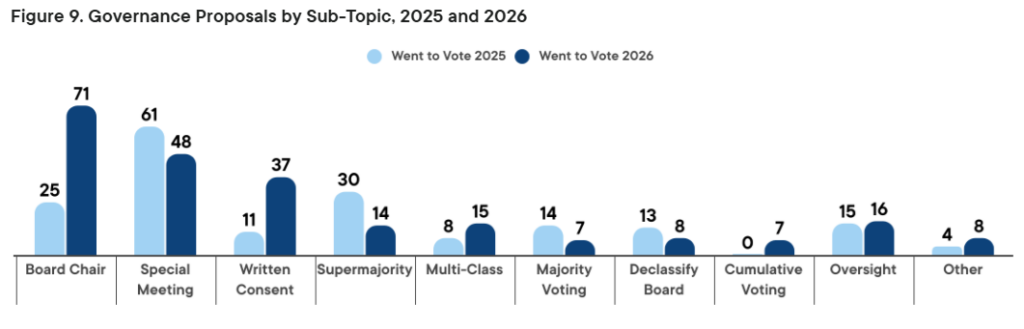
In 2024, governance-themed ESG proposals constituted 33% of the ESG shareholder proposal landscape. This figure climbed to 41% in 2025 and reached a significant 60% in 2026. Last year’s spike was primarily attributed to a substantial reduction in environmental and social proposals. While this downward trend for E&S proposals persisted in 2026, the accelerated growth in the proportion of governance proposals was further fueled by a steep decline in compensation-related proposals. This shift suggests a strategic recalibration by shareholders, who may be focusing their efforts on areas where they perceive the most leverage or the most pressing need for reform, particularly in light of ongoing debates surrounding corporate governance practices.
The specific governance topics gaining traction include a surge in proposals calling for the separation of the chair and CEO roles, and those advocating for shareholders’ right to act by written consent. Notably, these increases appear to be driven by specific, prolific proponents. For instance, out of 71 proposals concerning the chair/CEO roles, a substantial 60 were filed by John Chevedden or the National Legal and Policy Center. Similarly, 36 out of 39 proposals related to written consent were attributed to Mr. Chevedden. This concentration of activity by a few key individuals underscores the significant impact individual activists can have on shaping the shareholder proposal agenda.
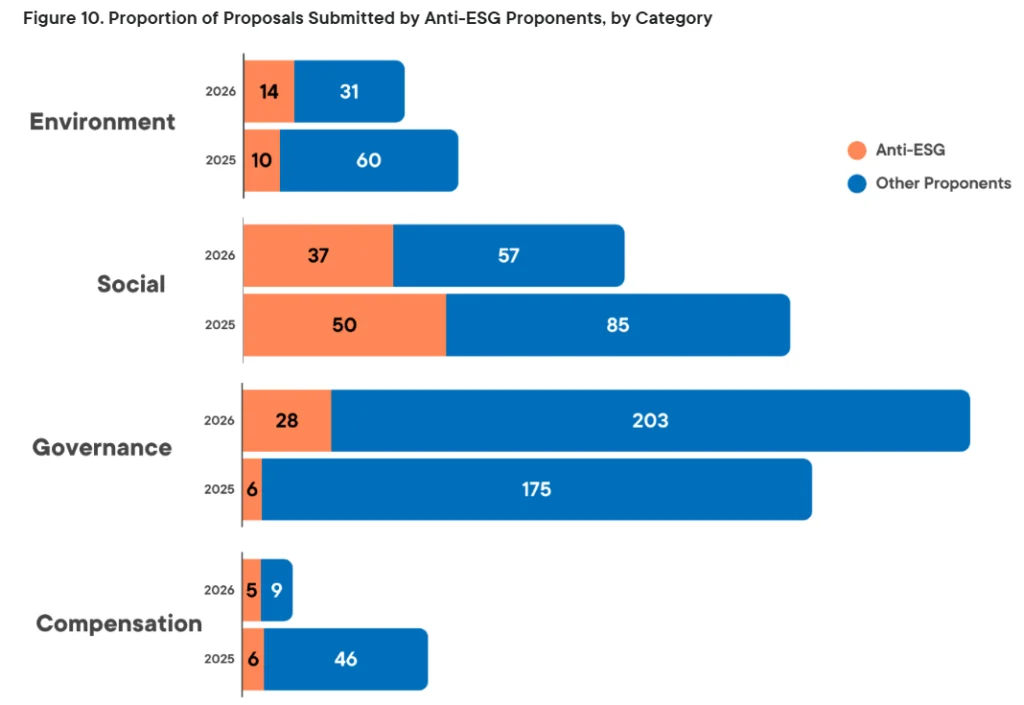
Furthermore, "anti-ESG" proponents have become increasingly visible across all categories of shareholder proposals. From 2025 to 2026, their share of environmental and social proposals rose from 29.2% to 40% of the total. These proponents also contributed to the growth in governance proposals, submitting 28 out of 231 (13.7%) in 2026, a notable increase from 6 out of 181 (3.3%) in 2025. The majority of these "anti-ESG" governance proposals were submitted by the National Legal and Policy Center, primarily focusing on the separation of chair and CEO roles, with a smaller number addressing cumulative voting. This trend indicates a potential polarization within the shareholder activism sphere, with some investors actively pushing back against widely adopted ESG principles.
The Complex Landscape of Investor Responses: Litigation and Negotiation
The SEC’s revised stance on no-action requests has undeniably created a more intricate environment for shareholder engagement and negotiation. The absence of a clear regulatory arbiter means that disputes over proposal eligibility are more likely to spill into the realm of direct litigation between companies and proponents, or even involve the SEC itself as a defendant.
Proponents have indeed responded to proposal exclusions with a variety of tactics, including legal challenges, direct negotiations with companies, and other innovative strategies aimed at ensuring their proposals reach the ballot. However, the success rate of these legal challenges has been mixed. Several high-profile cases have emerged, illustrating the evolving dynamics:
-
BJ’s Wholesale Club: In April 2026, New York State Comptroller Thomas DiNapoli announced a victory in a shareholder rights lawsuit against BJ’s Wholesale Club. The lawsuit challenged the company’s exclusion of a shareholder proposal concerning workforce demographic data disclosure. The settlement mandated that the company allow the proposal to be voted on at its next shareholder meeting.
-
AT&T: Trillium Asset Management took innovative action to defend shareholder rights in March 2026, specifically highlighting the need for protections for shareholders when they are under pressure. This action appears to be in response to the exclusion of shareholder proposals, though specific details regarding AT&T’s actions and the nature of the "innovative action" remain to be elaborated. However, a subsequent SEC filing from AT&T in May 2026 indicated a settlement related to an unlawful exclusion of a shareholder proposal requesting workforce demographic data disclosure.
-
PepsiCo: In February 2026, PETA announced a victory against PepsiCo, which had initially sought to exclude a shareholder proposal addressing concerns about bull abuse. Following a lawsuit, PepsiCo agreed to allow the shareholder vote on the proposal.
-
Axon: In March 2026, a judge ordered Axon to work with an investor on a "compromise" shareholder proposal. This suggests a judicial intervention aimed at facilitating dialogue and finding common ground between the company and its shareholders regarding proposal content.
-
UnitedHealth: A judge denied an injunction in a lawsuit concerning a UnitedHealth shareholder proposal in April 2026. This ruling implies that the company’s argument for exclusion may have been upheld, at least in the context of the injunction.
-
Chubb Limited: In March 2026, As You Sow and the Interfaith Center on Corporate Responsibility (ICCR) filed a complaint against the SEC itself. The lawsuit alleged that the SEC’s revised approach to no-action relief, while framed as guidance, effectively operates as a legislative rule that diminishes shareholder rights. The complaint reportedly included allegations regarding the SEC’s failure to provide adequate notice and comment for the rule change, its arbitrary and capricious implementation, and its violation of the Administrative Procedure Act. This litigation is reportedly ongoing.
Implications and Future Outlook
The SEC’s shift away from the no-action relief process has undeniably altered the dynamics of shareholder engagement and corporate governance. The data from the 2026 proxy season indicates a more cautious and selective approach to proposal exclusions by companies, likely driven by a heightened awareness of litigation risks. This trend, coupled with the increasing prominence of governance-focused proposals and the rise of "anti-ESG" activism, suggests a more complex and potentially volatile shareholder proposal environment in the coming years.
The ongoing litigation involving the ICCR and As You Sow against the SEC could further reshape this landscape, potentially leading to a re-evaluation of the SEC’s current guidance. Glass Lewis will continue to monitor these crucial developments, providing essential analysis and data to help market participants navigate this evolving terrain. The delicate balance between shareholder rights, corporate autonomy, and regulatory oversight remains a central theme, and its future trajectory will be keenly watched by investors, companies, and regulators alike.
