

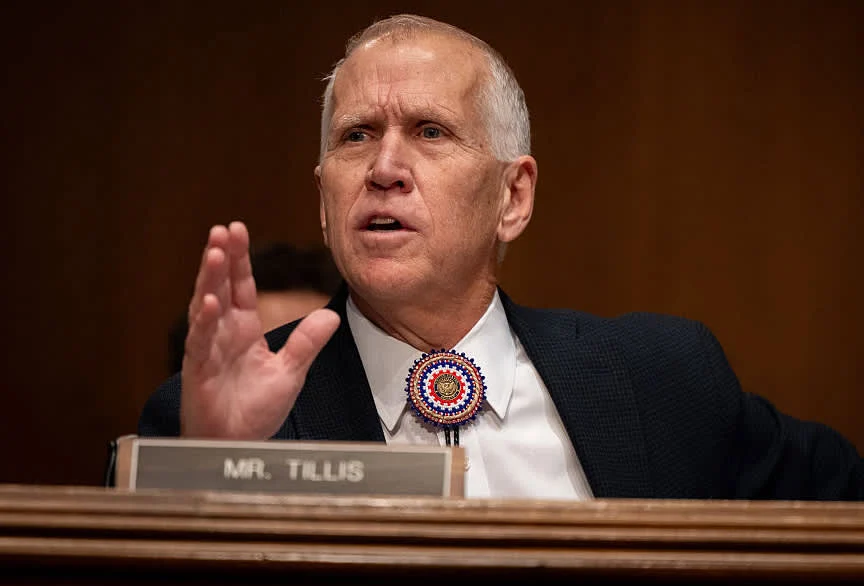
Republican Senator Thom Tillis of North Carolina delivered a blistering condemnation of President Donald Trump’s selection of Bill Pulte as the acting Director of National Intelligence (DNI) on Wednesday, labeling him an "incendiary attack dog" and asserting that he possesses "no path to being confirmed by the Senate." The remarks, made during an appearance on CNBC’s "Squawk Box," intensified a growing bipartisan backlash against Pulte, who currently serves as the head of the Federal Housing Finance Agency (FHFA) and was tapped by Trump for the intelligence role on Tuesday. Tillis, a retiring senator, did not mince words, declaring, "I don’t think he has a prayer" of securing permanent confirmation from the Senate for the critical DNI position.
The DNI role, established in the wake of the September 11, 2001, terrorist attacks through the Intelligence Reform and Terrorism Prevention Act of 2004, is designed to serve as the principal intelligence advisor to the President, the National Security Council, and the Homeland Security Council. The Director is responsible for overseeing and directing the implementation of the National Intelligence Program, ensuring that the 17 disparate agencies comprising the U.S. Intelligence Community (IC) operate cohesively and effectively. This includes managing the intelligence budget, setting priorities, and ensuring the timely and accurate flow of intelligence to policymakers. Given its crucial national security implications, the DNI position traditionally demands a nominee with extensive experience in intelligence, foreign policy, or national security, coupled with a non-partisan temperament and the trust of both the executive and legislative branches. Critics argue that Pulte’s background starkly contrasts with these established expectations.
Bill Pulte’s professional history has been primarily in the housing sector, most notably as the head of the FHFA, where he also chairs the mortgage giants Fannie Mae and Freddie Mac. However, it is his conduct in this role, rather than any perceived lack of housing expertise, that has fueled much of the controversy surrounding his DNI appointment. Pulte has been widely accused of leveraging his access to sensitive mortgage records at the FHFA to target individuals perceived as political adversaries of the president, subsequently referring them for prosecution. Among those reportedly targeted were Federal Reserve Governor Lisa Cook and New York Attorney General Letitia James, both of whom faced allegations of mortgage-related wrongdoing initiated by Pulte. This history has profoundly alarmed intelligence analysts and lawmakers alike, who warn that granting an individual with such a track record access to the nation’s most sensitive secrets could lead to the politicization and weaponization of intelligence, undermining the integrity and independence of the IC.
Senator Tillis’s critique was echoed and amplified by a chorus of lawmakers from both sides of the aisle, signaling an unusual degree of bipartisan opposition to a presidential appointment. Tillis meticulously outlined his objections, questioning Pulte’s fundamental suitability for the DNI role. "I don’t believe he’s ever had a security clearance. He clearly has no experience in intelligence, he has no geopolitical experience, no international connections — the sorts of things you would look for" in a DNI, Tillis asserted. Beyond the lack of professional qualifications, Tillis raised significant concerns about Pulte’s temperament, referencing reports of his removal from his family’s corporate board in 2020 after the family’s ownership stake fell below 51%. Tillis also cited a public statement from the Pulte Family Charitable Foundation, clarifying that Bill Pulte, known for his active social media presence, does not speak for the family "in any capacity." "Why do I bring that up?" Tillis asked rhetorically. "I bring it up because it suggests a temperament that’s probably not right for the DNI role."
The Republican opposition extended beyond Tillis. Senator Bill Cassidy (R-La.), who recently lost his primary election despite President Trump’s endorsement of a rival, publicly questioned Pulte’s competence. Speaking at a CNBC CEO Council Summit, Cassidy stated that Pulte does not appear "competent" to serve as acting DNI. Senate Majority Leader John Thune (R-S.D.) also weighed in, telling reporters on Capitol Hill, "We don’t need a weaponized DNI, we need professionals there." These statements from prominent Republicans underscore the depth of concern within the president’s own party regarding the appointment.
On the Democratic side, the alarm bells were equally loud. Senate Intelligence Committee Vice Chairman Mark Warner (D-Va.) reportedly urged Majority Leader Thune to intercede and convince President Trump to reverse Pulte’s appointment. A person familiar with the matter confirmed to MS NOW that Warner warned that if the reversal does not happen, "all options are on the table," including the potential collapse of a bipartisan deal to extend Section 702 of the Foreign Intelligence Surveillance Act (FISA). Warner had previously expressed his apprehension, stating, "The idea that you put in somebody unqualified, who also has a record of weaponizing confidential information, and I’m supposed to ask, ‘just trust us?’" This bipartisan consensus against Pulte’s appointment highlights the profound uneasiness across the political spectrum about his suitability for a position that demands absolute impartiality and a steadfast commitment to national security over partisan interests.

The appointment of Bill Pulte now threatens to derail the crucial reauthorization of Section 702 of the Foreign Intelligence Surveillance Act (FISA), a law widely regarded as indispensable for U.S. national security. Section 702 authorizes the government to conduct warrantless surveillance of non-U.S. persons located outside the United States to acquire foreign intelligence information. While it is not intended to target U.S. citizens, its implementation has raised significant privacy concerns among civil liberties advocates and some lawmakers due to the "incidental collection" of U.S. persons’ communications and the procedures for accessing such data. Despite these concerns, intelligence officials and national security experts consistently emphasize that Section 702 is a vital tool for thwarting terrorist plots, cyberattacks, and foreign espionage, providing critical intelligence on adversaries like China, Russia, and Iran. The statute, which requires periodic reauthorization by Congress, has been a contentious issue for years, often subject to intense debate and last-minute extensions. The current political climate, already fraught with partisan divisions and distrust, makes its reauthorization particularly challenging.
With Pulte’s appointment, the already precarious legislative path for FISA Section 702 has become even more perilous. Lawmakers, particularly those on intelligence committees, are deeply hesitant to grant broad surveillance authorities to an administration led by an individual perceived as lacking the necessary judgment, experience, and commitment to uphold the law’s strictures against abuse. Warner’s explicit warning that "all options are on the table" regarding the FISA reauthorization underscores the gravity of the situation. This suggests that the Senate is prepared to leverage its legislative power, potentially allowing the crucial surveillance authority to lapse, rather than confirm or implicitly endorse an intelligence chief they deem unfit. The potential failure to reauthorize Section 702 would represent a significant blow to the U.S. intelligence community’s capabilities, potentially creating dangerous blind spots in the nation’s ability to monitor and counter foreign threats.
Senator Tillis also acknowledged a cynical but plausible maneuver by the Trump administration: simply leaving Pulte in place indefinitely with the "acting" title, thereby circumventing the Senate confirmation process entirely. This tactic has been employed by administrations in the past to install preferred officials in key roles without facing congressional scrutiny. While legally permissible for a limited period, prolonged reliance on "acting" officials can undermine accountability, stability, and the institutional authority of government agencies. It bypasses the constitutional "advice and consent" role of the Senate, designed to ensure that high-ranking officials are thoroughly vetted and possess the public trust required for their positions. Such a move would undoubtedly further inflame tensions between the White House and Capitol Hill, exacerbating an already "simmering rift between the president and the Senate, which has been repeatedly angered by a series of moves from the White House."
The White House, when pressed on Wednesday about Tillis’s biting comments, reiterated a statement from the previous day, offering a staunch defense of Pulte’s selection. "The President chooses the best and most talented people to serve in his Cabinet," spokesman Davis Ingle said via email. "Bill Pulte is a great selection and he will do a great job on behalf of the American people." This official response, while boilerplate, highlights the administration’s determination to stand by its choice, despite the widespread and bipartisan condemnation. It also suggests a potential unwillingness to reconsider the appointment, setting the stage for a prolonged standoff with Congress.
Further underscoring the concerns about Pulte’s temperament and his capacity to work effectively within the administration, Senator Tillis alluded to internal friction within the executive branch. He referenced a particularly colorful incident involving Treasury Secretary Scott Bessent and Pulte. During a Senate Finance Committee hearing, when Tillis asked Bessent if he had indeed threatened to punch Pulte in the face, Bessent candidly replied, "I actually said I was going to kick his ass." Bessent quickly downplayed the remark, adding, "that was last summer… many teams have fights in the locker room, and then go out and win for the team on the field." While Bessent framed it as a normal team dynamic, the public acknowledgment of such a confrontational incident between two senior administration officials raises legitimate questions about Pulte’s interpersonal skills and his ability to foster collaboration within the complex and often sensitive intelligence community. This anecdote, combined with Tillis’s remarks about Pulte’s family board removal and public disavowal, paints a picture of an individual whose temperament may not be suited for the delicate diplomacy and consensus-building required of the nation’s top intelligence official.
The departure of the previous DNI, Tulsi Gabbard, who announced last month that she would resign on June 30, created the vacancy that President Trump moved to fill with Pulte. Gabbard’s tenure, while not without its own political nuances, did not face the same level of immediate and widespread bipartisan opposition regarding her qualifications or conduct. The contrast highlights the exceptional nature of the controversy surrounding Pulte.
In summation, the appointment of Bill Pulte as acting Director of National Intelligence has ignited a firestorm of bipartisan criticism, threatening to destabilize the nation’s intelligence leadership and imperil crucial national security legislation like FISA Section 702. Senator Thom Tillis’s scathing characterization of Pulte as an "incendiary attack dog" who lacks the experience, temperament, and congressional support for confirmation underscores the gravity of the situation. The White House’s steadfast defense of Pulte, coupled with the potential for the administration to bypass Senate confirmation by retaining him in an "acting" capacity, suggests a looming confrontation between the executive and legislative branches. This unprecedented level of opposition, rooted in concerns about Pulte’s alleged politicization of previous roles and his apparent lack of relevant experience, poses significant risks to the integrity of the U.S. intelligence community and the nation’s ability to effectively address global threats. The coming weeks will undoubtedly test the resilience of congressional-executive relations and the nation’s commitment to a non-partisan intelligence apparatus.
