

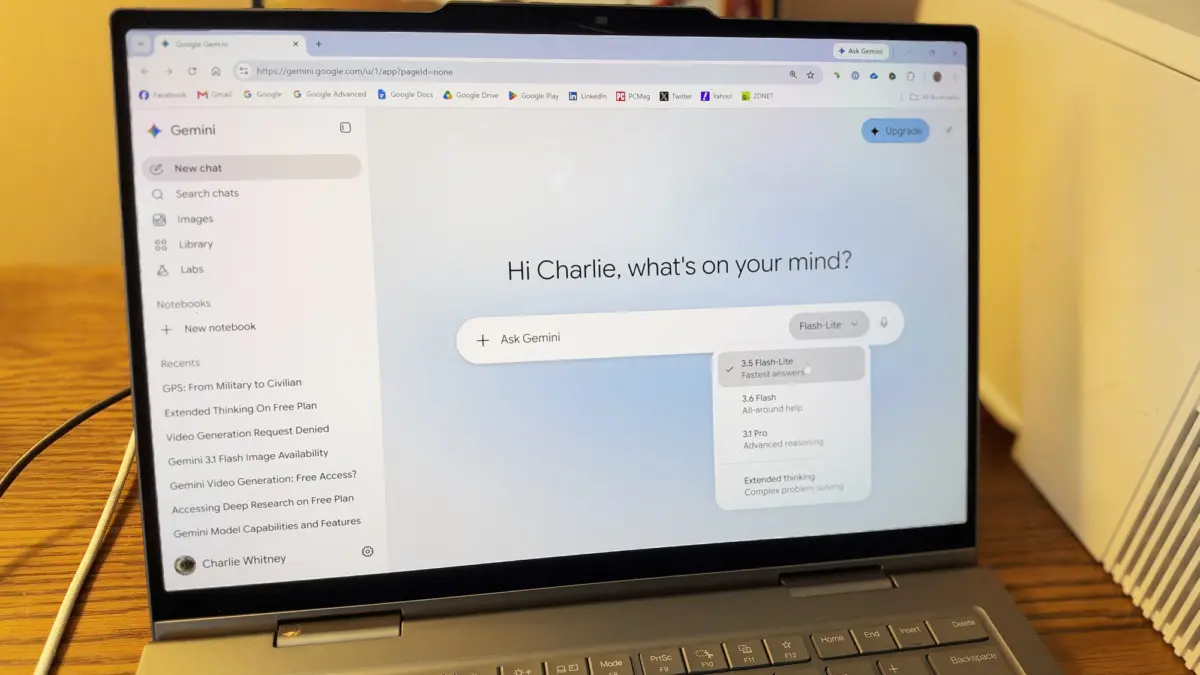
Google has announced a significant shift in its artificial intelligence service strategy, implementing a new tier-based access model that will restrict the availability of its most capable large language models (LLMs) to paying subscribers. According to a recently updated support document from the technology giant, users of the free version of the Gemini app and website will soon be limited to a single, lower-tier AI model, effectively removing access to more robust versions previously available at no cost. This transition, scheduled to take effect on Friday, October 9, represents a pivot toward a more aggressive monetization strategy as Google seeks to balance the high operational costs of generative AI with its massive global user base.
Under the new guidelines, free users will lose access to the Gemini Flash and Gemini Pro models. In their place, Google will provide the Gemini 3.5 Flash-Lite model, which is described as the fastest but least powerful variant in the current lineup. This change is not limited to free users; those subscribed to the entry-level "AI Plus" plan, which currently costs $5 per month, will also see their access curtailed. Starting on the October deadline, AI Plus subscribers will no longer have access to the Gemini 3.1 Pro model, leaving them with only the Flash and Flash-Lite variants.
The reorganization appears designed to push power users toward higher-priced subscription tiers. The $20-per-month "AI Pro" plan will become the primary gateway for users seeking advanced analytical capabilities, logic, and coding assistance. To sweeten the deal for Pro subscribers, Google is introducing the "Deep Think" reasoning mode to this tier. Previously, this advanced reasoning capability was restricted to the "AI Ultra" plans, which carry premium price tags of $100 to $200 per month and are typically aimed at enterprise-level users and developers.
The Evolution of Google’s AI Ecosystem
To understand the context of these changes, one must look at the rapid evolution of Google’s AI branding and infrastructure over the past two years. Google initially entered the consumer generative AI space with "Bard" in early 2023, a move largely seen as a response to the viral success of OpenAI’s ChatGPT. In early 2024, Google rebranded Bard to Gemini, aligning the product name with the underlying family of multimodal models developed by Google DeepMind.
Since the rebranding, Google has rapidly iterated on its model architecture. The introduction of the Gemini 1.5 series brought significant improvements in "context window" size, allowing the AI to process massive amounts of data—such as hour-long videos or thousands of lines of code—in a single prompt. However, the computational cost of running these high-parameter models is immense. Industry analysts estimate that the hardware and energy requirements for a single generative AI query are significantly higher than those of a traditional Google search. Consequently, the move to restrict model access is seen by market observers as a necessary step to ensure the financial sustainability of the service.
Detailed Breakdown of Gemini Model Tiers
The restructuring centers on three primary model variants, each optimized for different balance points between speed, intelligence, and computational efficiency:
Gemini 3.5 Flash-Lite
This model is the new baseline for the free tier. It is engineered for high-velocity, low-latency interactions. While it is capable of handling basic conversational tasks, simple summaries, and repetitive data entry, it lacks the deep reasoning capabilities found in its larger counterparts. Users relying on the free tier may find that the model struggles with complex multi-step instructions or nuanced creative writing compared to the models they previously accessed.
Gemini 3.8 Flash
Positioned as a versatile generalist, the Flash model is the standard for the $5 AI Plus tier. It offers a middle ground, providing better image generation, file analysis, and information retrieval than the Lite version. It is designed to handle the vast majority of everyday consumer tasks, from drafting emails to planning travel itineraries, without the heavy computational overhead of the Pro model.
Gemini 3.1 Pro
The Pro model is the "heavy lifter" of the consumer-facing lineup. It is optimized for complex problem-solving, particularly in technical fields. Its training focuses heavily on math, logical reasoning, and software engineering. By moving this model exclusively behind a $20-per-month paywall, Google is signaling that high-level cognitive assistance is now a premium commodity.
Introduction of Compute-Based Usage Limits
In addition to the model restrictions, Google is refining how it monitors and limits user activity. Moving away from a simple "number of messages" cap, the company is implementing a "compute-based limit." This system evaluates the "cost" of a user’s request based on the complexity of the prompt, the length of the conversation history, and the specific features utilized (such as generating a high-resolution image versus a text response).

These limits will now refresh on a five-hour cycle, a change from previous daily or weekly structures. Once a user reaches their compute quota, they may be throttled to a lower-tier model or asked to wait until the next refresh period. Paid users will maintain significantly higher quotas than free users, but even premium subscribers will find that resource-intensive tasks—such as using the new "Deep Research" or "Deep Think" modes—deplete their limits faster than standard chatting.
Strategic Implications and Market Reaction
The decision to limit free access reflects a broader trend across the AI industry. OpenAI and Anthropic have similarly established clear boundaries between their free and paid offerings. For instance, while OpenAI provides free users with limited access to its flagship GPT-4o model, it eventually downgrades them to the smaller GPT-4o mini once limits are reached. Google’s approach is slightly more rigid, as it removes the option for free users to even "sample" the Pro model after the October 9 cutoff.
Data from market research firms suggests that while millions of users utilize free AI tools, the conversion rate to paid subscriptions remains the primary metric for Silicon Valley investors. By placing the Pro model and the "Deep Think" mode behind a $20 paywall, Google is directly competing with ChatGPT Plus and Claude Pro. The inclusion of Deep Think is particularly notable, as it suggests Google is ready to challenge OpenAI’s "o1" series in the realm of deliberate, chain-of-thought reasoning.
User and Industry Feedback
Early reactions to the announcement have been mixed. Tech enthusiasts and power users have expressed frustration over what they perceive as a "downgrade" of the free experience. However, enterprise analysts suggest that the clarity provided by the new tier system may actually benefit Google in the long run.
"Google is finally treating AI as a utility rather than a laboratory experiment," noted one industry consultant. "By defining exactly what you get for $5, $20, or $100, they are setting expectations for reliability and performance that were previously blurred."
For the average user, the impact will likely be felt in the quality of complex responses. A free user asking Gemini to "debug this Python script" or "summarize a 50-page legal document" may find the Flash-Lite model less adept at catching subtle errors compared to the outgoing Pro model.
Looking Ahead: The Future of the "AI Divide"
As Google moves forward with this restructuring, the industry is closely watching how it affects user retention. The "AI divide"—the gap between those who can afford premium reasoning tools and those relegated to basic models—is becoming a central topic of discussion in digital equity circles.
Google has attempted to mitigate some of this friction by offering flexible, month-to-month subscription plans. This allows users to "level up" for a single month when they have a specific project requiring high-tier logic, and then revert to the free version afterward.
The transition on October 9 will serve as a major test for Google’s infrastructure. As free users are migrated to Flash-Lite, the company expects to see a decrease in total server strain, potentially allowing for faster response times across the board. Whether this efficiency gain will be enough to satisfy a user base that has grown accustomed to high-performance AI for free remains to be seen.
In the long term, this move signals the end of the "experimental" phase of consumer AI. The industry is moving into a mature phase where sophisticated reasoning, deep research, and high-level coding assistance are recognized as premium services with associated costs, while basic conversational AI becomes a standard, low-cost commodity.
