

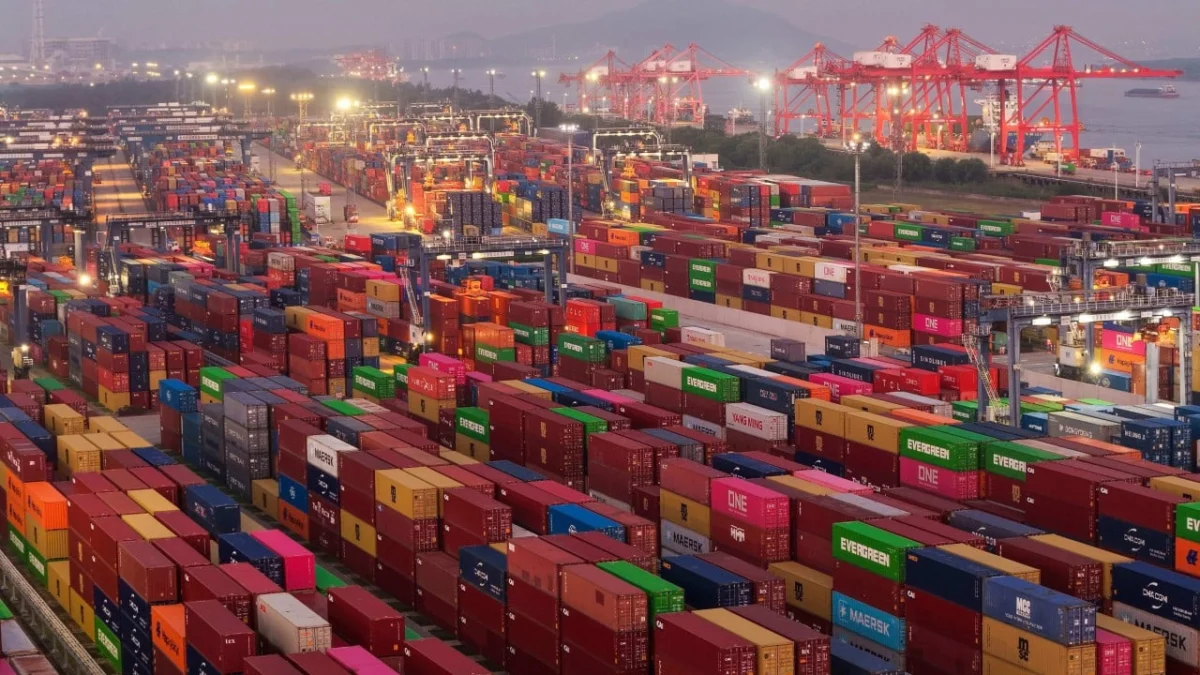
In a comprehensive study that challenges conventional wisdom regarding the interconnectedness of the world’s two largest economies, Chinese researchers have developed a sophisticated "war game" simulation of global trade. The findings suggest that a total economic decoupling between the United States and China—once viewed as a catastrophic "lose-lose" scenario for the planet—could actually generate significant economic dividends for a wide array of other nations. This counterintuitive projection hinges on a massive restructuring of global supply chains, where neutral countries step into the vacuum left by the severance of the Washington-Beijing corridor.
The study, which utilizes a quantitative trade model to estimate the macroeconomic shocks of aggressive tariff policies and trade barriers, was conducted by a collaborative team from the Guangzhou Geological Survey Institute and the Bay Area International Business School at Beijing Normal University. Published in the peer-reviewed South China Journal of Economics, the research provides a data-driven look at how the "Great Fragmentation" of global trade might redistribute wealth and industrial capacity across the globe, particularly benefiting developing regions in Southeast Asia and beyond.
The Mechanics of the Trade Simulation
To reach their conclusions, the researchers employed a quantitative trade model—a data-intensive economic framework designed to simulate how changes in trade policy, such as tariffs or total embargoes, ripple through international markets. By inputting various levels of decoupling, ranging from sector-specific restrictions to a total cessation of bilateral trade, the model estimated the resulting shifts in Gross Domestic Product (GDP), consumer welfare, and industrial output.
The primary finding of the simulation is that a complete severance of trade relations between the U.S. and China would trigger an unprecedented "supply chain restructuring." In this scenario, the trade and production activities that currently define the U.S.-China relationship would not simply vanish; instead, they would be absorbed by third-party nations. As the two superpowers withdraw from one another’s markets, they are forced to seek alternative suppliers and consumers, effectively "outsourcing" their economic reliance to other regions.
According to the authors, "These favourable changes are attributable to the fact that, in the process of global supply chain restructuring, these countries have partially taken over trade and production activities previously carried out through US-China cooperation." This suggests that the vacuum created by decoupling acts as a powerful catalyst for industrialization and trade expansion in neutral territories.
Identifying the Beneficiaries: The Rise of the "Global South"
The simulation identifies Southeast Asia as the primary beneficiary of a U.S.-China split. Nations such as Vietnam, Thailand, Malaysia, and Indonesia are uniquely positioned to serve as the new intermediaries of global trade. These countries already possess burgeoning manufacturing sectors and have increasingly become hubs for "China Plus One" strategies, where companies diversify their production away from China while remaining in close proximity to Asian supply networks.
Under the researchers’ model, the welfare gains for these nations are not merely marginal. By taking over the manufacturing of consumer electronics, textiles, and mid-tier machinery, these economies could see a sustained increase in overall economic welfare. The shift would involve a massive relocation of capital and labor, as multinational corporations move factories from the Chinese mainland to Southeast Asian industrial zones to avoid U.S. tariffs, while simultaneously seeking to maintain access to the Chinese market through regional trade agreements like the Regional Comprehensive Economic Partnership (RCEP).
Beyond Southeast Asia, other regions also stand to gain. Latin American nations, particularly Mexico, and parts of Eastern Europe could see increased integration into the U.S. supply chain as "near-shoring" becomes the standard operational procedure for American firms. The model suggests that as long as these third-party nations maintain open trade relations with both the U.S. and China, they can effectively play both sides, reaping the benefits of increased demand from two desperate superpowers.
The Fragility of the Decoupling Dividend
While the initial findings offer a glimmer of optimism for developing economies, the researchers include a critical and sobering caveat: the projected welfare gains are remarkably fragile. The "war game" scenario demonstrates that the benefits for third-party nations are entirely dependent on their ability to remain neutral and maintain deep economic ties with both the United States and China.
If these beneficiary nations were to be pressured—or were to choose—to cut their own economic ties with China in alignment with U.S. policy, their initial gains would evaporate almost instantly. The model shows that for most of these countries, the loss of Chinese intermediate goods, raw materials, and market access would outweigh the benefits of increased exports to the United States.
"Any spillover benefits would be fragile," the authors warned. "If those economies were subsequently to cut their own economic ties with China, their initial welfare gains would quickly turn into losses." This highlights the complex "middle-man" role that these nations must play. Their prosperity in a decoupled world is predicated on their function as a bridge between two isolated giants; if the bridge is cut on either side, the economic logic of their growth collapses.
Historical Context: From Trade War to De-risking
The research arrives at a pivotal moment in the timeline of U.S.-China relations. The trajectory toward decoupling began in earnest in 2018, when the Trump administration initiated a series of aggressive tariff hikes on Chinese goods, citing unfair trade practices and intellectual property theft. What was initially viewed as a temporary negotiating tactic evolved into a systemic shift in American foreign policy.
The Biden administration has largely maintained these tariffs while introducing more targeted "de-risking" strategies. These include the CHIPS and Science Act and various executive orders aimed at restricting Chinese access to high-end semiconductor technology and quantum computing. In response, China has intensified its drive for "self-reliance," particularly in core technologies, and has sought to strengthen its trade ties with the Global South through the Belt and Road Initiative.
This chronological progression from a trade war to a technological "cold war" has created a climate of uncertainty for global markets. The International Monetary Fund (IMF) has repeatedly warned of the dangers of "geoeconomic fragmentation," estimating that a severe splintering of the global economy could reduce global GDP by as much as 7 percent in the long run. The Chinese study adds a new layer to this discussion by suggesting that while the global aggregate might suffer, the distribution of that suffering is uneven, and some may find opportunity in the chaos.
Data and Economic Indicators
To understand the scale of the potential shift, it is necessary to look at current trade trajectories. In 2023, Mexico surpassed China as the leading source of goods imported to the United States for the first time in over two decades. Similarly, U.S. imports from Vietnam have surged by over 200% since the onset of the trade war in 2018.
Chinese foreign direct investment (FDI) has also begun to pivot. While FDI into China has seen significant fluctuations and recent declines, Chinese investment into Southeast Asian manufacturing has reached record highs. This "triangular trade"—where Chinese components are shipped to Southeast Asia for final assembly before being exported to the U.S.—is already a reality. The researchers’ model suggests that a "total decoupling" would essentially force this clandestine or indirect trade to become the primary engine of the global economy.
However, the data also supports the "fragility" argument. Many Southeast Asian exporters remain heavily reliant on Chinese inputs. For example, Vietnam’s electronics industry, while a major exporter to the U.S., imports nearly 40% of its intermediate components from China. A secondary decoupling—where the U.S. demands its partners stop using Chinese components—would be devastating for these emerging markets.
Global Implications and Strategic Autonomy
The implications of this study extend beyond mere trade figures; they touch upon the strategic autonomy of mid-sized powers. If the model’s predictions hold true, the coming decade will be defined by the ability of nations in ASEAN, the African Union, and CELAC (Community of Latin American and Caribbean States) to resist being forced into binary trade blocs.
For the United States, the study suggests that a strategy of total decoupling might not "starve" the Chinese economy as effectively as intended if China can successfully pivot its trade to the rest of the world. Instead, it might simply result in American consumers paying higher prices for Chinese goods that have been rerouted through a third country.
For China, the findings underscore the importance of maintaining "iron discipline" in its economic management and debt risk mitigation. As the researchers noted, the ability to weather the shock of decoupling depends on China’s internal resilience and its capacity to remain an indispensable partner to the rest of the world, even if its direct relationship with the U.S. is severed.
Conclusion: A New Economic World Order
The research from the Guangzhou Geological Survey Institute and Beijing Normal University provides a provocative look at a post-U.S.-China trade world. It paints a picture of a global economy that is more fragmented but also more multi-polar. While the "war game" suggests that a total decoupling is not a zero-sum game of total destruction, it emphasizes that the "winners" are those who can navigate the narrow path between two competing spheres of influence.
As the world’s two largest economies continue to drift apart, the "decoupling dividend" remains a tantalizing but dangerous prospect for the rest of the world. The fragility of these gains serves as a reminder that in a highly integrated global economy, no nation is truly an island, and the cost of stability is often a complex, and sometimes uncomfortable, interdependence. The study ultimately serves as a call for strategic balance, suggesting that the future of global prosperity may no longer be decided in Washington or Beijing, but in the capitals of the nations that sit between them.
