

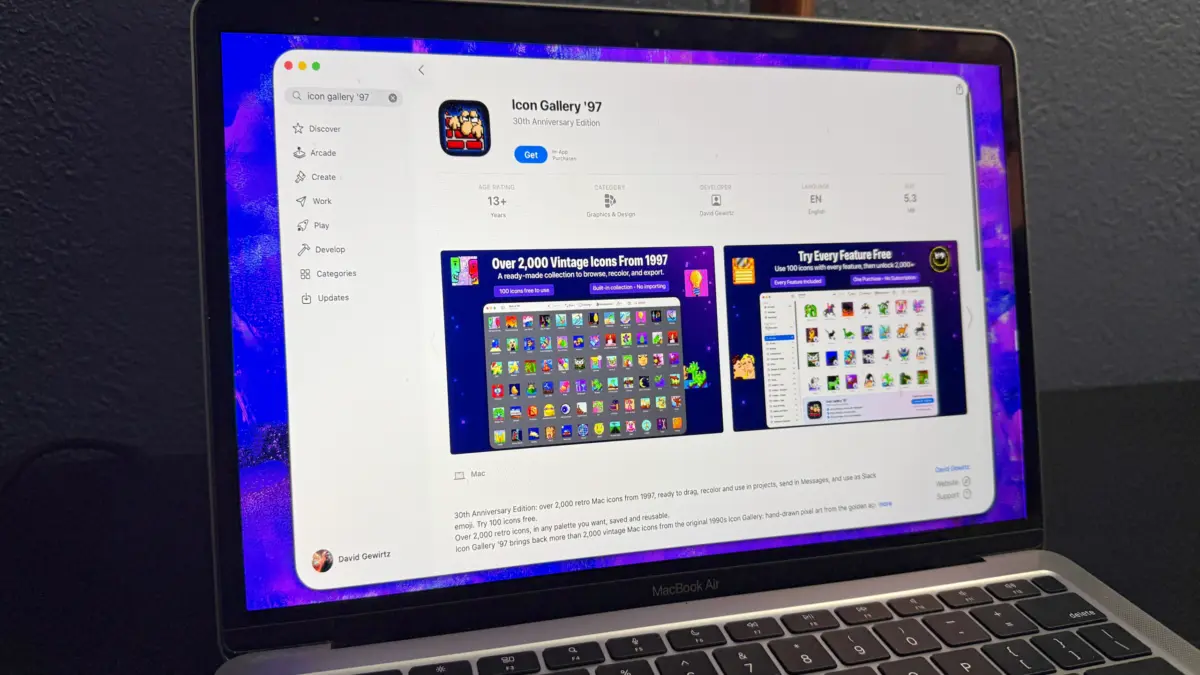
The landscape of software development is undergoing a seismic shift as generative artificial intelligence transitions from a simple autocomplete tool to a sophisticated agent capable of end-to-end application creation. This evolution was recently exemplified by the rapid development and publication of "Icon Gallery ’97," a Mac application that moved from a conceptual spark to a live product on the Apple App Store in precisely one week. Remarkably, the project was completed without the developer writing a single line of manual code, relying instead on a methodology now colloquially known as "vibe coding."
Vibe coding represents a paradigm shift where the developer acts as a high-level creative director or product manager, issuing natural language instructions to AI agents that handle the underlying syntax, logic, and debugging. In this instance, the developer utilized Anthropic’s Claude AI ecosystem—specifically Claude Desktop and the command-line tool Claude Code—to resurrect a 30-year-old library of digital assets and package them into a modern, functional utility for macOS.

The Resurrection of Legacy Media: From Macromedia to macOS
The genesis of the project dates back to 1997, an era dominated by "boxed" software and the rise of CD-ROM multimedia. The original Icon Gallery was a collection of over 2,000 hand-crafted, 32×32 pixel color icons designed for the classic Mac OS Finder. These assets were originally stored in a Macromedia Director file, a format that has long been considered obsolete following the decline of Adobe Flash and the transition to modern web standards.
The first technical hurdle involved digital archeology: extracting bitmapped data from a "dead" file format. When the legacy file was presented to Claude, the AI did not falter due to the age of the format. Instead, through a process involving 30 discrete steps and approximately four minutes of processing, the AI extracted 2,338 individual icons, converted them into modern PNG files, and organized them into topical folders. This initial success demonstrated the capability of large language models (LLMs) to interpret legacy binary structures that would typically require specialized, hard-to-find extraction tools.
The Development Timeline: A Seven-Day Sprint
The transition from a folder of images to a commercial application followed a remarkably compressed schedule, highlighting the efficiency gains offered by agentic AI.

- September 2: Initial extraction of 2,338 vintage icons from a legacy Macromedia Director file using AI.
- September 20: The conceptual birth of the app. The developer identified a need for a tool to browse and resize these retro assets for modern use cases.
- September 21–24: The core development phase. Using Claude Code, the developer issued 502 individual directives to build the app’s architecture, user interface, and feature set.
- September 25–26: Final testing and the creation of App Store promotional materials. This phase included the implementation of security measures and "adversarial testing" by AI agents.
- September 27: The completed application was submitted to Apple’s App Store Review team.
- October 1: Apple officially approved the application, and "Icon Gallery ’97" went live for public download.
Throughout this period, the developer balanced the project with a full-time professional workload, suggesting that AI-driven development significantly lowers the "barrier to entry" for side projects and niche utility tools.
Technical Architecture and Feature Integration
The resulting application is not merely a static gallery but a robust utility designed for modern workflows. To move beyond a simple "proof of concept," several sophisticated features were integrated via AI-guided prompts:
Dynamic Scaling and Image Processing
The app includes a custom engine to scale 32×32 pixel icons up to 1,024×1,024 pixels. To maintain the "retro" aesthetic, the AI was instructed to use hard-edge scaling (nearest-neighbor interpolation) rather than modern smoothing algorithms, ensuring the pixel art remained crisp at high resolutions.

Modern Workflow Exports
Recognizing the popularity of retro aesthetics in digital communication, the developer added "Export to Slack" and drag-and-drop functionality for text messaging. This allows users to utilize the 1990s-era icons as modern emojis or stickers.
Security and Intellectual Property Protection
A notable challenge arose during development when it was discovered that the app’s assets were stored as loose PNG files within the application bundle, making them vulnerable to unauthorized copying. The developer and the AI collaborated to implement a dynamic encryption system. The icons were packaged into a single scrambled file and are now decrypted in memory only when requested by the user interface.
Cloud Synchronization and Monetization
To ensure a consistent user experience across multiple devices, iCloud syncing was implemented for user "Favorites" and custom collections. Furthermore, the AI assisted in integrating Apple’s In-App Purchase (IAP) framework, allowing for a "freemium" model where a subset of icons is free, and the full library is unlocked via a one-time payment.

The "Vibe Coding" Methodology: Managing the Machine
The success of this project relied heavily on the developer’s ability to manage the AI as a human partner. This involved a "headcanon" approach where the AI was treated as a junior programmer. The developer reported that the AI occasionally exhibited "personality traits" similar to human collaborators, such as pushing back on design choices or expressing concern over App Store guidelines.
For instance, Claude expressed caution regarding the provenance of the icons, requiring the developer to confirm legal ownership of the assets created by his predecessor company in the 1990s. The AI also identified potential trademark risks, flagging icons that resembled protected characters (such as a Charlie Brown-like figure) or corporate logos (such as Caterpillar Inc.), which were subsequently removed to ensure App Store compliance.
However, the process was not entirely automated. The AI struggled significantly with the creation of App Store promotional graphics. While LLMs excel at code and text, they often fail to capture the specific layout requirements and marketing nuances of high-resolution "hero" images. Consequently, these assets had to be created manually using traditional tools like Adobe Photoshop, a task that took nearly as long as the coding of the app itself.

Supporting Data and Market Context
The rapid development of "Icon Gallery ’97" occurs against a backdrop of increasing AI adoption in the software industry. According to recent surveys, approximately 75% to 80% of developers now use some form of AI coding assistant, though most use them for snippets rather than entire applications.
Apple’s ecosystem has also evolved to support smaller creators. The developer noted the importance of the App Store Small Business Program, introduced by Apple in 2021. Under this program, developers earning less than $1 million in annual proceeds qualify for a reduced commission rate of 15%, down from the standard 30%. This shift has made the publication of niche, low-cost utility apps more financially viable for independent creators.
Additionally, the project highlighted the strictures of Apple’s TestFlight system. During the final fine-tuning phase, the developer attempted to upload 22 builds in a single day. Apple’s automated systems eventually throttled the submissions, enforcing a 24-hour cooling-off period, which serves as a reminder that even in an AI-accelerated world, human-governed platforms maintain guardrails on the pace of deployment.

Broader Impact and Industry Implications
The implications of "zero-code" App Store successes are profound for the future of the software economy.
- Democratization of Development: The ability to build functional, secure, and monetized applications through natural language dialogue opens the door for subject matter experts (designers, historians, educators) to become software publishers without years of formal CS training.
- The Shift to Intent-Based Programming: As AI models become more adept at handling syntax, the value of a developer shifts from "knowing how to code" to "knowing what to build." Architectural oversight, user experience (UX) intuition, and ethical judgment become the primary skills.
- Legacy Content Revitalization: There are trillions of files locked in obsolete formats worldwide. AI’s ability to act as a universal translator for legacy data could lead to a renaissance of "retro" content being repackaged for modern hardware.
- Security and Oversight: The use of "adversarial AI agents" to test code before submission suggests a new standard for software quality assurance, where AI is used to catch the very bugs that AI might have introduced.
"Icon Gallery ’97" stands as a case study for the "vibe coding" era. It proves that with the right guidance, modern AI can bridge the gap between 20th-century digital art and 21st-century distribution platforms, turning a week of "vibing" into a lifetime of digital presence. While the developer did not write a line of code, the project required intense curation, strategic decision-making, and a deep understanding of the Apple ecosystem—qualities that suggest the "human in the loop" remains the most critical component of the AI revolution.
