

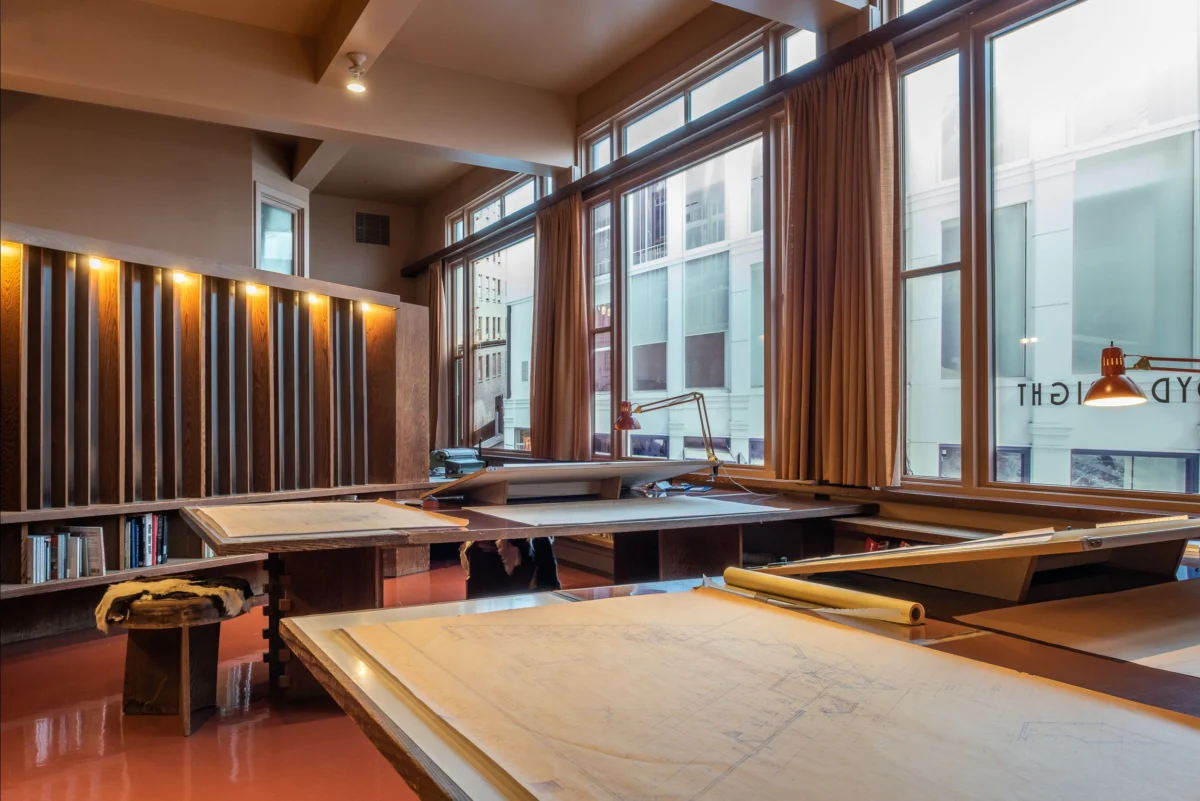
The Frank Lloyd Wright San Francisco Field Office arrived at the Hagen History Center in Erie, Pennsylvania, in a manner more reminiscent of contemporary modular furniture than a priceless architectural treasure: as a series of plywood planks packed into crates. It was 2020, and the workspace once inhabited by the most influential architect in American history had spent the previous three decades sequestered in a storage facility in Buffalo, New York. The journey of this artifact—from the bustling streets of Northern California to a museum in the Great Lakes region—represents a significant triumph in architectural preservation. Caleb Pifer, the president and CEO of the Hagen History Center, describes the arrival as the culmination of a long and circuitous path, noting that while the logistics were daunting, the ultimate success lies in the fact that the structure was saved from obscurity.
Today, the Hagen History Center officially opens the Frank Lloyd Wright Field Office Museum. This 3,000-square-foot immersive education center serves as a permanent home for the reconstructed office, housed within a purpose-built facility designed by Kidder Architects. The exhibit is not merely a static display of mid-century design; it is a meticulously curated environment intended to transport visitors into the professional world of Frank Lloyd Wright during the final, prolific decade of his life.
The Genesis of the San Francisco Workspace
The history of the field office begins in 1951. At the time, Wright was experiencing a late-career resurgence, particularly in California, where he was managing several high-profile commissions. To facilitate his work on the West Coast, Wright decided to establish a formal workspace in San Francisco in partnership with his associate, Aaron Green. Rather than constructing a new building, Wright selected the second floor of an existing structure at 133 Maiden Lane.
Despite the conventional exterior of the host building, the interior was transformed into a quintessential Wrightian environment. Utilizing redwood plywood, Wright designed a space that Mark Schmitz—a member of the Board of Trustees for Taliesin Preservation and founder of the design firm Zebradog—describes as one of the most beautiful interiors ever conceived. A notable technical feat of the office is its self-supporting nature; the structure sits upon the original floor plate without requiring structural reinforcement from the surrounding walls of the building. This "room within a room" concept allowed the office to remain an independent architectural entity, which ultimately facilitated its preservation and eventual relocation.
.jpg)
Throughout the 1950s, this office served as Wright’s only formal workspace outside of his primary residences and studios: Taliesin in Wisconsin, Taliesin West in Arizona, and his home and studio in Oak Park, Illinois. While it was primarily a private sanctuary for drafting and conceptualization, Wright occasionally hosted clients there, making it a pivotal hub for his late-period West Coast projects, including the iconic Marin County Civic Center.
A Chronology of Preservation and Relocation
The survival of the San Francisco office is largely credited to the foresight of Aaron Green. Following Wright’s death in 1959, Green continued to utilize the space for his own architectural practice for nearly thirty years. When the office finally closed in 1988, Green recognized the "star power" and historical importance of the interior. Rather than allowing it to be demolished or sold off piecemeal, he oversaw a meticulous dismantling process. Every board was tagged, every joint cataloged, and every piece crated to ensure the possibility of future reconstruction.
For the next several decades, the crated office moved through a series of owners, including museums and private collectors. It made a brief public appearance in the 1990s at the Heinz Architectural Center within the Carnegie Museum in Pittsburgh, Pennsylvania. However, during that exhibition, the office was presented behind glass, functioning as a distant artifact rather than an interactive space. After its stint in Pittsburgh, the office returned to storage, eventually landing in Buffalo before being acquired by the Hagen History Center.
The reconstruction process in Erie began in earnest in 2021. The museum team was determined to move beyond the "behind-the-glass" approach of previous exhibitions. Their goal was to create a "living" artifact that visitors could enter and experience with all their senses. This vision required a collaboration between historians, architects, and experiential designers to bridge the gap between historical preservation and modern museum technology.
Architectural Philosophy: Compression, Release, and Organic Design
The field office is a masterclass in the architectural principles that defined Wright’s career. Visitors to the museum will recognize the hallmarks of "Organic Architecture," a philosophy that promotes harmony between human habitation and the natural world. Even within the confines of an urban office building, Wright utilized local materials—most notably the California redwood—to create a warm, tactile environment that felt connected to the landscape.
.jpg)
One of the most significant architectural techniques on display is "compression and release." In many of Wright’s residential designs, this involves a low-ceilinged entryway (compression) that opens into a soaring, light-filled living space (release), directing the inhabitant’s attention toward the outdoors. In the San Francisco field office, Wright adapted this concept for a professional setting. The "release" in this instance is directed toward the drafting room. By utilizing high ceilings and strategically placed windows within the office structure, Wright drew attention to the workspace itself, emphasizing that the "action" and creative energy of the firm were the focal points of the environment.
The Immersive Visitor Experience
To enhance the educational value of the office, the Hagen History Center partnered with Zebradog to develop a suite of experiential exhibitions. The centerpiece of this effort is a sophisticated soundscape that plays throughout the tour. Visitors will hear the muffled sounds of 1950s San Francisco traffic, the rhythmic clicking of typewriters, the intermittent ringing of period-accurate telephones, and the low hum of conversation among apprentices. The intent is to create the illusion that the draftsmen have simply stepped out for lunch, leaving the office in a state of "frozen animation."
Upon entering the museum, guests are greeted by a digital representation of Wright himself. The museum commissioned an actor to portray the architect, filming the segments with equipment and lighting styles consistent with the 1950s to maintain aesthetic authenticity. Proximity sensors allow the "virtual" Wright to acknowledge guests as they approach his desk. He addresses the visitors as if they were prospective clients, discussing his theories on design and his commitment to creating structures that exist in tandem with nature.
Caleb Pifer notes that this approach was intentional. "If you don’t understand Wright, his story, his theories, and the nuances of organic architecture, can you really appreciate the design?" he asks. The exhibit aims to humanize the legendary figure, moving past the often-intimidating mythos of the "starchitect" to reveal the man and his methods.
Interactive Learning and Historical Context
The museum also features several interactive stations designed to engage visitors of all ages in the fundamentals of design. One activity allows guests to design their own "art glass" windows, reflecting Wright’s famous geometric leaded-glass patterns. Another station features "Froebel blocks," the educational toys developed by Friedrich Froebel. Wright famously credited these blocks, which he played with as a child, with shaping his understanding of geometry and spatial relationships.

The exhibition also highlights the extremes of Wright’s late-career output. On display is a recreation of the smallest structure Wright ever designed: a doghouse commissioned by a young boy for his Labrador Retriever. In stark contrast, the museum provides extensive documentation and photographs of the Marin County Civic Center, Wright’s largest realized project. Both of these designs—the minuscule and the monumental—were developed within the confines of the San Francisco field office, illustrating the immense range of Wright’s late-life creativity.
Institutional Vision and Regional Impact
The opening of the Frank Lloyd Wright Field Office Museum is a landmark event for the Hagen History Center and the city of Erie. By securing such a prestigious architectural artifact, the center has positioned itself as a destination for architectural enthusiasts and historians worldwide. The project underscores the importance of regional museums in the preservation of national heritage.
The museum is open to the public Tuesday through Saturday from 10 a.m. to 5 p.m., and on Sundays from noon to 5 p.m. Admission is priced at $14, a fee intended to support the ongoing maintenance of the exhibit and the center’s broader educational mission.
For the architectural community, the resurrection of the San Francisco office provides a rare opportunity to study Wright’s professional environment in its intended configuration. For the general public, it offers a window into the mind of a man who redefined the American built environment. As the office begins its new chapter in Pennsylvania, it stands as a testament to the power of preservation and the enduring relevance of Wright’s vision. The ultimate hope of the museum’s creators is that every guest walks away with a deeper understanding of why Frank Lloyd Wright remains a towering figure in the history of global architecture.
