

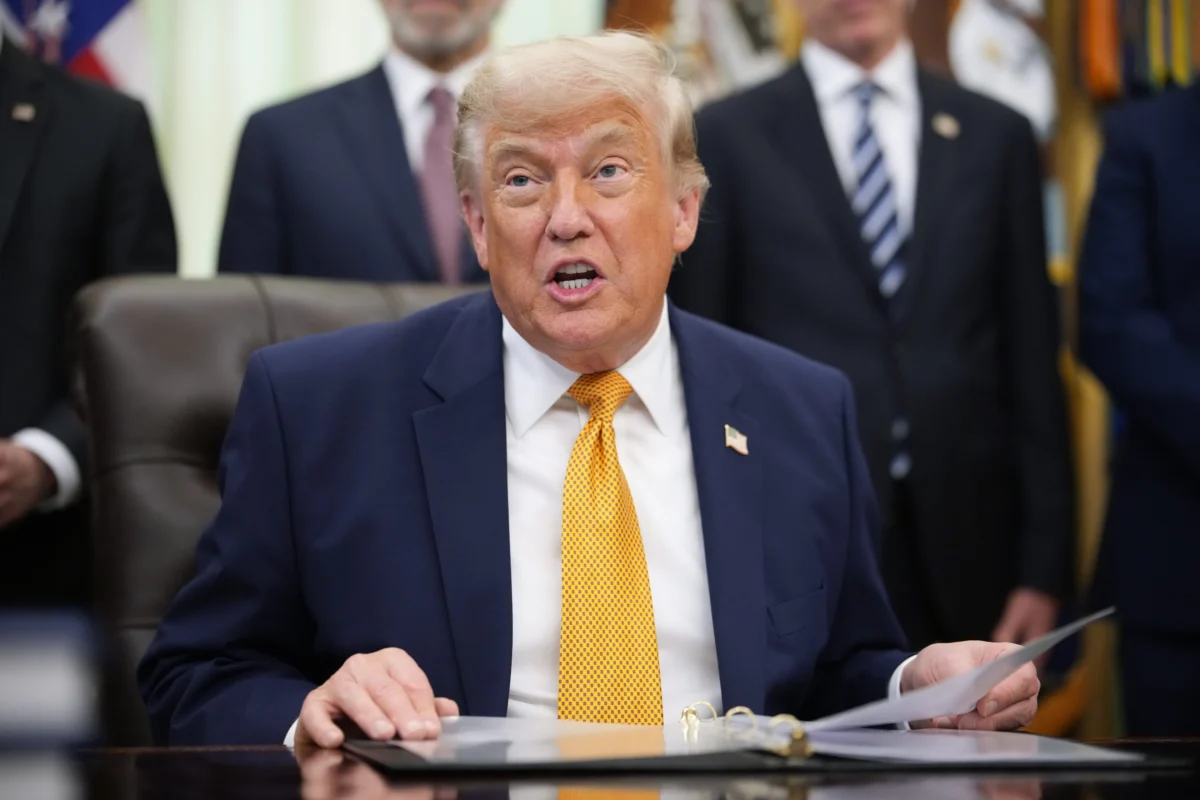
In an unexpected and dramatic move that sent ripples through Capitol Hill, former President Donald Trump on Wednesday abruptly canceled the scheduled signing of a landmark bipartisan housing bill, just over an hour before the ceremony was set to take place. The sudden reversal, announced via a post on his Truth Social platform, underscored Trump’s continued influence over Republican legislative priorities and ignited a fresh political standoff. Trump declared the housing measure would not be enacted until Congress passed the "SAVE America Act," an election integrity bill he deemed a "National Emergency."
A Bipartisan Triumph Derailed
The housing package, which had garnered rare overwhelming bipartisan support in both the House and Senate, was heralded by leaders from both parties as a significant legislative achievement. It aimed to address critical issues within the nation’s housing market, including increasing supply, enhancing affordability, and imposing caps on the number of single-family homes that private equity firms could purchase. These measures were seen as crucial responses to the escalating housing crisis, a dominant concern for American families struggling with rising costs of living. Congressional Republicans, including House Speaker Mike Johnson (R-La.) and Senate Majority Leader John Thune (R-S.D.), had actively championed the bill and publicly announced Trump’s participation in the signing ceremony in Statuary Hall at noon ET.
The legislation’s journey through Congress was itself a testament to its broad appeal, navigating a sharply divided political landscape where consensus is often elusive. Sponsors like Senator Elizabeth Warren (D-Mass.), who co-led the bill in the Senate, and Representative French Hill (R-Ark.), who chaired the House Financial Services Committee and spearheaded the bill in the House, had invested considerable effort in crafting a package that could bridge ideological divides. Its passage was poised to provide a tangible victory for lawmakers to campaign on ahead of the 2026 midterm elections, where economic issues, particularly affordability, are expected to play a decisive role. The bill represented a rare moment of unity, with lawmakers acknowledging the urgent need to tackle a housing market characterized by soaring prices, limited inventory, and increasing institutional ownership that often prices out individual buyers.
The Demand: Prioritizing the SAVE America Act
However, Trump’s directive shifted the focus dramatically. In his Truth Social post, he stated, "Today’s Housing News Conference and Signing is hereby cancelled until such time as we pass the desperately needed SAVE AMERICA ACT, which I consider to be a National Emergency. Thank you for your attention to this matter!" This followed an earlier post on Wednesday morning in which he had already begun to downplay the significance of the housing bill.
The SAVE America Act, the legislation Trump now insists upon, is a controversial election measure designed to address concerns about noncitizen voting and to implement nationwide voter identification laws. While noncitizen voting in federal elections is already illegal and widely acknowledged by election experts as extremely rare, proponents of the SAVE America Act argue it is necessary to bolster election integrity and public confidence. The House of Representatives passed its version of the SAVE America Act in February, largely along party lines. However, the bill has faced an insurmountable hurdle in the Senate, where it lacks the necessary Democratic support to overcome the legislative filibuster, which requires 60 votes to advance most legislation.
Trump has been a vocal advocate for the SAVE America Act, repeatedly pressing Republicans to either abolish the filibuster rule or find a way to attach the legislation to a larger, must-pass bill. His demand comes just hours before a scheduled meeting with Senate Republicans at the Capitol, a gathering notably arranged by Senator Rick Scott (R-Fla.) rather than through traditional GOP leadership channels, signaling Trump’s direct engagement with the party’s rank and file.
A Pattern of Eleventh-Hour Interventions
This is not the first instance of Trump utilizing his political leverage to disrupt congressional Republican priorities at the eleventh hour, specifically to push for the SAVE America Act. Just last week, he intervened in another critical process. On June 17, he used Truth Social to instruct Jay Clayton, his permanent nominee for Director of National Intelligence (DNI) and the U.S. attorney for the Southern District of New York, not to appear for a scheduled Senate confirmation hearing. This move was intended to prevent Bill Pulte, the Federal Housing Finance Agency (FHFA) head, from automatically becoming acting DNI. Pulte’s potential elevation was controversial, as he had faced opposition from Democrats and some Republicans due to his perceived willingness to target Trump’s political opponents while leading the housing agency.
Trump’s intervention in Clayton’s nomination further complicated negotiations surrounding the extension of Section 702 of the Foreign Intelligence Surveillance Act (FISA), a critical foreign surveillance provision that had lapsed earlier in June. Democrats had vowed to oppose any extension of Section 702 as long as Pulte remained in the DNI role. Trump then explicitly linked the FISA reauthorization to his demands for the SAVE America Act, posting on June 17: "[T]o add a slight bit of intrigue but, for the Good of the Nation, and the People of our Country, I will not approve FISA without THE SAVE AMERICA ACT going along with it." These consecutive interventions highlight a clear strategy by Trump to exert maximum pressure on Congress to prioritize his specific legislative agenda, regardless of other pressing matters.
The Housing Crisis: A National Imperative

The housing bill’s cancellation comes at a time when the United States is grappling with a severe and multifaceted housing crisis. Data from the National Association of Realtors (NAR) consistently shows that median home prices have surged by double-digit percentages in many markets over recent years, far outstripping wage growth. Inventory levels have remained stubbornly low, with the supply of existing homes for sale often dipping below pre-pandemic levels. This scarcity, coupled with rising mortgage rates and inflationary pressures, has made homeownership an increasingly distant dream for millions of Americans, particularly first-time buyers and those in lower-income brackets.
The bipartisan bill sought to tackle these issues through a combination of incentives for new construction, streamlining regulatory processes, and critically, addressing the growing presence of institutional investors in the single-family housing market. Research by organizations like the Urban Institute and academic studies have highlighted how private equity firms and large institutional investors have aggressively purchased single-family homes, particularly in affordable and growing markets, often converting them into rental properties. This trend has contributed to inventory shortages for traditional buyers and inflated housing costs, creating a less competitive market for individuals. The proposed cap on such purchases was a direct response to these concerns, reflecting a rare alignment between Democrats advocating for consumer protection and Republicans concerned about market distortion. The bill was not merely symbolic; it contained provisions with the potential to genuinely impact market dynamics and ease the financial burden on millions of households.
The Filibuster and Reconciliation: Procedural Minefields
The path forward for the SAVE America Act, as suggested by Speaker Johnson, involves using budget reconciliation. This congressional process allows certain spending and budgetary measures to pass the Senate with a simple majority (51 votes) rather than the 60 votes typically required to overcome a filibuster. This mechanism has historically been used for controversial legislation that aligns strictly with budgetary concerns, such as tax reform or healthcare changes.
However, the application of reconciliation is governed by strict rules, most notably the "Byrd Rule," which dictates that only provisions with a direct and significant impact on federal spending or revenues are eligible. Measures deemed "extraneous" to the budget — including those that are primarily policy-driven with incidental budgetary effects — can be stripped out by the Senate parliamentarian. There are serious questions, therefore, about whether an election bill like the SAVE America Act, which primarily focuses on voter ID and noncitizen voting, would qualify for reconciliation under these stringent Senate rules. The process itself is also notoriously complex, time-consuming, and often leads to bitter partisan battles over what constitutes a legitimate budgetary provision. Speaker Johnson, while acknowledging Trump’s "laser focus" on the bill, conceded, "The only path, I think, to get that done … you have to put it on a reconciliation bill," while simultaneously hinting at the procedural difficulties.
Reactions from Capitol Hill and Beyond
The cancellation immediately drew strong reactions from across the political spectrum. Senate Majority Leader John Thune, speaking to reporters at the Capitol, expressed his disappointment: "It’s a great piece of legislation that increases the supply of housing and the availability of credit to afford homes, so it’s an affordability issue, and eventually I hope he finds a way to sign it." His measured tone underscored the frustration among Republican leaders who had worked to deliver a tangible legislative win. Representative French Hill, the lead House sponsor, offered a diplomatic but pointed remark: "He picked the day, and now he’s chosen to change the day. So we’ll let him do that, and we’ll see what he decides to do."
Democrats were less reserved in their criticism. Senator Elizabeth Warren, a key architect of the housing bill, appeared on CNBC’s "Squawk on the Street" and slammed Trump’s decision. "This just doesn’t make any sense, other than whatever it is he wants to do is a complete indifference to the cost squeeze on American families and to genuine efforts to do something about it," Warren stated. She continued, "He could be over here trying to claim a victory lap. And instead he’s saying, no, no, he doesn’t want anything to do it. It’s because he really doesn’t care about American families." This sentiment reflects a broader Democratic argument that Trump’s actions prioritize political maneuvering over the tangible needs of average Americans, particularly on kitchen-table economic issues.
Broader Implications and the Path Forward
The standoff initiated by Trump carries significant implications for legislative progress, intra-party dynamics within the GOP, and the broader political landscape. The housing bill, a rare example of bipartisan cooperation, now faces an uncertain future. Trump has a 10-day window to either sign or veto the legislation, or allow it to become law without his signature. If he does neither, and Congress adjourns within that period, it could result in a "pocket veto," effectively killing the bill. The tight timeframe leaves little room for Congress to pass the SAVE America Act, especially given the procedural hurdles and Democratic opposition.
The incident highlights the persistent tension between Trump’s personal agenda and the legislative priorities of congressional Republican leadership. It underscores his unparalleled ability to sway the party’s direction, even from outside formal office. His meeting with Senate Republicans on Wednesday afternoon was undoubtedly shaped by this latest demand, setting the stage for what could be a tense discussion about party strategy and allegiance.
For Democrats, the episode provides potent political fodder ahead of the 2026 midterms, allowing them to frame Trump and, by extension, the Republican Party, as indifferent to the economic hardships faced by ordinary Americans. The continued lapse of FISA Section 702 also poses national security concerns, as intelligence agencies rely on the authority to monitor foreign adversaries. Trump’s linkage of this critical national security tool to the SAVE America Act adds another layer of complexity and risk to already fraught legislative negotiations.
As Washington grapples with the fallout, the episode serves as a stark reminder of the unique challenges and unpredictable nature of American politics in an era defined by deep partisan divisions and the enduring influence of figures like Donald Trump. The fate of a desperately needed housing bill, and potentially other critical legislation, now hangs in the balance, hostage to a broader political battle over election integrity and presidential power.
