

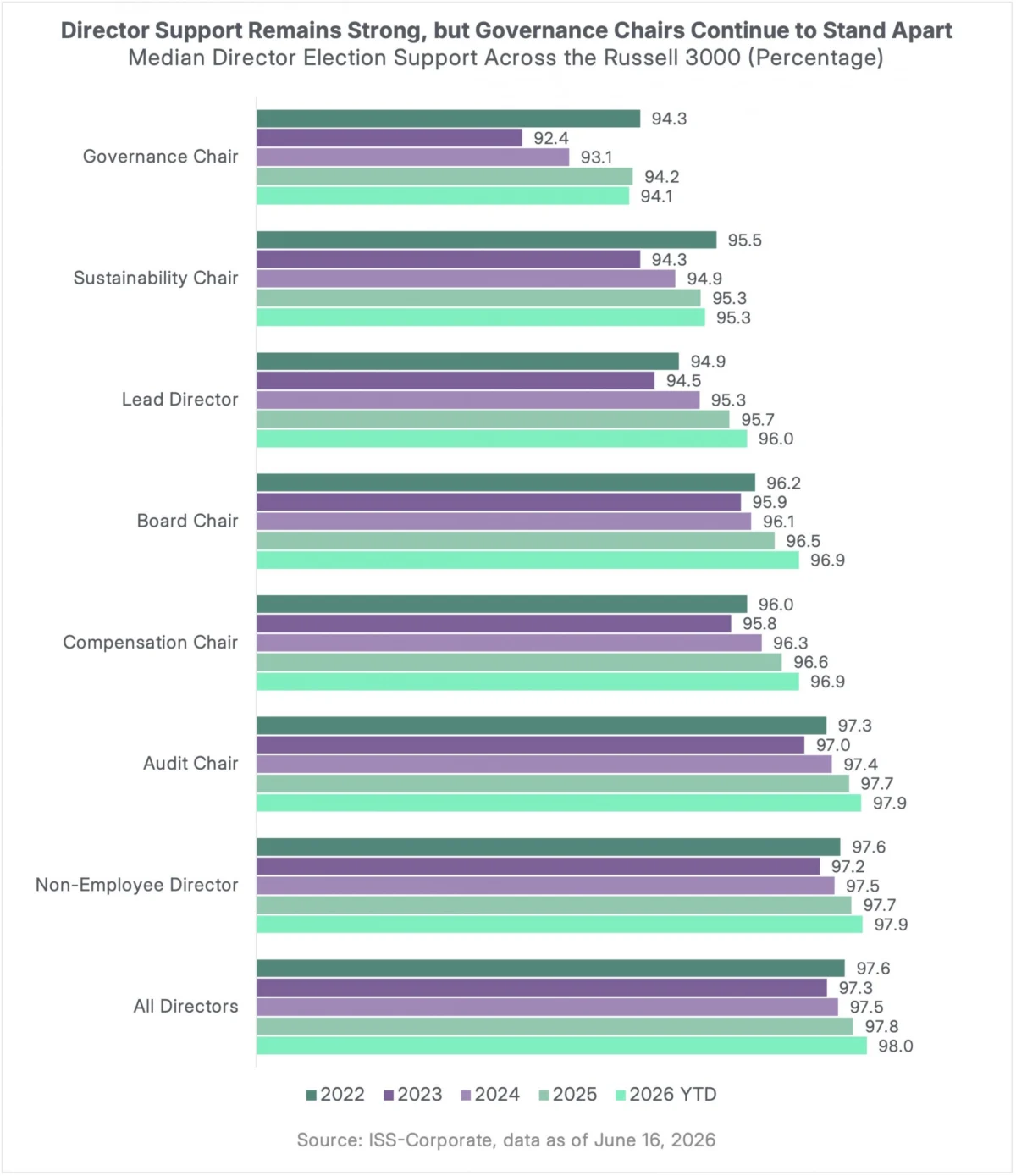
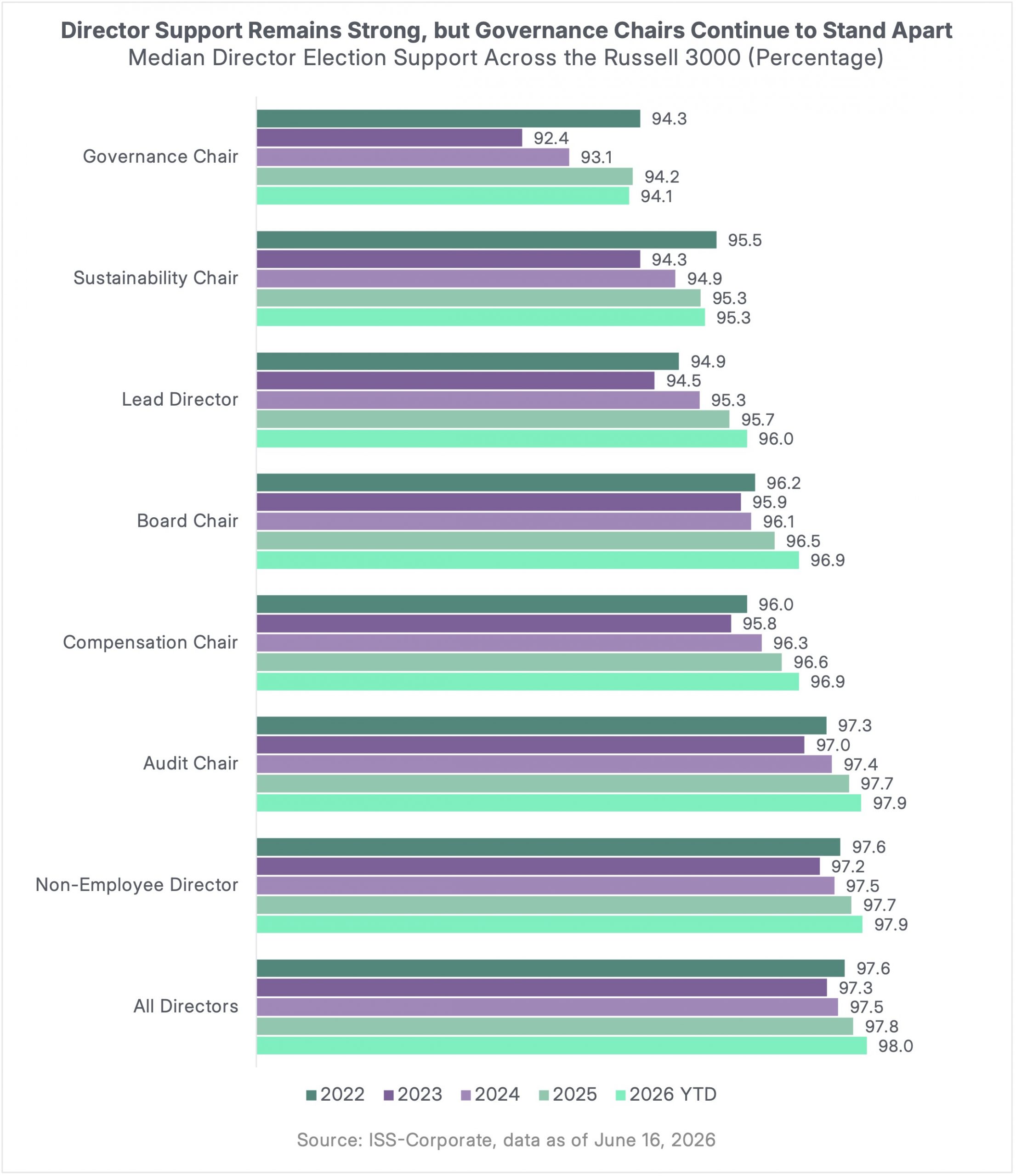
The 2026 U.S. proxy season has revealed a nuanced landscape for director support within the Russell 3000 index, with overall shareholder backing recently recovering from 2023 lows. However, a persistent divergence in support levels across various board roles underscores ongoing investor concerns regarding accountability, oversight, and director time commitments. Governance chairs, in particular, continue to receive the lowest levels of shareholder approval, signaling a persistent focus on the oversight of critical governance matters.
This analysis, drawn from an ISS-Corporate memorandum authored by Kevin Kim, Senior Associate for Compensation & Governance Advisory, and Toby Huang, Senior Associate for Data Analytics, provides a comprehensive look at director support trends. The findings are particularly relevant as companies navigate evolving investor expectations and prepare for future annual general meetings. The ISS STOXX perspective, as articulated by Subodh Mishra, Global Head of Communications, highlights the critical need for issuers to understand these trends to proactively engage with shareholders and manage potential vulnerabilities.

A Rebound from 2023 Lows, Yet Persistent Disparities Emerge
Over the past five years, the proxy season of 2023 marked a nadir for director support across all board positions within the Russell 3000. This period of heightened scrutiny likely reflected a confluence of factors, including increased focus on executive compensation practices, environmental, social, and governance (ESG) issues, and broader economic uncertainties. However, the most recent proxy season indicates a rebound, with overall support levels showing an upward trend. This recovery suggests that either companies have made progress in addressing investor concerns, or investors have recalibrated their voting thresholds in certain areas.
Despite this aggregate improvement, a significant disparity persists in the median director support based on the director’s specific role on the board. Governance chairs consistently face the most significant headwinds, garnering the lowest levels of shareholder backing. This sustained underperformance is likely attributable to the broad range of responsibilities and oversight functions falling under their purview. Issues such as compensation committee oversight, executive remuneration, board composition, shareholder rights, and the implementation of corporate governance best practices are all areas where investors often demand a high degree of accountability. When these areas fall short of investor expectations, governance chairs are frequently identified as the focal point for shareholder dissatisfaction.
Overboarding: A Growing Concern for Investor Confidence
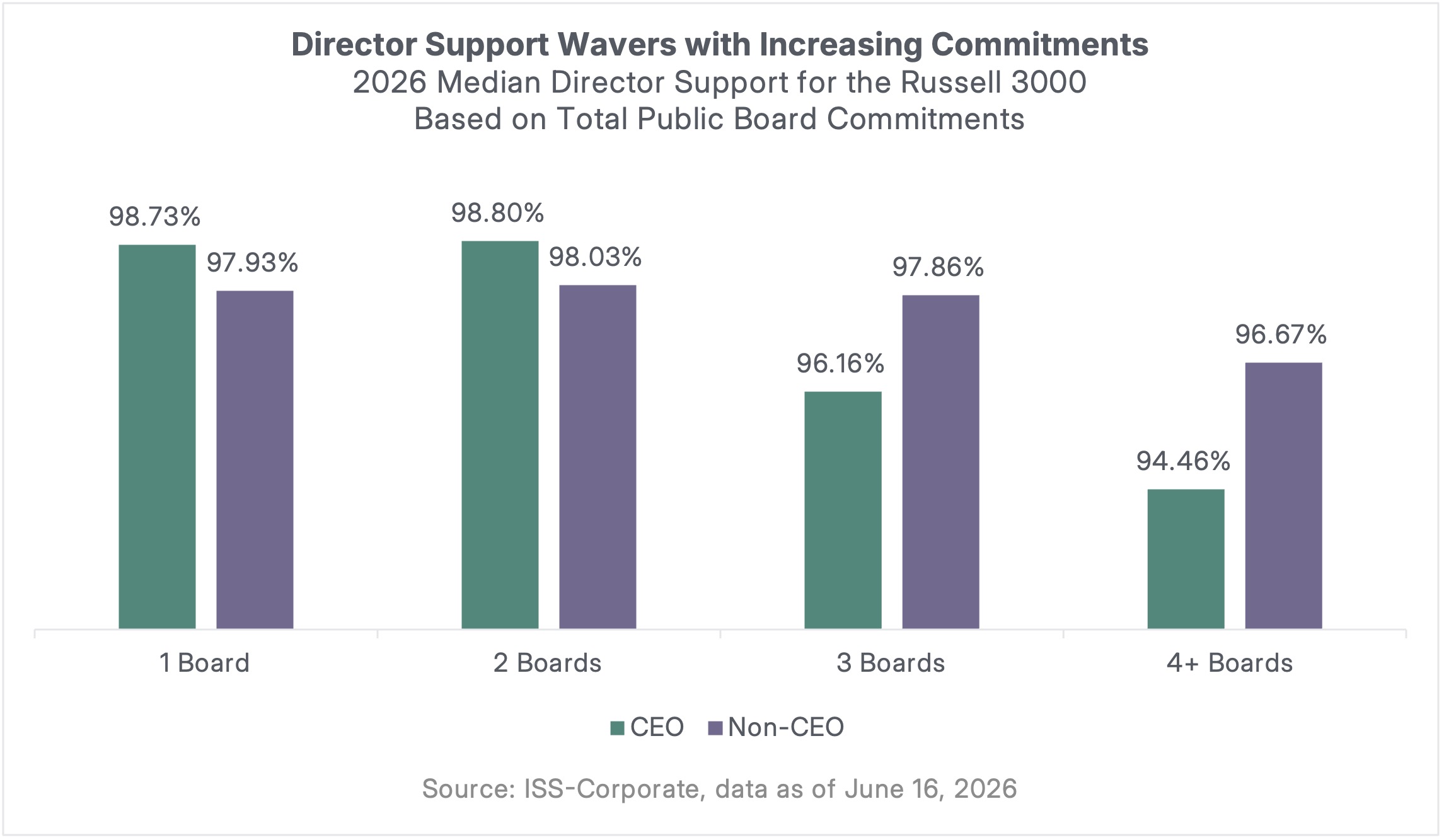
Beyond specific board roles, the issue of "overboarding" – a director holding an excessive number of public company board seats – continues to be a significant factor influencing shareholder support. Investors are increasingly scrutinizing directors who sit on multiple boards, raising concerns about their ability to dedicate sufficient time and attention to each of their directorial duties. The principle of "diligence and care" is paramount for directors, and an overburdened director may struggle to fulfill these obligations effectively.

The data presented illustrates a clear correlation: directors with more extensive board commitments generally receive lower vote support. This trend is particularly pronounced for Chief Executive Officers (CEOs) who serve on four or more boards. For these individuals, the perceived conflict between their demanding executive role and their director responsibilities on multiple boards appears to be a significant deterrent for many investors. This suggests a growing investor preference for directors who can demonstrate a focused commitment to the companies they serve. The implication is that companies seeking to attract and retain director support may need to emphasize the time commitment required for each role and ensure that their nominees are not overextended.
Board Independence: A Steady March Forward, Yet S&P 500 Leads
The trend towards increased board independence across U.S. markets, encompassing both the S&P 500 and the Russell 3000, has been a consistent theme over the years. This movement reflects a broader investor demand for boards that are free from undue influence by management and can exercise objective oversight. However, a noticeable gap persists between larger, more established companies in the S&P 500 and the broader universe of Russell 3000 companies. S&P 500 companies generally exhibit higher overall independence rates.
This divergence can be attributed to several factors. Larger companies often have more mature governance structures and greater resources to attract a diverse pool of independent directors. Furthermore, the increased prevalence of CEO board service, a factor that can constrain gains in board independence, is notable across both indexes. As more CEOs are appointed to boards, it can become more challenging to maintain a majority of truly independent directors, especially if those CEOs are also expected to serve on other boards. For the Russell 3000, achieving higher levels of board independence may require a more concerted effort to identify and recruit qualified independent candidates, potentially with a focus on ensuring that board seats held by CEOs do not hinder the overall independence of the board.

The Separation of Chair and CEO Roles: Gaining Momentum
The separation of the Board Chair and CEO roles has been a focal point of corporate governance discussions for years, with investors increasingly advocating for this structure to enhance board independence and accountability. While the S&P 500 continues to lead in overall board independence, companies within the broader Russell 3000 have historically demonstrated a higher prevalence of independent board chairs. This suggests that even in companies with a less independent overall board composition, the role of the chair has been more frequently entrusted to an independent director.
In recent years, there has been a steady and encouraging growth in the separation of these two key leadership positions across both indexes. While this dual-hatted structure (where the CEO also serves as Chair) has not yet become the minority practice in either the S&P 500 or the Russell 3000, the S&P 500 has now reached a significant threshold, with nearly 40 percent of companies appointing independent board chairs. This trend indicates a growing recognition among corporate leaders that separating these roles can lead to more robust board oversight and a more balanced distribution of power. The benefits often cited include an independent chair’s ability to lead executive sessions of independent directors, set board agendas, and provide a direct channel for communication between independent directors and shareholders.
Broader Implications for Corporate Governance and Investor Relations
The trends observed in director support within the Russell 3000 have significant implications for corporate governance practices and investor relations strategies. As investor scrutiny intensifies, companies must proactively address the concerns that are driving uneven director support.
Key implications include:
- Enhanced Focus on Governance Committee Performance: The persistent low support for governance chairs signals a need for these committees to be exceptionally transparent and effective in their oversight of critical governance matters. This includes clear communication regarding executive compensation philosophy, robust policies on ESG integration, and proactive engagement on shareholder rights.
- Strategic Director Recruitment and Time Management: Companies need to be highly discerning in their director recruitment process, prioritizing individuals who can dedicate sufficient time and expertise to their roles. The "overboarding" trend suggests a need for stricter policies on director commitments and clear articulation of time expectations. This also implies that boards may need to consider reducing the number of directorships held by existing members to ensure adequate focus.
- The Strategic Value of Board Independence: The continued emphasis on board independence underscores its importance in building investor trust. Companies that have not yet achieved high levels of independence should prioritize strategies to recruit qualified independent directors, potentially by expanding their search beyond traditional networks.
- The Growing Momentum for Independent Chairs: The steady growth in the separation of Chair and CEO roles suggests that this structure is increasingly viewed as a best practice. Companies that have not yet adopted this model may face increased pressure from investors to do so, particularly as more data emerges on its positive governance outcomes.
ISS-Corporate’s Role in Navigating the Proxy Season Landscape
ISS-Corporate’s analytical approach, which involves scrutinizing proxy voting outcomes and early filing data, is designed to provide issuers with timely insights into emerging governance trends. As investor expectations continue to evolve, particularly concerning director accountability and time commitments, companies require a clearer and earlier understanding of potential areas of vulnerability.
ISS-Corporate’s Governance advisors play a crucial role in helping companies navigate this complex landscape. They assist organizations in:
- Assessing Potential Vulnerabilities: By analyzing historical voting data and current market trends, advisors can identify specific directors or board committees that may be at risk of lower support.
- Contextualizing Voting Outcomes: Understanding the "why" behind voting decisions is critical. ISS-Corporate helps companies interpret proxy advisor recommendations and shareholder votes within the broader context of investor concerns.
- Developing Proactive Engagement Strategies: Armed with this insight, companies can develop targeted engagement strategies to address shareholder concerns before the annual general meeting. This might involve pre-engagement with major shareholders, enhanced disclosures, or adjustments to governance practices.
The 2026 proxy season, as illuminated by this analysis, underscores the dynamic nature of investor engagement and the ongoing evolution of corporate governance best practices. Companies that can effectively anticipate and respond to these trends will be better positioned to maintain strong shareholder support and foster long-term value creation. The commitment to transparency, accountability, and effective oversight remains paramount in building and sustaining investor confidence.
