

The Atlantic Ocean is currently witnessing an unprecedented environmental transformation as the Great Atlantic Sargassum Belt (GASB) expands to record-breaking proportions, reshaping the ecological and economic landscape of the Western Hemisphere. Once a localized phenomenon largely confined to the Sargasso Sea, this massive accumulation of brown macroalgae has evolved into a trans-continental "floating rainforest" that now stretches more than 8,800 kilometers from the coast of West Africa to the Gulf of Mexico. While this biomass serves as a vital sanctuary for marine life in the open ocean, its arrival on the shores of the Caribbean, Florida, and Mexico has triggered a regional emergency, threatening multibillion-dollar tourism industries and fragile coastal ecosystems.
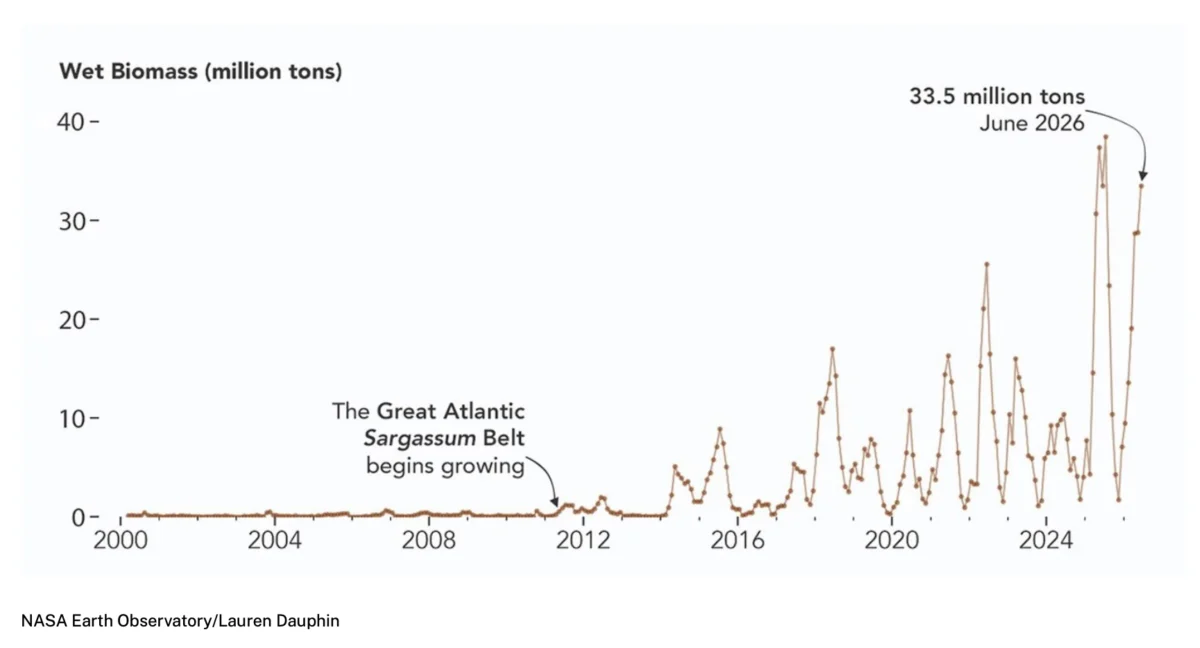
By the end of last year, scientific monitoring confirmed that the belt had reached a staggering weight of 38 million metric tons. This represents a 40% increase from the previous record set in 2022, signaling an acceleration in growth that has outpaced previous predictive models. The scale of the bloom is so vast that it is no longer merely a seasonal nuisance but a permanent fixture of the Atlantic’s biological cycle, prompting a surge in international scientific inquiry and high-level political intervention.
The Dual Identity of Sargassum: From Habitat to Hazard
To understand the complexity of the current crisis, scientists emphasize the dual nature of sargassum. In the deep ocean, these mats of seaweed are essential to marine biodiversity. Known as a "floating rainforest," sargassum provides a mobile habitat for more than 100 species of fish, dozens of species of sea turtles—including the endangered loggerhead—and various marine birds and invertebrates. It serves as a critical nursery for young sea life, offering both food and protection from predators in the vast, otherwise featureless expanse of the open sea.
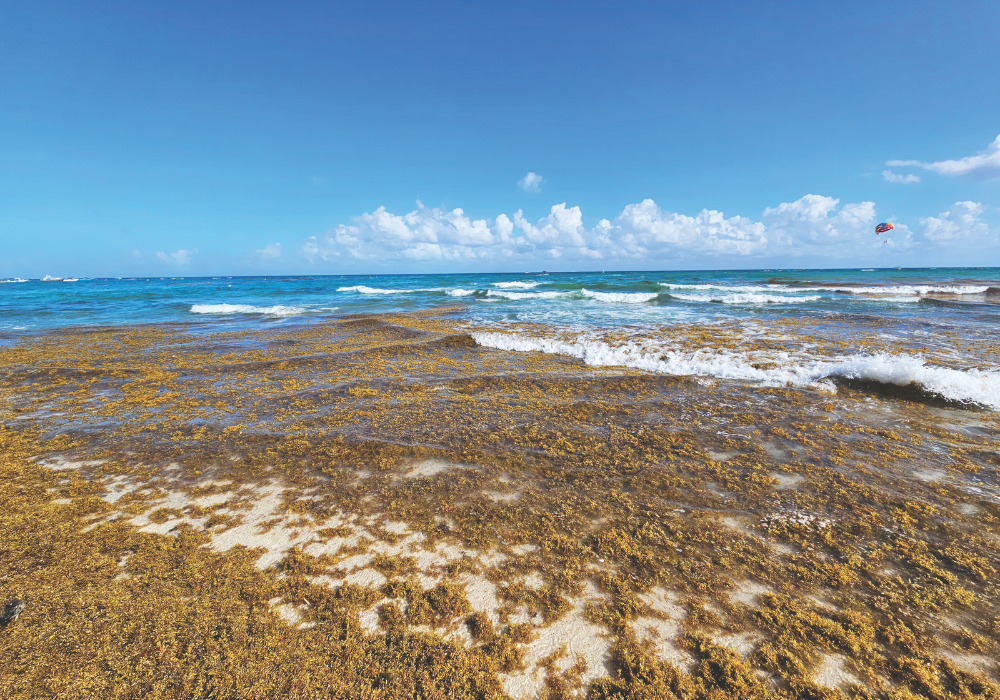
However, the context changes entirely when this vegetation drifts into shallow coastal waters. As the sargassum mats approach the shore, they begin to trap heat and block sunlight, which can be fatal to coral reefs and seagrass beds located beneath the surface. When the seaweed eventually makes landfall, it accumulates in thick, rotting piles that can reach several feet in depth.
The decomposition process is particularly destructive. As the organic matter breaks down, it consumes oxygen in the water, creating "hypoxic zones" or dead zones where fish and other marine organisms cannot survive. Furthermore, the rotting seaweed releases hydrogen sulfide gas, which produces a pungent, "rotten egg" odor. This gas is not only an irritant to the respiratory systems of residents and tourists but also has the capacity to corrode electronics and metal infrastructure in coastal homes and businesses.
A Growing Regional Emergency: Political and Economic Fallout
The social and economic consequences of the sargassum inundation have reached a breaking point. In June 2025, President Luis Abinader of the Dominican Republic formally declared the situation a "regional emergency," calling for a unified international response to protect the Caribbean’s blue economy. The Dominican Republic, like many of its neighbors, relies heavily on its pristine beaches to drive tourism, which accounts for a significant portion of its Gross Domestic Product (GDP).
In Mexico’s Riviera Maya, including popular destinations like Cancun, Tulum, and Playa del Carmen, local authorities have spent millions of dollars annually on manual removal and the installation of offshore barriers. Despite these efforts, the sheer volume of the seaweed often overwhelms physical defenses. In Florida, the presence of the belt has forced local municipalities to reconsider beach management strategies, as the costs of cleaning and transporting thousands of tons of seaweed to landfills become unsustainable.
Economists warn that if the sargassum blooms continue at this trajectory, the long-term impact on property values and tourism revenue could be catastrophic. "We are seeing a fundamental shift in the attractiveness of Caribbean destinations," noted one regional economic analyst. "If a traveler cannot access the water or breathe the air comfortably, the primary draw of these islands is neutralized."
Chronology of the Great Atlantic Sargassum Belt
The emergence of the GASB is a relatively recent phenomenon in geological terms, but its growth has been exponential.
- 2011: The First Detection. Scientists first identified a massive, anomalous bloom of sargassum in the tropical Atlantic, distinct from the traditional Sargasso Sea. This marked the beginning of what would become the Great Atlantic Sargassum Belt.
- 2015–2018: Expansion and Consolidation. The belt began to appear annually, with significant peaks in 2015 and a then-record-breaking bloom in 2018. During this period, researchers began to link the growth to nutrient runoff from major river systems.
- 2022: The Previous Record. The belt reached a mass that alarmed the global scientific community, leading to increased funding for satellite tracking and coastal defense research.
- 2024–2025: The Current Surge. The belt expanded to 8,800 kilometers in length and reached 38 million metric tons, a 40% jump from 2022 levels.
- 2025 (June): Political Escalation. The Dominican Republic leads a diplomatic push to treat sargassum as a transboundary environmental crisis rather than a local sanitation issue.
Scientific Drivers: Why the Seaweed is Exploding
There is no single "smoking gun" responsible for the sargassum explosion. Instead, researchers point to a "perfect storm" of environmental factors driven largely by human activity and climate change. Brian Lapointe, a principal investigator at Harbor Branch Oceanographic Institute at Florida Atlantic University, has been at the forefront of this research.
"The climate is having a very significant effect on this bloom, but there are many underlying drivers," Lapointe explained. He cited a combination of high ocean temperatures, extreme rainfall patterns, and shifting wind cycles.
One of the primary drivers is nutrient enrichment, often referred to as "ocean eutrophication." Massive amounts of nitrogen and phosphorus from agricultural fertilizers and untreated sewage are flowing into the Atlantic via the Amazon, Congo, and Mississippi Rivers. When these nutrients hit the warm, sunlit waters of the tropical Atlantic, they act as a super-charged fertilizer for sargassum.
Additionally, climate change has altered ocean currents and upwelling patterns. Dust from the Sahara Desert, which contains iron and other minerals, is blown across the Atlantic and deposited into the ocean, further fueling the growth of the algae. While the southern belt thrives, a curious counter-phenomenon is occurring in the North Atlantic. The original Sargasso Sea, located between Nova Scotia and Bermuda, has seen its sargassum levels dwindle by approximately 90% since 2015. Scientists attribute this decline to rising water temperatures that have exceeded the thermal tolerance of the seaweed in that specific region, causing the "floating rainforest" to shift its range southward toward the equator.
Space-Age Solutions: NASA’s Role in Monitoring
Given the speed at which the Atlantic seaweed situation is evolving, traditional boat-based monitoring is no longer sufficient. Scientists have enlisted NASA to track the bloom from space using advanced satellite technology. Instruments such as the Moderate Resolution Imaging Spectroradiometer (MODIS) on NASA’s Terra and Aqua satellites allow researchers to detect the unique spectral signature of sargassum.
This satellite data is processed to create the "Alternative Floating Algae Index," which provides real-time maps of where the seaweed is densest and where it is likely to drift next. By analyzing ocean currents and wind vectors, NASA and its partners can provide coastal managers with several weeks of lead time before a massive "inundation event" occurs. This early warning system is crucial for mobilizing cleanup crews and deploying floating barriers to protect sensitive coral reefs and harbor entrances.
Broader Implications and the Search for a "Sargassum Economy"
As the world adjusts to the reality of a permanent sargassum belt, the focus is shifting from mere disposal to "valorization"—the process of turning the seaweed into a valuable resource. Entrepreneurs and researchers are exploring several avenues:
- Biofuels and Energy: The high organic content of sargassum makes it a candidate for anaerobic digestion to produce methane gas.
- Construction Materials: In Mexico, some innovators have successfully used dried and compressed sargassum to create "seaweed bricks" for sustainable housing.
- Agricultural Fertilizer: While sargassum is rich in nutrients, it also often contains high levels of heavy metals like arsenic and cadmium, which it absorbs from the ocean. This complicates its use in food crops and requires expensive processing to make it safe for agricultural use.
- Carbon Sequestration: There is ongoing debate about the potential for sinking sargassum into the deep ocean as a way to sequester carbon dioxide and mitigate climate change, though the ecological impact on the deep-sea floor remains unknown.
Despite these potential uses, the sheer volume of the seaweed remains the primary challenge. Processing 38 million metric tons of biomass requires an industrial infrastructure that does not yet exist.
Conclusion: A New Normal for the Atlantic
The transformation of the Great Atlantic Sargassum Belt from a biological curiosity into a 8,800-kilometer environmental juggernaut represents one of the most visible signs of a changing ocean. The 40% increase in biomass over just a few years serves as a stark reminder of how quickly marine ecosystems can respond to human-induced changes in climate and nutrient cycles.
For the nations of the Caribbean and the coastal communities of Florida and Mexico, the sargassum crisis is no longer a "seasonal problem" but a long-term strategic challenge. Addressing it will require more than just tractors on beaches; it will necessitate international cooperation on river management, carbon emissions, and the development of new technologies to monitor and utilize the vast "floating rainforest" that now defines the Atlantic Ocean. As the belt continues to change shape and scale, the race between scientific understanding and ecological collapse intensifies, placing the future of the Atlantic’s blue economy at a critical crossroads.
