

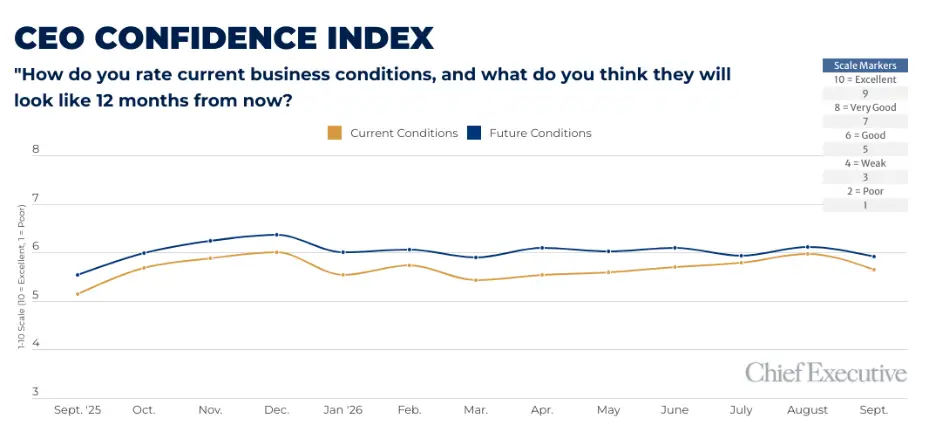
America’s chief executive officers exhibited a notable shift towards caution in September, marking the first significant downgrade in their assessment of current business conditions since March. This sentiment reflects a growing unease about the trajectory of economic growth and the persistent pressure of rising costs on corporate profit margins. The latest CEO Confidence Index, compiled by Chief Executive, reveals a tangible dip in optimism, signaling a potential turning point in corporate outlooks as the year progresses.
Economic Outlook Dims as CEOs Temper Expectations
The September iteration of the Chief Executive CEO Confidence Index, which surveyed over 150 U.S. CEOs from September 1st to 3rd, registered a score of 5.6 out of 10 for current business conditions. This represents a nearly 6% decline from the 6.0 score recorded in August, making it the most substantial one-month decrease since January. That earlier dip was attributed to uncertainties surrounding Washington’s policy decisions. Despite this recent retreat, the index remains 2% higher than its starting point at the beginning of the year and is broadly in line with the 2026 average of 5.7.
This downturn in current conditions is echoed in CEOs’ forward-looking statements. Their 12-month outlook for the economy also saw a reduction, albeit a less pronounced one. The forecast declined by 3%, settling at 5.9 from 6.1 in August. While this still suggests an expectation for conditions to improve from the present, the widening gap between current assessments and future expectations doesn’t necessarily indicate a surge in optimism for the coming year. Instead, it points to a more rapid deterioration in the perception of present conditions than in the outlook for what lies ahead. As one CEO candidly remarked, "Things can’t get much worse from a disruption standpoint."
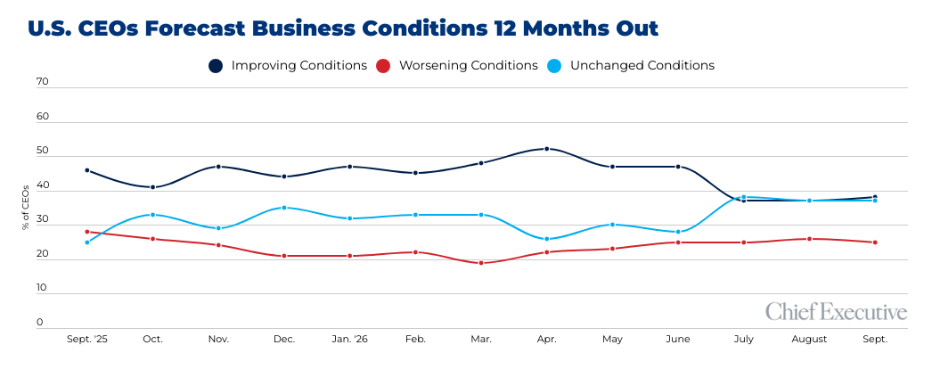
The distribution of expectations for the next 12 months remained largely consistent with August figures. Approximately 38% of CEOs anticipate business conditions to improve, while 37% foresee little change, and 25% expect a deterioration. However, a more granular analysis reveals a heightened sense of caution within the middle market, particularly among smaller enterprises. CEOs of companies with annual revenues between $10 million and $24.9 million reported that 36% expect conditions to worsen over the next year, a figure significantly higher than the overall 25% average. This suggests that smaller players in the middle market are feeling the economic headwinds more acutely.
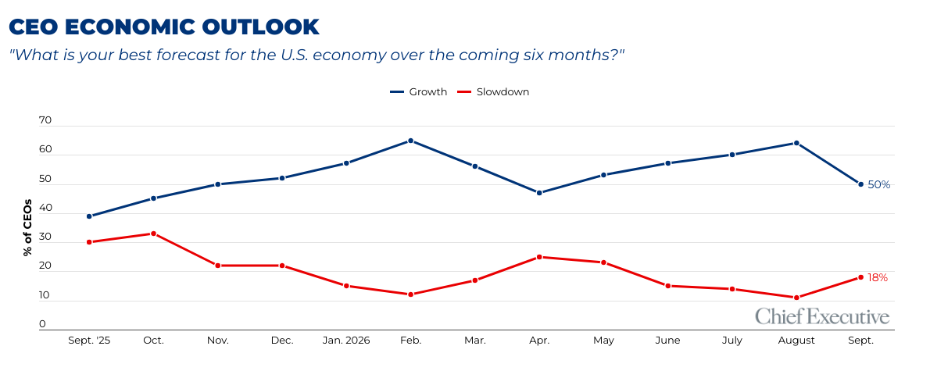
The most striking shift in the September data lies in CEOs’ expectations for the U.S. economy over the next six months. Only half of the surveyed leaders now forecast economic growth, a sharp decline from 64% in August. Concurrently, the proportion expecting the economy to remain flat held steady at 32%, while those anticipating a slowdown increased to 18%. This marks the highest share of CEOs predicting an economic slowdown since May, signaling a palpable cooling of near-term economic momentum.
Factors Contributing to Increased Caution
CEOs’ commentary points to a multifaceted array of concerns contributing to this tempered outlook, rather than a single dominant culprit. Demand remains a significant differentiator, with some sectors experiencing robust pipelines and healthy spending, while others report customers delaying purchases or significantly pulling back.
"Demand remains strong, particularly across data centers, electrification, energy storage, and critical power infrastructure," noted one industrial manufacturing CEO. However, this positive sentiment was qualified by ongoing challenges related to supply-chain constraints, extended lead times, and tariff uncertainties, which temper their overall outlook.
Justin Moore, CEO of Mile Marker Industries, a Florida-based automotive manufacturer, described a bifurcated market reality. "Premium buyers are still spending, lower-end buyers are increasing, but the hardest negative sales impact has been that middle-class buyer," he observed. "They are saving more, spending less, and shifting down or up depending on their economics at home." This suggests a polarization of consumer behavior, with distinct segments reacting differently to economic pressures.
Beyond demand fluctuations, rising costs, geopolitical tensions, and government policies were repeatedly cited as key drivers of CEO apprehension. Inflationary pressures, particularly concerning labor and materials, are directly impacting profit margins. "Pricing power is eroding, and labor costs continue to increase well beyond headline inflation," stated the CEO of a Texas-based construction business.
A professional services CEO encapsulated the prevailing sentiment: "Uncertainty and trade relationships continue to be crucial. Real costs being passed to consumers are hurting the economy overall. If we didn’t have some of this, the economy would be booming. The fundamentals are strong; the noise on top is a mess/wrench in the works for products and manufacturers. Full stop." This highlights the disconnect between underlying economic strength and the disruptive impact of external factors.
Profitability Under Pressure from Rising Operating Expenses
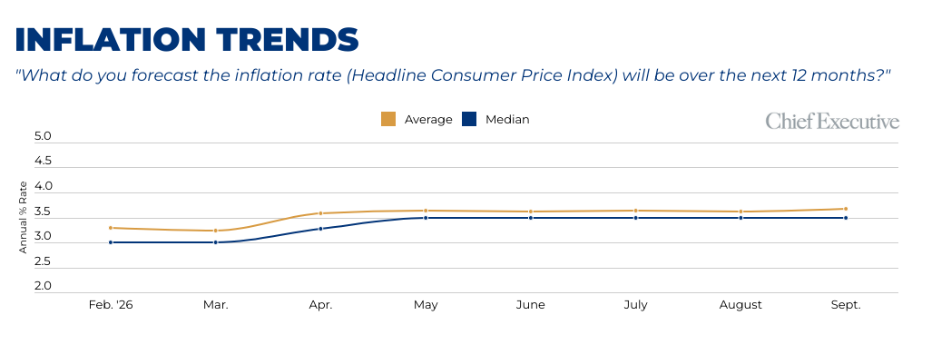
While inflation expectations have remained relatively stable in recent months, with the median forecast for headline CPI over the next 12 months at 3.5% (average 3.7%, a slight tick from August’s 3.6%), the impact of cost pressures is becoming increasingly evident in CEOs’ profit forecasts. Only 61% of CEOs polled in September expect to achieve higher profits in 2026 compared to 2025, a decrease from 69% in August and 67% in January.
The rising cost of operations is a significant contributor to this squeeze. Nearly eight in ten CEOs—78%—anticipate continued increases in operating expenses this year, up from 73% in August and 62% at the start of 2026. This upward trend in operational costs is becoming harder for businesses to absorb.
Merritt Becker, CEO of Innovance, noted, "Inflationary pressure on labor and material continues to challenge gross margins. Accelerating demand offers some pricing opportunities, but timing lags inflation’s rate of increase." This points to a delicate balancing act for businesses trying to pass on costs without alienating customers.
Michael McQueeney, president and owner of KR Johnson, a home improvement and hardware company that operates on the input side of the economy and typically leads broader economic trends by 8-12 months, issued a stark warning. "Manufacturers are bleeding down inventory and ordering lower quantities. Price increases are coming from every direction, which will lead to overall inflation increases over the next 8-12 months." His perspective suggests that the current inflationary pressures may have a more prolonged and significant impact on the wider economy than currently perceived.
Investment Plans Remain Resilient, but Hiring Moderates
Despite the prevailing headwinds and concerns about profitability, CEOs are not broadly scaling back their investment plans. Half of the CEOs surveyed expect to increase capital expenditures in the coming months, a slight uptick from 45% at the beginning of the year. This indicates a continued commitment to long-term growth and operational enhancements.
However, hiring intentions appear more restrained. While 45% of CEOs expect to increase headcount, this figure is down from 53% in January. This suggests that while companies are investing in their future, they are adopting a more cautious approach to expanding their workforce, perhaps anticipating a period of slower growth or seeking to optimize existing staff levels.
For many executives, the current investment focus is geared towards enhancing capacity and productivity to sustain top-line growth. "We are trying to navigate an environment where investment is clearly necessary to generate growth, but capital to do so is virtually non-existent," remarked one PE-backed CEO, highlighting the challenges of securing funding in the current economic climate.
Allen Krueger Jr., president of Krueger Communications, a managed IT and cybersecurity company, echoed the sentiment of uncertainty. "Unpredictable forecasts mean unpredictable results with unknown solutions to overcome. Relentless effort is all we have," he stated, underscoring the need for adaptability and perseverance in navigating a complex business landscape.
Despite the mixed signals regarding economic growth and profitability, revenue forecasts have remained relatively resilient. A substantial 73% of CEOs expect their companies to generate higher revenue in 2026 than in 2025. However, this figure is a slight decrease from 75% in August and 76% at the start of the year, suggesting that even revenue growth expectations are experiencing a subtle moderation. This continued, albeit slightly diminished, optimism for revenue growth may be a key factor preventing a more drastic pullback in capital expenditures. The underlying strength of some sectors and the ongoing need to invest in competitive capabilities appear to be sustaining a baseline level of investment, even amidst a cloud of increasing economic uncertainty and cost pressures.
