

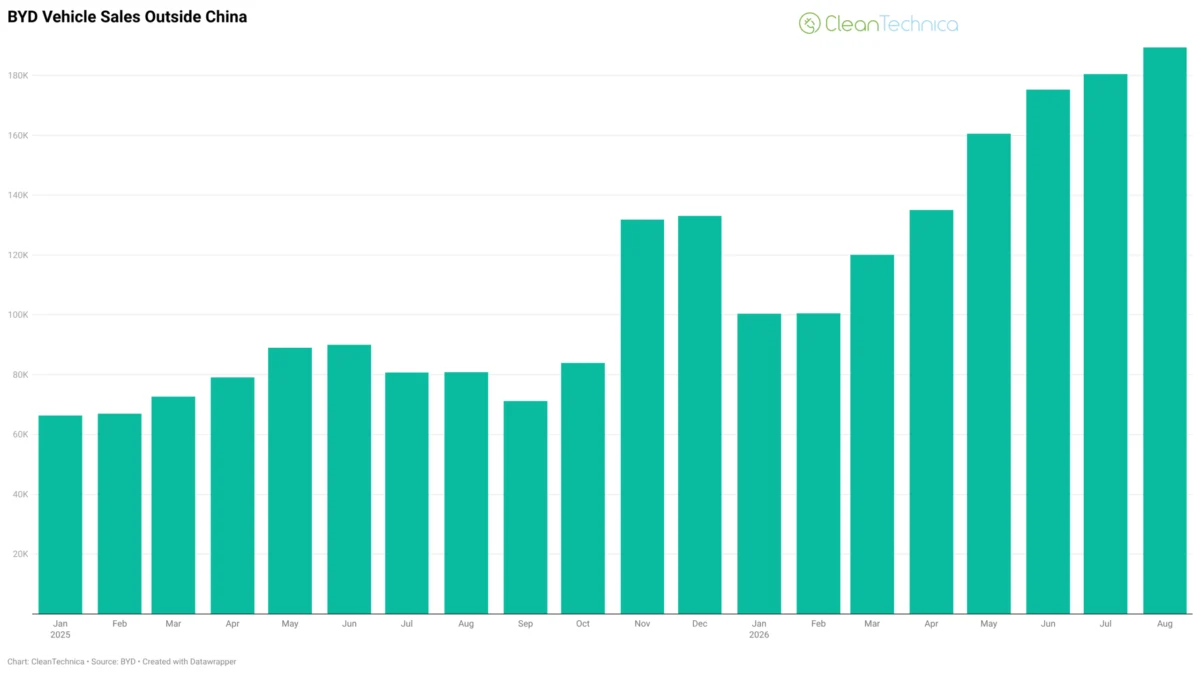
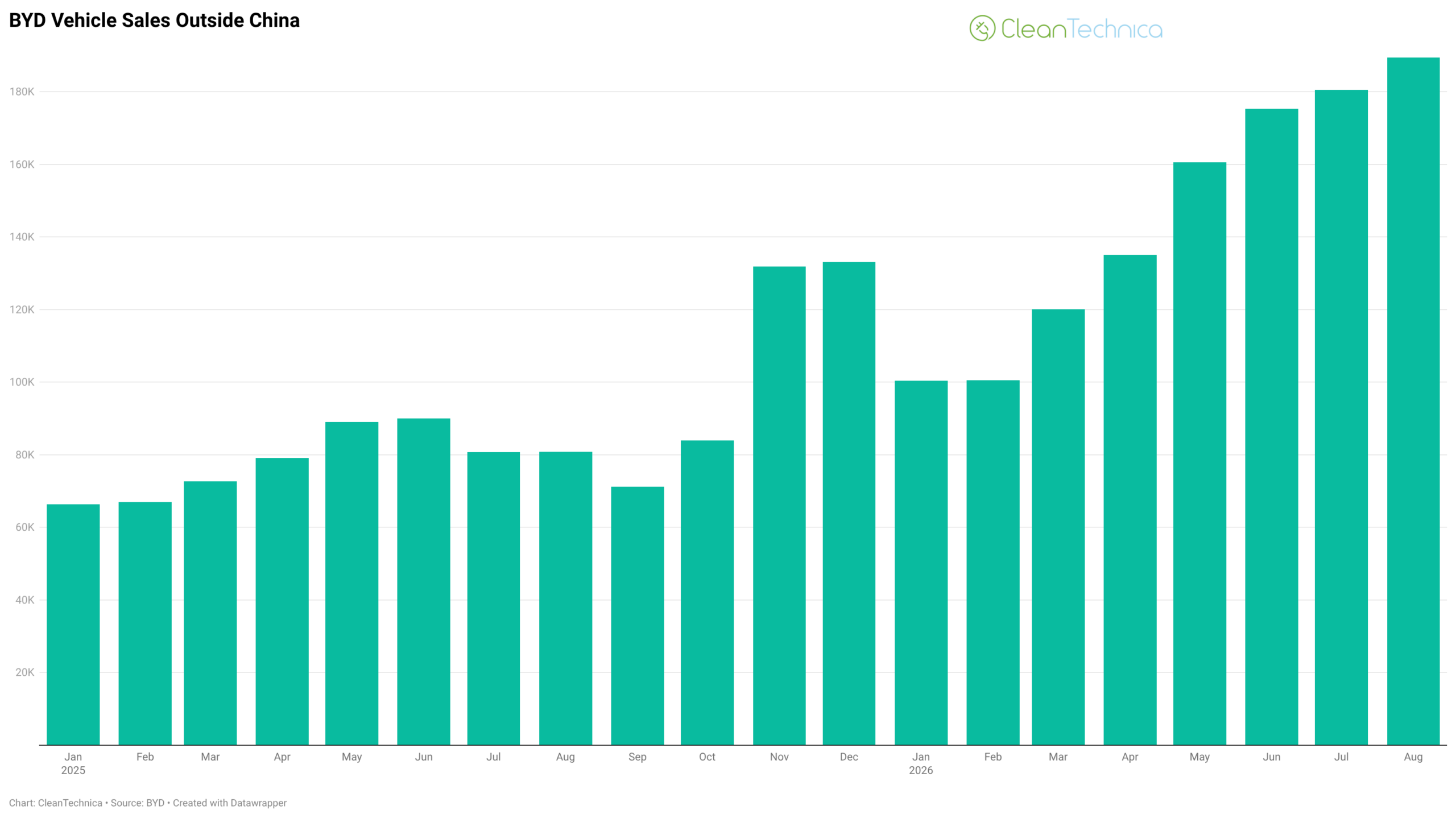
BYD, the world’s leading manufacturer of new energy vehicles (NEVs), has reported a record-breaking performance in international markets for August, signaling a definitive shift in the company’s long-term growth strategy from domestic dominance toward global ubiquity. The Shenzhen-based automaker disclosed that it sold 189,466 vehicles outside of China in August, representing a staggering 134.5% increase compared to the same period in the previous year. This performance marks not only a monthly record but also a clear indication that the company’s aggressive push into Europe, Southeast Asia, and Latin America is yielding significant dividends. On a month-over-month basis, the company achieved a 5% growth rate, maintaining a consistent upward trajectory that has seen export volumes climb steadily throughout the current fiscal year.
The surge in August sales is part of a broader, more ambitious roadmap. According to internal targets and reports from financial institutions including Deutsche Bank and Citi, BYD is now aiming to sell 2.5 million vehicles annually in overseas markets by 2027. This target represents a massive leap from current levels. For the first eight months of 2026, the company has already moved 1,162,260 vehicles outside of China, averaging roughly 145,282 units per month. If this pace continues, BYD is on track to exceed 1.74 million overseas sales for the full year, with some analysts suggesting the final figure could approach the 2 million mark if supply chain constraints ease.
A Strategic Pivot from Domestic Saturation to Global Growth
The history of the automotive industry has often seen legacy manufacturers from the United States, Europe, and Japan turn to China as a "cash cow" to offset stagnant growth in their home markets. For decades, companies like Volkswagen, General Motors, and Toyota relied on the rapid expansion of the Chinese middle class to fuel their global profits. However, the tide has turned with the rapid electrification of the Chinese market. Domestic players, led by BYD, leveraged their expertise in battery technology and vertical integration to capture the hearts of Chinese consumers, leaving legacy foreign brands struggling to maintain relevance.
As the Chinese market reaches a level of maturity and faces intensified price competition, BYD has adopted the playbook once used by Western firms: seeking growth in international territories. The company’s transition from a regional leader to a global powerhouse is driven by the necessity to find new outlets for its massive production capacity. With the domestic Chinese EV market experiencing a period of cooling growth after years of exponential expansion, the international stage has become the primary theater for BYD’s next chapter of evolution.
Overcoming Logistical Bottlenecks and Shipping Constraints
Despite the record-breaking sales figures, BYD’s management has indicated that the company’s potential has been somewhat throttled by logistical challenges. In a recent note to clients, Deutsche Bank highlighted that shipping constraints had limited overseas deliveries throughout the first half of the year. Had the global maritime logistics been more favorable, the company’s export volumes likely would have been even higher.
To address these bottlenecks, BYD has taken the unprecedented step of commissioning its own fleet of massive car-carrying vessels, known as Ro-Ro (Roll-on/Roll-off) ships. The "BYD Explorer No. 1," which set sail earlier this year, is the first of several planned vessels designed to ensure that the company is not at the mercy of third-party shipping availability or fluctuating freight rates. By controlling its own logistics chain, BYD aims to stabilize its delivery schedules and reduce the landed cost of its vehicles in distant markets like Europe and South America.
Localization and the Manufacturing Footprint
A central pillar of BYD’s strategy to reach 2.5 million overseas sales by 2027 is the transition from a "made-in-China" export model to a "localized production" model. Exporting vehicles from China is increasingly fraught with geopolitical risks and economic barriers, specifically in the form of import tariffs. By building factories in key regions, BYD can bypass these hurdles while also tailoring its products to local consumer preferences.
In Europe, BYD’s plant in Hungary is a cornerstone of this strategy. Management expects assembly operations in Hungary to commence as early as November or December of this year. This facility will serve as a gateway to the European Union, allowing BYD to avoid the roughly 27% tariff currently imposed on Chinese-made battery electric vehicles (BEVs). Analysts at Citi have noted that local production in Europe and Brazil could save the company more than 40,000 yuan (approximately $5,961) per vehicle in tariff costs. These savings are expected to more than offset the initial costs associated with ramping up new manufacturing facilities.
Beyond Hungary, BYD is actively evaluating additional manufacturing sites. The company has already inaugurated a plant in Thailand, which serves the Southeast Asian market, and is moving forward with a major complex in Brazil. These regional hubs are essential for BYD to compete on price with local incumbents and other global players who have long-established manufacturing bases in these territories.
Navigating the Global Tariff Landscape
The geopolitical environment has become increasingly complex for Chinese automakers. The European Union’s anti-subsidy probe and subsequent tariff hikes, along with Brazil’s 34% import tariff, represent significant headwinds. However, BYD’s management remains optimistic that its cost advantages, rooted in high levels of vertical integration, will allow it to remain competitive even in the face of protectionist measures.
By manufacturing its own batteries, semiconductors, and electric motors, BYD maintains a cost structure that is significantly lower than that of most Western competitors. This "efficiency cushion" allows the company to absorb some tariff costs while it transitions toward local production. Furthermore, the push for 2.5 million overseas sales is not just about volume; it is about establishing a permanent presence that makes the company a "local" player in the eyes of regulators and consumers alike.

Maintaining Momentum in the Domestic Chinese Market
While the international expansion takes center stage, BYD has no intention of ceding ground in its home market. China remains the world’s largest automotive market and the most competitive arena for electric vehicles. In 2025, BYD held nearly 15% of the total Chinese auto market share. By July of the current year, that figure had climbed to approximately 18%.
The company has set an aggressive internal target to reach a 25% share of the Chinese market. Achieving this would be an extraordinary feat, given the diversity of the Chinese market and the sheer number of competing brands. To reach this goal, BYD is continuously refreshing its product lineup, particularly with its "fifth-generation" DM-i plug-in hybrid technology, which offers exceptional fuel efficiency and range, appealing to consumers who are not yet ready to make the full leap to pure battery electric vehicles.
Industry Implications and Future Outlook
The rise of BYD as a global export giant has profound implications for the global automotive industry. Traditional powerhouses in Germany, Japan, and the United States are facing a "China Shock" 2.0. Unlike the first wave of Chinese manufacturing, which focused on low-cost consumer goods, this wave involves high-tech, capital-intensive products that sit at the heart of the industrial economy.
Analysts suggest that BYD’s success is forcing legacy automakers to accelerate their own EV development cycles and rethink their supply chain strategies. The 2027 target of 2.5 million overseas sales would place BYD in the top tier of global automakers by volume, potentially rivaling the export figures of long-established giants.
As BYD continues to scale its operations, the focus will likely shift toward software integration, autonomous driving capabilities, and brand building. While the company has mastered the hardware and the battery, the next challenge will be winning the "mindshare" of consumers in markets where brand loyalty to domestic or European marques remains high. With record-breaking August sales and a clear roadmap for localization, BYD has positioned itself not just as a Chinese success story, but as a primary architect of the global electric mobility era.
