

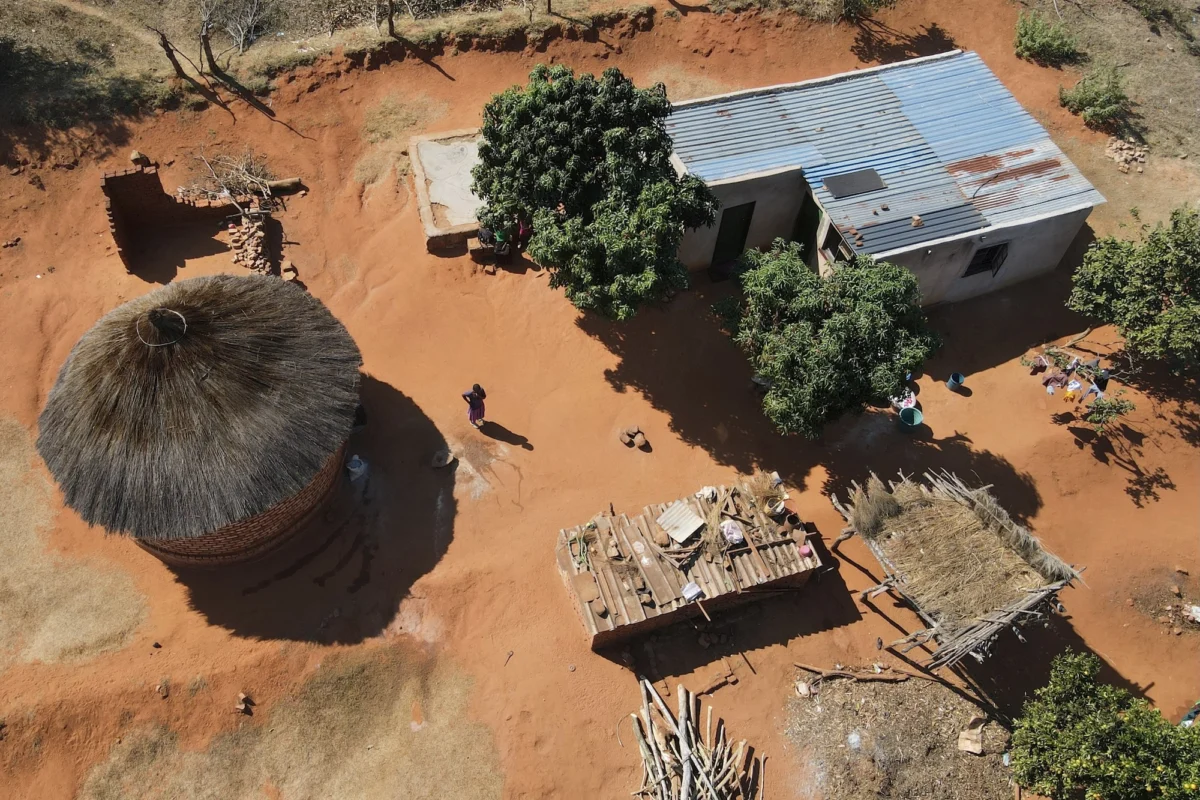
In the sun-drenched landscape of eastern Zimbabwe, the front veranda of a modern brick house serves as a quiet monument to financial independence. Esther Mwedzi, a 38-year-old mother of three, sits here separating her laundry, her home standing as a stark, sophisticated contrast to the dusty yard surrounding it. This structure, featuring four bedrooms, glass windows, and sturdy doors, was not funded by a commercial bank or a government grant. Instead, it was built through the "mukando" system—an informal, community-driven savings model that is currently filling a massive void in Zimbabwe’s fractured financial sector.
Mwedzi is a member of Mutekwatekwa, a savings group based in Chitiyo village near Mutare, the capital of Manicaland province. In a region where formal banking infrastructure is either physically distant or economically out of reach, Mwedzi turned to her neighbors. By borrowing low-interest loans from this informal collective, she purchased bricks, cement, and timber incrementally. Within eighteen months, she had transitioned her family from a traditional dwelling into a contemporary home. Her story is not an isolated success but part of a burgeoning movement across rural Zimbabwe where trust acts as the primary currency and community cohesion replaces traditional collateral.
The Economic Landscape and the Barrier to Entry
The rise of informal savings groups is a direct response to the prohibitive nature of Zimbabwe’s formal financial institutions. According to data from the World Bank and local financial analysts, the country’s formal banking sector remains largely inaccessible to the majority of the population. Commercial bank interest rates in Zimbabwe can soar as high as 46 percent annually, a figure that makes long-term borrowing nearly impossible for small-scale farmers or informal traders.
Beyond interest rates, the administrative barriers are insurmountable for many. To secure a loan from a registered bank, applicants must typically provide payslips, formal letters of employment, and proof of residence—requirements that exclude the vast majority of Zimbabweans who work in the informal sector or survive on subsistence farming. With national unemployment figures remaining a point of significant economic concern, the "unbanked" population has been forced to innovate.

Rashweat Mukundu, a prominent social commentator, notes that the financial sector’s exclusivity has historical roots but has been exacerbated by recent economic volatility. "The poor, urban, and rural communities mobilize whatever they have to support investment and to support food security," Mukundu observed. "Formal banking is limited to the few who hold formal jobs and businesses, so savings groups are a long-standing method community members can use to support each other."
Mechanics of the Mutekwatekwa Savings Model
The Mutekwatekwa savings group, established in January 2024, provides a blueprint for how these informal systems operate with high efficiency. The group consists of 50 members, subdivided into four smaller clusters of approximately 12 people each. This subdivision ensures that members are familiar with one another, maintaining the high level of trust necessary for the system to function.
Each member contributes a minimum of US$5 per month into a shared pool. This pool is then used to provide short-term loans to members of that specific cluster. Unlike the 46 percent interest charged by commercial banks, these groups typically charge a flat 10 percent interest rate. Borrowers are expected to repay the loan within a month, and at the end of the calendar year, the accumulated interest is shared among the 12 members as a dividend.
Jeremiah Chitiyo, the chairperson of the Mutekwatekwa group, explains that the initiative does more than just provide cash; it fosters a culture of disciplined labor. "The clubs encourage people to work hard so that they can contribute something to the group at the end of the month," Chitiyo said. "Small loans have enabled people in this community to build houses, buy cows and goats, pay school fees, and drill boreholes."
The group’s sustainability is further bolstered by a communal garden. Here, members grow a variety of vegetables and fruits, which serve a dual purpose: providing nutritional food security for their families and creating a surplus that can be sold to fund their monthly contributions. This integrated approach ensures that even during months when personal livestock or crop sales are low, members have a fallback to maintain their standing in the savings group.

Expanding Infrastructure and Climate Resilience
The impact of these groups extends beyond individual housing. In Chitiyo village, water scarcity is a perennial threat to livelihoods. Senior Chitiyo, a relative of Jeremiah and a dedicated member of Mutekwatekwa, has taken the savings model a step further. She is part of a separate, specialized six-member club composed of smallholder farmers focused specifically on water infrastructure.
The cost of drilling a borehole in Zimbabwe is approximately $2,000—an astronomical sum for a single farmer. However, by contributing $25 a month to their specialized club, the members take turns receiving the "pot" to fund a borehole on their respective properties. So far, the group has successfully installed boreholes at three members’ homes, providing consistent irrigation for crops and mitigating the effects of recurring droughts. Senior Chitiyo is scheduled for her installation in August 2027.
"I have participated in different clubs for more than a decade," Senior Chitiyo said, standing in her small shop where she sells flour and cooking oil—items often purchased with the help of small-scale credit. "The proceeds have allowed me to build my house and ensure my four children are fed and clothed."
The Role of International Aid and the Impact of Policy Shifts
The success of the Mutekwatekwa model was initially catalyzed by external support. CARE Zimbabwe, an international humanitarian organization, played a pivotal role in establishing the communal garden and training the groups in financial management. This was funded through a United States Agency for International Development (USAID) program designed to enhance food security and climate resilience, originally slated to run from 2020 to 2027.
However, the landscape of international aid shifted abruptly in early 2025. Following funding cuts imposed by the U.S. administration under President Donald Trump, many USAID-supported programs in the region faced sudden budget contractions. Despite this disruption, the Mutekwatekwa group and similar entities have continued to thrive.

Delilah Takawira, the country director for CARE Zimbabwe, emphasizes that the program was designed for this exact eventuality. "Our role is facilitator, not financier," Takawira explained. "We train groups, support them to develop their own constitutions, and step back. Members own and manage their money. Savings groups do not require external funding to operate; they belong to their members."
As of mid-2025, CARE Zimbabwe’s data indicates the sheer scale of this movement. Their programs have supported 47,777 village savings members across 5,013 groups nationwide. Together, these groups have saved over $1.1 million and circulated nearly $2 million in internal loans. This circulation of capital within rural economies provides a stimulus that formal banking sectors have failed to deliver.
Risk Management in a Trust-Based System
The primary criticism of informal savings groups is the lack of legal recourse. Without legally binding agreements or registered guarantors, the risk of default is a constant shadow. Across Zimbabwe, there have been instances where individuals have joined groups with the intent to defraud them, or where members have simply been unable to repay loans due to personal tragedy or economic shocks.
To mitigate these risks, Mutekwatekwa employs a rigorous "internal constitution." All transactions must take place in front of the entire membership to ensure transparency. Furthermore, the group utilizes a physical security measure: a reinforced lockbox that requires three separate keys to open. These keys are held by three different members, ensuring that the funds cannot be accessed without collective oversight.
"This is a system entirely based on trust and promoting the common good," Mukundu noted. By restricting loans to members only and avoiding external capital, the groups create a closed-loop system where the social cost of defaulting—losing the trust of one’s neighbors and family—is often a more powerful deterrent than a legal summons.

Broader Implications and Future Outlook
The success of these groups is redefining the role of women in the Zimbabwean economy. For many, like 23-year-old Tsitsi Mahari, the savings group provided the capital necessary to leapfrog into the middle class. Mahari used loans as high as $300—an amount exceeding the monthly salary of many government-employed teachers and nurses—to build a three-bedroom home complete with tiled floors and a solar-powered television system.
"I bought building materials and furniture," Mahari said. "It has changed how we live."
The transformation is not merely material; it is educational. Takawira points out that the real impact is the "financial literacy" acquired by members. Participants learn to budget, invest in diversifying their income, and manage household finances with a long-term perspective. This literacy builds a layer of resilience that allows families to survive economic shocks without falling back into absolute poverty.
Looking forward, members like Esther Mwedzi are already planning their next ventures. Having secured her housing, she now intends to use her group’s credit facility to launch a commercial broiler poultry project. Her goal is to move beyond subsistence and tap into the larger markets of Mutare.
The "mukando" system represents a paradigm shift in development philosophy. It suggests that while international aid can provide the initial spark, the most sustainable path to poverty alleviation is through local ownership and the formalization of existing social capital. In the absence of a functioning formal banking system, the people of Manicaland have built their own, one $5 contribution at a time. For the thousands of members across Zimbabwe, these groups are not just a way to save money—they are the foundation of a new, self-determined economic future.
