

Prime Minister Mark Carney has signaled a decisive break from the climate policies of the Trudeau era, characterizing the inherited framework as a product of a different time that no longer meets the urgency of the present economic and environmental landscape. Since assuming office, the Carney administration has sought to redefine Canada’s path toward decarbonization, pivoting toward a strategy that emphasizes market mechanisms, industrial pragmatism, and what the Prime Minister calls "forward guidance" for the national economy. However, as the government concludes its first 18 months in power, an analysis of its five core climate commitments reveals a complex picture of ambitious rhetoric contrasted with uneven implementation and significant policy gaps.
The transition from the previous administration’s approach to the current "Carney Doctrine" has been marked by a shift in tone—moving away from prescriptive mandates toward a framework that attempts to align financial markets with environmental outcomes. This strategy, while theoretically robust, faces intense scrutiny from climate scientists and policy analysts who argue that the pace of reform remains insufficient to meet Canada’s international obligations under the Paris Agreement.
The Evolution of Industrial Carbon Markets and the Alberta MOU
One of the most significant pillars of the Carney government’s climate agenda is the reform of industrial carbon pricing, specifically through a high-stakes Memorandum of Understanding (MOU) with the province of Alberta. Industrial carbon pricing is designed to incentivize heavy emitters to reduce their carbon footprint by placing a price on every tonne of greenhouse gas (GHG) emitted above a specific performance standard. In theory, this allows for substantial emissions reductions at a lower economic cost than traditional regulation.
However, the implementation of this "carbon market that actually works" remains a work in progress. When the Carney government took office, the industrial carbon market was fragmented, with varying standards across provinces. The MOU with Alberta was intended to stabilize these markets and provide a floor for investment. Instead, recent data from the Canadian Climate Institute suggests that the price of carbon credits in Alberta has actually declined since the agreement was signed. This price erosion undermines the very incentive the system was designed to create.
Analysts point out that for a carbon market to be effective, there must be a scarcity of credits to drive prices up and encourage innovation. The current oversupply in the Alberta system, coupled with regulatory uncertainty, has left the industrial carbon market on shaky ground. For the Carney government to succeed in this commitment, it must navigate the political sensitivities of federal-provincial relations while ensuring that the "made-in-Alberta" solution does not dilute national climate targets.
The Shift in Transportation: EV Adoption and the Repeal of ZEV Mandates
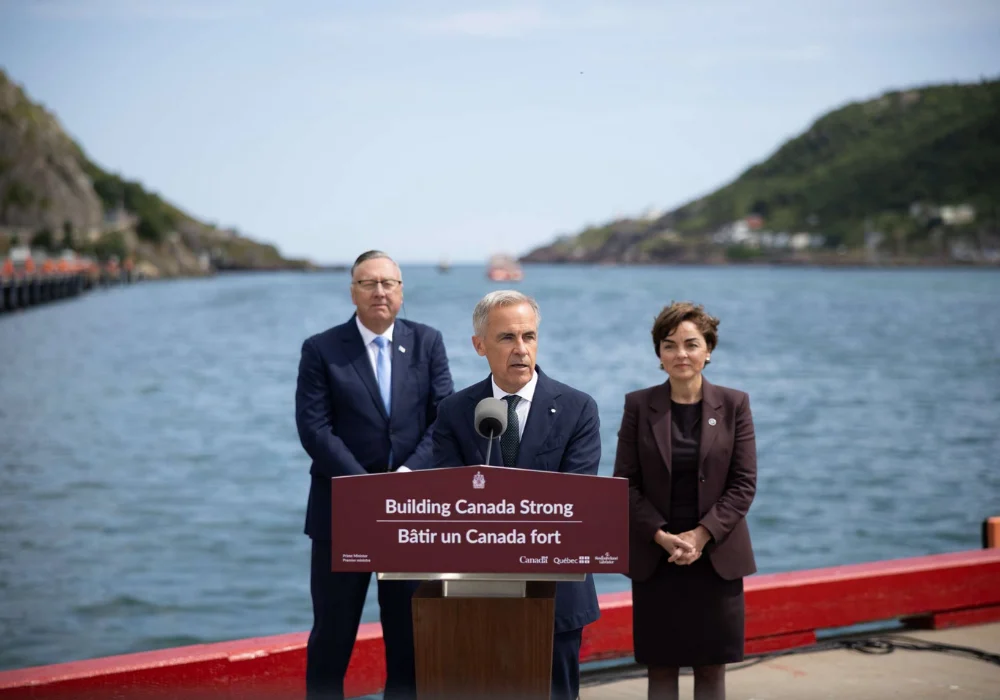
Perhaps the most controversial move by the Carney administration has been the overhaul of Canada’s automotive strategy. During a landmark press conference, the Prime Minister set a bold target: achieving the equivalent emissions reductions of a 75% electric vehicle (EV) adoption rate by 2030, rising to 90% by 2040. While these figures are ambitious, the methodology chosen to reach them has drawn criticism.
Upon taking office, the government moved to repeal existing Zero-Emission Vehicle (ZEV) mandates, which required manufacturers to sell an increasing percentage of electric cars. In their place, the Carney government proposed a new federal standard focused on "equivalent emissions reductions." The delay in implementing this new standard, combined with the removal of the previous legislative floor, has created what some industry experts call a "regulatory vacuum."
According to 440 Megatonnes, a climate policy tracking initiative, the current trajectory of the new automotive strategy is not yet aligned with the 75% adoption goal. Critics argue that by moving away from hard sales mandates toward a more flexible emissions-based standard, the government risks slowing the transition of the domestic auto sector. As global competitors in the United States, Europe, and China accelerate their EV infrastructure, Canada’s pivot toward a less direct regulatory approach remains a high-stakes gamble on market-led adoption.
The "Clean and Conventional" Energy Paradox
The Carney government has frequently utilized the phrase "clean and conventional energy superpower" to describe its vision for Canada’s role in the global energy transition. This branding attempts to reconcile the continued production of fossil fuels with the massive expansion of renewable energy capacity. A central component of this vision is the "Forward Guidance" video series, in which the Prime Minister pledged to build clean energy infrastructure on a scale that would rival the historical achievements of Sir Adam Beck, the pioneer of Ontario’s hydroelectric power.
The "conventional" side of this equation is currently well-supported, with billions of dollars in public funds allocated toward carbon capture, utilization, and storage (CCUS) and other technologies aimed at reducing the intensity of oil and gas production. On the "clean" side, progress has been more incremental. A recent agreement between the federal government, Quebec, and Newfoundland and Labrador regarding the Churchill Falls hydroelectric project represents a significant step forward in inter-provincial clean energy cooperation.
However, policy analysts from Corporate Knights and the Canadian Climate Institute have noted that the scale of investment required to meet "superpower" status is far beyond what has been committed to date. To achieve the government’s goals, Canada would need to triple its current renewable generation capacity by 2050—a task that requires not only massive capital but also a significant overhaul of the national grid and regulatory approval processes.
Sustainable Finance: The Made-in-Canada Taxonomy
As a former Governor of both the Bank of Canada and the Bank of England, Mark Carney has long championed the role of the financial sector in the climate fight. It is no surprise, then, that Budget 2025 included a flagship commitment to develop "Made-in-Canada sustainable investment guidelines." This initiative, often referred to as a "green taxonomy," is designed to provide clear definitions of what constitutes a "green" or "transition" investment.
The goal is to prevent greenwashing and provide institutional investors—such as pension funds and insurance companies—with the certainty they need to deploy trillions of dollars in capital toward decarbonization. The government tasked the Canadian Climate Institute and Business Future Pathways with leading this work. In July 2026, the first draft report was released, outlining a framework that distinguishes between low-carbon activities (like wind and solar) and "transition" activities (like decarbonizing heavy industry).
The publication of these guidelines, slated for 2027, is expected to be a watershed moment for Canadian capital markets. If successful, it will align Canada with international standards while accounting for the unique nature of its resource-heavy economy. However, the challenge lies in ensuring the taxonomy is rigorous enough to satisfy international investors while remaining practical for Canadian industries that are still in the early stages of the transition.
The Path to Net-Zero 2050: A Question of Credibility
The overarching goal of the Carney government remains the achievement of net-zero emissions by 2050. This commitment was a central feature of the final MOU agreement with Alberta and has been reiterated in nearly every major policy speech by the Prime Minister.
Despite the rhetorical commitment, the math of Canada’s current emissions trajectory remains a concern. National inventory data indicates that while some sectors have seen modest declines, total emissions have not yet begun the steep downward curve required to meet 2030 or 2050 targets. The Canadian Climate Institute’s assessment of the Alberta MOU, for instance, concluded that the agreement as currently structured leaves emissions largely unchanged in the short term.
The credibility of the 2050 goal rests on the government’s ability to translate high-level agreements into enforceable, measurable policy. As Parliament returns, the focus is shifting from the transition of power to the tangible results of the Carney climate plan. The administration’s "Forward Guidance" approach relies on the belief that clear signals will drive market behavior. However, as the country faces increasingly frequent and severe wildfire seasons—clear indicators of the climate crisis—the demand for more immediate and direct action is intensifying.
Broader Implications and Future Outlook
The Carney government’s first 18 months have established a new paradigm for Canadian climate policy—one that is more integrated with the financial sector and more collaborative with resource-producing provinces than its predecessor. By framing climate action as an economic opportunity rather than just an environmental necessity, Carney has attempted to build a broader coalition of support for the transition.
Yet, the risks are substantial. The reliance on market-based mechanisms like carbon markets and sustainable finance taxonomies assumes that these systems can be perfected in time to avoid the worst impacts of warming. The repeal of direct mandates in the auto sector and the slow rollout of clean energy infrastructure suggest a government that is cautious of over-regulation but perhaps too optimistic about the speed of market-led change.
As the Carney administration enters the second half of its current mandate, the "Forward Guidance" must evolve into concrete achievements. The success of the "Made-in-Canada" taxonomy, the stabilization of the industrial carbon price, and the actual reduction of national GHG levels will be the metrics by which this government is ultimately judged. For now, Canada remains at a crossroads, with a new plan in place but the destination of net-zero still appearing as a distant and difficult peak to climb.
