

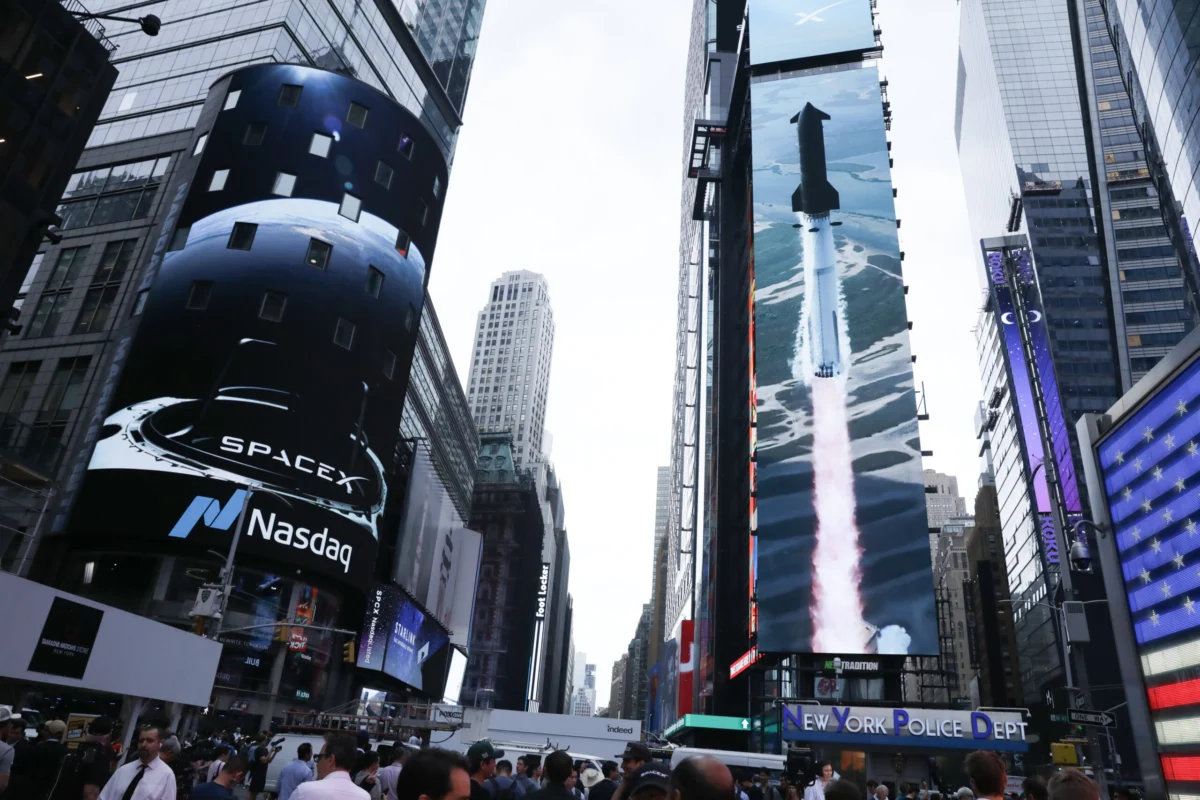
The highly anticipated initial public offering (IPO) of SpaceX, the pioneering aerospace manufacturer and space transportation services company founded by Elon Musk, commenced trading on the Nasdaq in New York City on June 12, 2026. This monumental event, long awaited by investors and industry observers, immediately sent ripples through the commercial space sector, particularly impacting a cohort of publicly traded companies often referred to as "proxy stocks" due to their indirect ties to the private space giant. As SpaceX shares, trading under the ticker SPCX, began their journey on the public market, the initial euphoria surrounding these proxy plays swiftly began to unwind, signaling a significant shift in investor sentiment and capital allocation within the burgeoning space economy.
The Genesis of a Space Colossus: SpaceX’s Journey to IPO
SpaceX’s public debut marks a pivotal moment, culminating over two decades of groundbreaking innovation and audacious ambition. Founded in 2002 with the audacious goal of enabling human life on Mars, SpaceX has revolutionized spaceflight through its development of reusable rocket technology, significantly driving down launch costs. Its achievements include the Falcon 9 and Falcon Heavy rockets, the Dragon spacecraft for cargo and crew transport to the International Space Station, and the ambitious Starlink satellite internet constellation, which has rapidly become the world’s largest satellite network. Furthermore, the development of the Starship system, designed for deep-space missions and eventual Martian colonization, underscores the company’s long-term vision.
For years, SpaceX remained a closely held private entity, a characteristic that fueled immense speculation and investor hunger. Its private valuation soared to unprecedented levels, making it one of the world’s most valuable privately held companies. The decision to go public, a move that analysts had anticipated for years, was largely seen as a strategic step to raise substantial capital for its capital-intensive projects, including the continued expansion of Starlink and the accelerated development of Starship. The IPO pricing at $135 a share was considered a "sweet spot" by market strategists, appealing to a broad range of retail investors who might perceive it as an accessible entry point into a high-growth, high-profile technology stock, while still reflecting a substantial valuation for institutional investors. This pricing strategy aimed to maximize broad participation and liquidity, setting the stage for potentially astronomic demand in subsequent trading sessions and the nascent options market.
The Proxy Phenomenon: Riding the Coattails of Anticipation
Ahead of SpaceX’s IPO, a distinct trend emerged in financial markets: the rise of "proxy stocks." These were publicly traded companies that, due to various degrees of direct or indirect association with SpaceX, became de facto investment vehicles for those seeking early exposure to the space sector or a surrogate for SpaceX itself while it remained private. Investor demand for these proxy stocks surged in the weeks and months leading up to the IPO, driving up their share prices and options volumes. The rationale was simple: if one couldn’t directly invest in SpaceX, investing in companies that either supplied SpaceX, owned a stake in it, or operated in a similar segment of the commercial space industry offered a viable alternative.
This phenomenon was particularly evident in the options market, where call options for these companies saw booming volumes. Traders, both retail and institutional, were actively betting on a "halo effect" where SpaceX’s public listing would validate and uplift the entire commercial space industry, including these related entities. The heightened activity suggested a speculative fervor, as investors clamored for any avenue to gain long exposure to the SpaceX narrative.
Immediate Market Reaction: A Swift Unwinding of Gains
However, the reality of SpaceX’s public debut brought a swift recalibration. As the "real thing" became available, the speculative premium embedded in these proxy stocks began to dissipate. The market, now presented with the direct opportunity to invest in SpaceX, started to reallocate capital, leading to a significant unwinding of the gains these proxy companies had accumulated.
Shares of EchoStar (SATS), a Colorado-based networking business that holds an estimated 3% stake in SpaceX, reversed course dramatically, dropping 14% on the day of the IPO. EchoStar’s connection, while direct through its equity holding, had previously made it a popular indirect play for SpaceX exposure. Similarly, AST SpaceMobile (ASTS), a company developing a space-based cellular broadband network whose satellites are anticipated to launch on a SpaceX rocket next week, saw its shares fall nearly 13%. While AST SpaceMobile’s connection is operational and forward-looking, its fortunes were closely tied to the broader excitement surrounding SpaceX’s launch capabilities. Perhaps the most significant reversal was observed in Virgin Galactic Holdings (SPCE), the space tourism venture. Virgin Galactic completely erased its substantial gains from the previous day, plummeting by 34%. Virgin Galactic, while a prominent player in the commercial space sector, operates in a distinct niche (human spaceflight tourism) and has no direct financial or operational ties to SpaceX beyond being part of the broader space industry. Its volatility underscores the speculative nature of its prior run-up, largely driven by generalized space enthusiasm rather than specific SpaceX linkages.
Options Traders Remain Undeterred: A Focus on Future Volatility
Despite the sharp declines in proxy stock prices, the options market for these names exhibited a curious resilience, suggesting that a segment of traders remained unfazed and perhaps even saw new opportunities in the post-IPO landscape. Call options continued to outnumber puts across EchoStar, AST SpaceMobile, and Virgin Galactic, with AST SpaceMobile being particularly active, trading over 250,000 contracts and generating more than $60 million in premium. On Friday morning, more than twice as many calls were bought than puts, indicating a continued bullish bias, albeit perhaps for different reasons than pre-IPO.
Danny Kirsch, head of options trading at Piper Sandler, noted, "There’s a ton of short-dated call buying in these names as a way to get long SpaceX. I have no doubt part of it is retail demand, but there is definitely institutional demand for SATS." This suggests that some investors might be speculating on a rebound, believing the initial sell-off to be an overreaction, or perhaps that these companies still represent viable, albeit more volatile, alternatives for indirect space exposure. The implied volatilities for EchoStar and AST SpaceMobile, closing at $128.13 and $97.56 respectively on Thursday, stood at 91 and 126, reflecting the market’s expectation of significant future price swings. These high implied volatilities are a testament to the continued uncertainty and speculative interest surrounding these names in the wake of the SpaceX IPO.
The ETF Effect: A Bottleneck of Supply
Adding another layer to the complex market dynamics was the concurrent demand for exchange-traded funds (ETFs) specifically targeting the space category. According to Cory Johnson, chief market strategist of San Francisco-based Epistrophy Capital Research, this demand created a bottleneck of supply that paradoxically helped to keep prices for some of the proxy plays elevated, even amidst the post-IPO sell-off.
ETFs like the Procure Space ETF (UFO) and the Defiance Drone and Modern Warfare ETF (JEDI) both hold shares of AST SpaceMobile, among other space-related companies. The Procure Space ETF, trading as UFO, has seen a remarkable 38% increase in 2026, while the Defiance ETF, trading as JEDI, has risen approximately 33% in the same period. Johnson explained, "People who can’t buy SpaceX or didn’t think they could get enough quick enough, have been plowing money into these ETFs and so these funds are having to buy shares of AST, EchoStar, Spire, etc. It has nothing to do with the quality of these companies, demand for their products, or their cash flows." This highlights a significant market inefficiency where broad index-based buying, driven by investor appetite for thematic exposure, can influence individual stock prices irrespective of their intrinsic value or direct SpaceX connection. This flow of capital into space-themed ETFs underscores the broader trend of democratized access to specialized investment themes, yet it also introduces distortions in valuation.
SpaceX: A New Frontier for Retail Options Trading
The entry of SpaceX into the public market is widely expected to transform the landscape of retail options trading. The combination of its likely high share price, significant inherent volatility due to its ambitious projects and the personality of its founder, and immense public interest creates an "ideal environment for options trading," as stated by Anthony Denier, group president and U.S. CEO of Webull.
Denier elaborated via email, "SpaceX has the potential to become one of the most actively traded options names among retail investors. If borrowable shares become scarce or expensive, put options may offer investors a more practical way to express a bearish view than shorting the stock directly." This sentiment draws parallels to Tesla (TSLA), another company founded by Elon Musk, which has long been one of the most actively traded names among retail options traders. Tesla’s stock is renowned for its volatility and the passionate community of investors and traders it attracts, often leading to significant options volume. SpaceX is poised to replicate, if not exceed, this phenomenon, providing a new arena for speculative bets and sophisticated hedging strategies alike. The anticipation for SpaceX options, set to begin trading on the following Tuesday, is nothing short of astronomic, promising a new chapter in retail investor engagement with the commercial space sector.
Broader Implications for the Commercial Space Economy
SpaceX’s IPO is far more than just a public listing; it is a profound validation of the commercial space industry as a viable and rapidly maturing sector. For years, space exploration and utilization were primarily the domain of government agencies. SpaceX, along with a handful of other private companies, has irrevocably altered this paradigm, demonstrating the immense potential for innovation, cost reduction, and new market creation in areas ranging from satellite internet to space tourism and interplanetary travel.
The infusion of public capital into SpaceX will undoubtedly accelerate its already ambitious projects, potentially leading to faster advancements in reusable rocketry, satellite deployment, and deep-space infrastructure. This could in turn spur further innovation and competition across the industry, benefiting not only direct competitors but also a wide ecosystem of suppliers, technology developers, and service providers. The increased liquidity and transparency that come with public listing will also allow for more accurate market valuation of space assets, potentially attracting a new wave of institutional investors who were previously hesitant to engage with the predominantly private and often opaque space sector.
However, the IPO also brings new scrutiny and accountability. Public markets demand consistent performance, clear financial reporting, and effective corporate governance. While SpaceX has enjoyed considerable freedom as a private entity, it will now face the pressures of quarterly earnings, shareholder expectations, and regulatory oversight. This transition could influence its strategic decisions, balancing long-term visionary projects with short-term market demands.
Investor Psychology and the "Musk Effect"
The market’s reaction to SpaceX’s IPO also offers a fascinating glimpse into contemporary investor psychology, particularly the enduring influence of Elon Musk. Often described as a "cult stock" founder, Musk’s ventures tend to attract a highly engaged and often fervent investor base. This phenomenon, previously observed with Tesla, suggests that a significant portion of the demand for SpaceX shares and options is driven not just by fundamental analysis but also by belief in Musk’s vision and leadership.
This emotional component can lead to increased volatility, as retail investors, often driven by social media trends and community sentiment, can collectively move markets. The initial scramble for proxy stocks, followed by their swift unwinding, perfectly illustrates this dynamic. It underscores the dual nature of high-profile tech IPOs: they offer immense potential for growth and innovation, but also carry significant speculative risk, particularly when intertwined with charismatic leadership and aspirational narratives.
Looking Ahead: Navigating a New Era of Space Investment
As SpaceX embarks on its journey as a publicly traded company, the commercial space industry enters a new, more mature phase. The immediate volatility in proxy stocks is a natural market adjustment, reflecting the shift from speculative anticipation to the concrete reality of a direct investment opportunity. The sustained interest in options for both SpaceX and its peers, alongside robust ETF demand, indicates that investor appetite for the space sector remains strong, albeit with a renewed focus on direct exposure.
The coming months will be crucial in observing how SpaceX navigates its public life, how its share price stabilizes, and what impact its options trading will have on market dynamics. The continued development of Starlink, the progression of Starship, and potential new ventures will all be closely watched by a now much broader and more accessible investor base. The IPO of SpaceX is not just a financial event; it is a landmark moment that solidifies the commercialization of space, inviting the world to invest directly in humanity’s extraterrestrial future.
