

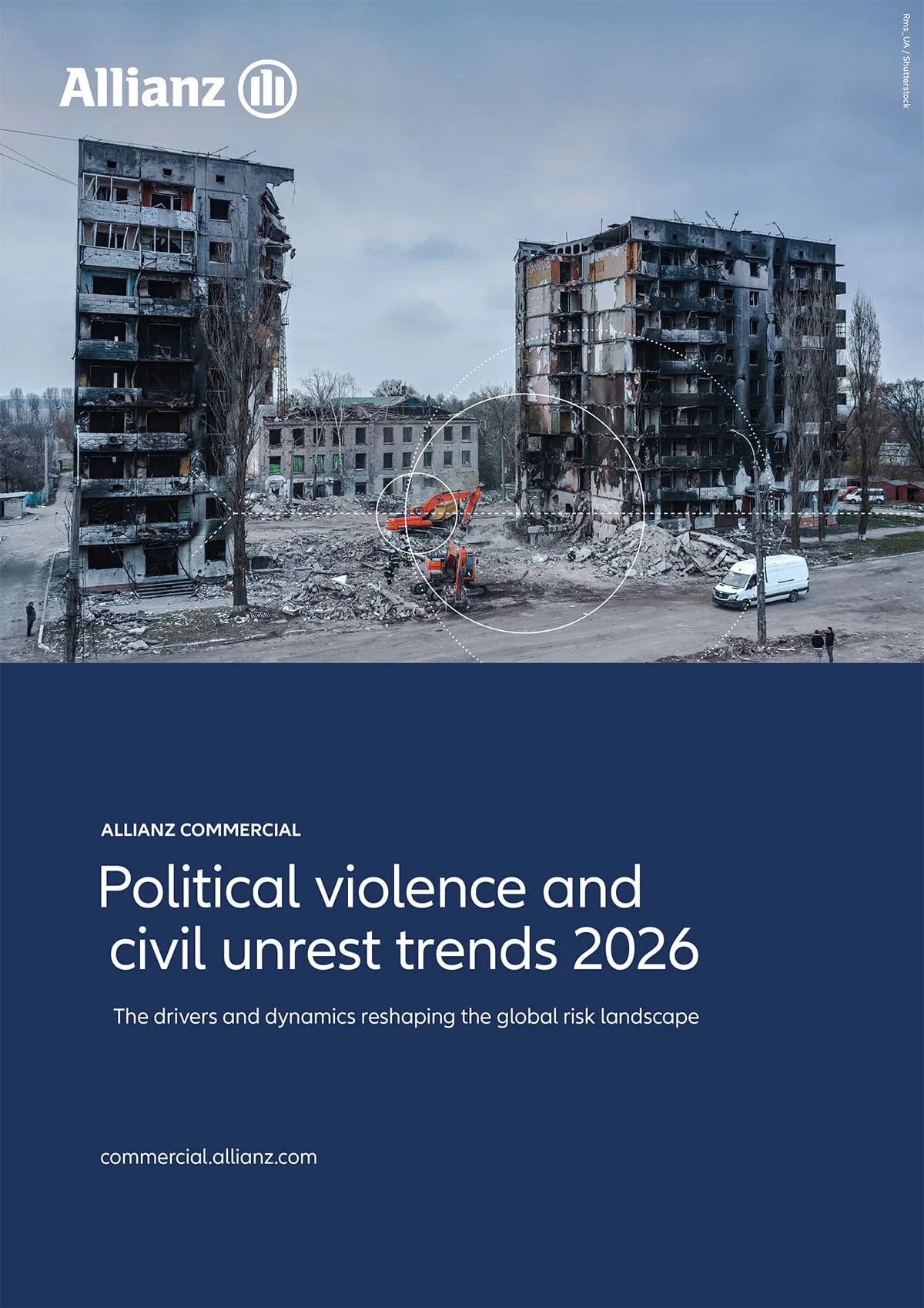
War has displaced civil unrest as the political violence exposure companies fear most, according to Allianz Commercial’s 2026 analysis of global political violence and civil unrest trends. This significant recalibration of corporate risk perception underscores a rapidly evolving and increasingly complex geopolitical environment, characterized by expanding conflict zones, disrupted supply chains, and a heightened awareness of the multifaceted threats facing global commerce. The findings, detailed in the latest report from Allianz Commercial, paint a stark picture for businesses navigating the turbulent waters of international operations.
The Escalation of Conflict and its Business Impact
The Allianz Commercial report highlights a dramatic surge in the scale and complexity of political violence risks. Over the past five years, areas affected by armed conflict have expanded by an alarming 89%. This expansion directly impacts businesses, with an estimated 36,000 business assets now situated within active conflict zones. The report further emphasizes the profound and immediate impact of new conflicts, citing the recent emergence of a new conflict in the Middle East as a prime example of an event already reshaping global trade routes, energy markets, and consequently, insurance exposures. This ripple effect demonstrates how localized geopolitical events can have far-reaching economic consequences.
This shift in fear from civil unrest to outright war is a direct reflection of the changing nature of global conflicts. While civil unrest remains a persistent threat, characterized by protests, riots, and strikes, the scale and destructive potential of interstate wars and prolonged armed conflicts present a more existential risk to businesses. These conflicts often involve state-level actors, leading to broader territorial control shifts, destruction of infrastructure, and significant disruptions to international commerce and travel.
A Shifting Risk Landscape: From Domestic Unrest to International Warfare
Historically, corporate concern regarding political violence has often focused on domestic instability. Civil unrest, while disruptive, typically involves localized events that can be managed through business continuity plans and localized security measures. However, the report’s findings suggest a growing recognition that the current era is defined by conflicts of a different magnitude.
The surge in armed conflict zones is not merely an abstract statistic; it represents tangible threats to physical assets, personnel safety, and the integrity of supply chains. Businesses with operations or supply chain dependencies in these regions face direct risks of property damage, business interruption, and the inability to access critical resources or markets. The report’s estimation of 36,000 business assets in conflict zones underscores the pervasive nature of this risk across various industries, from manufacturing and logistics to energy and agriculture.
The Middle East Conflict: A Case Study in Global Disruption
The recent eruption of conflict in the Middle East serves as a potent illustration of the report’s central thesis. This new theater of conflict has swiftly sent shockwaves through global markets. The immediate implications include:
- Reshaping Global Trade Routes: The Strait of Hormuz, a critical chokepoint for oil and gas shipments, faces increased risk, potentially forcing rerouting of vessels. This can lead to longer transit times, increased shipping costs, and potential shortages of essential commodities. Other trade routes in the broader region may also be impacted, affecting the flow of goods between Asia, Europe, and Africa.
- Impact on Energy Markets: The Middle East is a major producer and exporter of oil and natural gas. Conflict in the region directly threatens production facilities and export terminals, leading to price volatility and concerns about global energy security. Nations heavily reliant on these imports face significant economic and political challenges.
- Altered Insurance Exposures: Insurers are rapidly reassessing their exposure to political violence in the region. This includes evaluating the adequacy of coverage for war, terrorism, and business interruption. Premiums are likely to rise, and insurers may impose stricter terms and conditions for coverage in affected or adjacent areas. The report’s emphasis on evolving insurance exposures suggests a need for proactive risk management and dialogue between businesses and their insurers.
Key Findings and Emerging Trends
While the report’s full details are extensive, the overarching message points to a heightened and more complex risk environment. Beyond the shift from civil unrest to war, other critical trends likely to be explored within the full Allianz Commercial report include:
- Geopolitical Fragmentation: The report may delve into the increasing fragmentation of the global order, with a rise in regional conflicts and a weakening of multilateral institutions. This can lead to a less predictable international landscape, where localized disputes can escalate rapidly with global implications.
- Cyber Warfare as a Component of Political Violence: In modern conflicts, cyberattacks are increasingly employed as a tool of political destabilization. Businesses are likely to face elevated risks of cyber intrusions, data breaches, and disruption of critical IT infrastructure, often linked to state-sponsored or state-aligned actors. This adds another layer of complexity to the definition and management of political violence risk.
- The Interplay of Climate Change and Conflict: While not explicitly stated in the provided excerpt, it is plausible that the report might touch upon how climate change can exacerbate existing tensions and contribute to conflict. Resource scarcity, mass displacement due to environmental disasters, and competition for dwindling resources can all fuel political instability, creating new vectors for political violence.
- The Growing Importance of Resilience and Preparedness: The report’s focus on evolving threats implicitly underscores the critical need for businesses to enhance their resilience and preparedness strategies. This goes beyond traditional insurance coverage and involves robust risk assessment, contingency planning, supply chain diversification, and the implementation of advanced security measures.
Implications for Global Business
The findings of the Allianz Commercial 2026 report carry significant implications for businesses operating on a global scale:
- Enhanced Risk Assessment: Companies must move beyond static risk assessments and adopt dynamic, real-time monitoring of geopolitical developments. This requires investing in intelligence gathering capabilities and fostering a culture of continuous risk evaluation.
- Supply Chain Vulnerability: The interconnected nature of global supply chains means that a conflict in one region can have cascading effects. Businesses need to map their entire supply chain, identify critical dependencies, and develop contingency plans for disruptions. Diversification of suppliers and manufacturing locations will become increasingly crucial.
- Personnel Safety and Security: The safety of employees in regions affected by political violence is paramount. Companies must implement robust security protocols, evacuation plans, and provide adequate support and training to personnel operating in high-risk environments.
- Insurance Strategy Review: The evolving risk landscape necessitates a thorough review of existing insurance policies. Businesses should engage with their insurers to ensure adequate coverage for war, terrorism, political violence, and business interruption, and to understand any new exclusions or limitations.
- Investment in Business Continuity and Resilience: Beyond insurance, businesses need to invest in tangible measures that enhance their ability to withstand and recover from disruptions. This includes building redundant infrastructure, developing crisis management teams, and fostering strong relationships with local authorities and security providers.
The Allianz Commercial 2026 report serves as a critical wake-up call for the corporate world. The era of predictable political risk is over, replaced by a volatile and interconnected landscape where the specter of war looms larger than ever before. Proactive adaptation, strategic foresight, and a commitment to building resilience are no longer optional but essential for survival and success in the global marketplace. The report’s findings underscore the urgent need for businesses to recalibrate their understanding of political violence and to implement comprehensive strategies to mitigate these escalating threats.
