

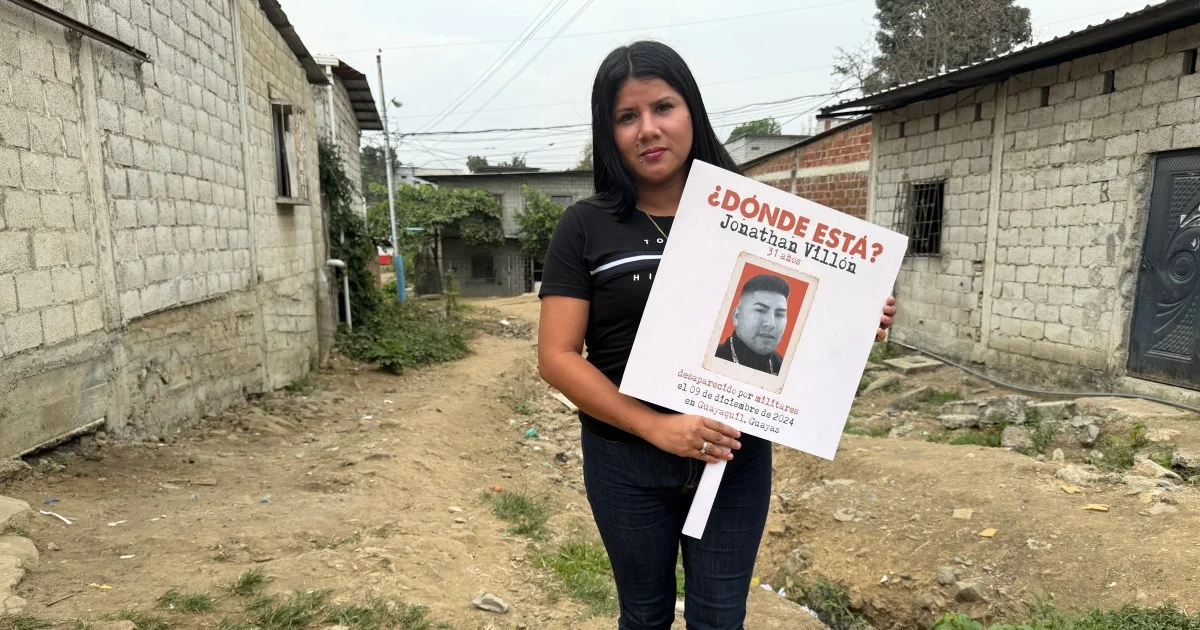
While official pronouncements might suggest progress in investigations into enforced disappearances across Ecuador, the families of the missing contend that the wheels of justice are turning at an agonizingly slow pace, perpetuating an unbearable cycle of uncertainty and grief. For months, and in some instances, years, these families have tirelessly advocated for accountability, pleading with government authorities for transparent answers regarding the fates of their loved ones. Since early December, the investigative journalism team at Fault Lines has immersed itself in the plight of these families, documenting their struggle and amplifying their urgent calls for truth and justice. Their testimonies reveal a disturbing pattern of official stonewalling and a profound lack of resolution that has left countless lives in limbo.
The Haunting Disappearance of Jonathan Villon
At the heart of this harrowing narrative is the case of Jonathan Villon, a 31-year-old father of three, whose disappearance on December 9, 2024, has become a potent symbol of the wider crisis. Villon was last seen leaving his home in the bustling port city of Guayaquil, specifically the Nueva Prosperina neighborhood, to perform the mundane task of picking up groceries. He never returned. His sister, Rosario Villon, articulates the profound anguish that has gripped their family since that day. "It gets harder every time my nephew asks when his father will come home and I don’t have any answers," she lamented, her voice heavy with the weight of eighteen months of unanswered questions. The emotional toll on the Villon family is immense, a constant, gnawing pain that manifests in daily life. At a vigil held for Jonathan last December, Rosario spoke candidly about the devastating impact on her elderly mother. "Seeing my mother cry for her son, not knowing what to do next to bring him home – it isn’t easy," she shared, highlighting the helplessness that pervades their existence.
The circumstances surrounding Jonathan’s disappearance are particularly troubling, pointing directly to the involvement of state actors. Fault Lines has meticulously reviewed critical evidence, including security camera footage from Villon’s neighborhood. These recordings depict soldiers actively patrolling Nueva Prosperina on the day of his disappearance. Further corroborating evidence comes from a mobile phone video captured by a neighbor, which chillingly records the moments immediately after Jonathan was allegedly forced into the bed of a municipal truck, concealed under a wooden bench. The vehicle then sped away, and Jonathan Villon has not been seen or heard from since. In a crucial effort to aid the investigation, the Villon family painstakingly recorded the license plate numbers of the military vehicle implicated in the incident. Despite this concrete evidence, the military establishment has steadfastly refused to respond to inquiries regarding Jonathan’s case, creating an impenetrable wall of silence.
Jonathan’s partner, Yadira Bohorquez, voiced the family’s exasperation and demand for accountability. "We have the evidence, we have videos, we have the license plates of the truck, and they won’t give us a concrete and exact answer. What happened to my husband?" she implored, her words echoing the desperation of many families caught in similar predicaments. The legal team representing the Villon family has confirmed the military’s official position: a blanket denial that any operations were conducted in the Nueva Prosperina area on the specified date, a claim that directly contradicts the documented video evidence. Fernando Bastias, a lawyer with CDH Guayaquil, a prominent human rights nonprofit dedicated to assisting the family, underscored the systemic obstruction. "The case of Jonathan Villon is completely paralyzed by the refusal of the Ministry of Defense to cooperate in handing over information that the Prosecutor’s Office has already requested," Bastias stated, exposing the deep-seated resistance within state institutions.
Ecuador’s Deepening Crisis: A Landscape of Insecurity and Impunity
Jonathan Villon’s case is not an isolated incident but rather a stark reflection of a broader, escalating crisis of insecurity and human rights concerns gripping Ecuador. For several years, the South American nation has grappled with a dramatic surge in violence, largely fueled by the proliferation of transnational organized crime, particularly drug trafficking. Guayaquil, as Ecuador’s principal port city, has become a major transit point for narcotics, transforming it into a hotbed of gang activity, extortion, and brutal violence. The government’s response to this deteriorating security situation has been characterized by increasingly assertive measures, including repeated declarations of states of emergency and the deployment of military forces to civilian areas, ostensibly to restore order. While these actions are framed as necessary to combat crime, they have concurrently raised alarms among human rights organizations regarding the potential for abuses of power and the erosion of civilian liberties.
The militarization of domestic security operations, while sometimes effective in disrupting criminal networks, also introduces significant risks. Military personnel are trained for combat and national defense, not civilian law enforcement, and their involvement in policing duties can lead to an increase in incidents of excessive force, arbitrary detentions, and, as critics argue, enforced disappearances. Data from human rights groups and local media consistently point to a rising trend in missing persons reports across Ecuador. While many of these cases are linked to gang violence and kidnapping by criminal elements, a concerning subset, like Jonathan Villon’s, involves credible allegations of state actor involvement, casting a shadow over the government’s commitment to due process and human rights. The lack of transparent accountability mechanisms for military actions further exacerbates this issue, fostering an environment where impunity can thrive.
A Chronology of Silence and Struggle: The Villon Family’s Ordeal

The timeline of Jonathan Villon’s disappearance and the subsequent struggle for answers paints a grim picture of a family caught in a bureaucratic nightmare.
- December 9, 2024: Jonathan Villon, a father of three, leaves his home in Nueva Prosperina, Guayaquil, to buy groceries. He is last seen being forced into a municipal truck by individuals identified as soldiers. His family records the vehicle’s license plate numbers.
- December 2024 (Post-Disappearance): The Villon family immediately reports Jonathan’s disappearance to the authorities. They begin their tireless search, circulating his image, making public appeals, and providing all available evidence, including security camera footage and the neighbor’s mobile video, to investigators. Rosario Villon speaks at a vigil, highlighting the family’s profound distress.
- Early 2025: The Prosecutor’s Office initiates an investigation, requesting information from the Ministry of Defense regarding military operations in Nueva Prosperina on December 9, 2024.
- Throughout 2025: The Villon family, supported by CDH Guayaquil, intensifies its advocacy efforts. They participate in protests, issue public statements, and continue to press authorities for concrete answers. The military, through the Ministry of Defense, consistently denies having any operations in the specified area on the date of Jonathan’s disappearance, despite the video evidence. This refusal to cooperate effectively stalls the official investigation.
- Late 2025 – Mid 2026: As the one-year mark of Jonathan’s disappearance passes, the family’s frustration mounts. The legal case remains "paralyzed," as described by Fernando Bastias, due to the Ministry of Defense’s non-compliance. Fault Lines begins its in-depth investigation, spending time with the Villon family and reviewing the evidence they have gathered. The emotional toll on Jonathan’s children, partner, and mother continues to deepen, exacerbated by the relentless uncertainty.
Official Responses and the Shadow of Impunity
The official responses to Jonathan Villon’s disappearance, or rather the lack thereof, underscore a troubling pattern of obstruction and denial. The military’s categorical denial of any operational presence in Nueva Prosperina on December 9, 2024, directly contradicts the compelling video evidence presented by the Villon family. This stance not only raises serious questions about transparency and accountability within the armed forces but also actively impedes the judicial process. When the Ministry of Defense refuses to cooperate with the Prosecutor’s Office, it essentially renders the investigation inert, creating a legal vacuum where justice cannot be pursued.
This refusal to cooperate has profound implications. It suggests a possible institutional cover-up or, at the very least, a severe lack of oversight and internal accountability mechanisms within the military. In a country grappling with escalating violence, where public trust in institutions is already fragile, such actions further erode confidence in the rule of law. The concept of enforced disappearance, defined under international human rights law as the arrest, detention, abduction, or any other form of deprivation of liberty by agents of the state or by persons or groups of persons acting with the authorization, support, or acquiescence of the state, followed by a refusal to acknowledge the deprivation of liberty or by concealment of the fate or whereabouts of the disappeared person, is among the gravest human rights violations. Ecuador is a signatory to various international human rights instruments that prohibit enforced disappearances, including the International Convention for the Protection of All Persons from Enforced Disappearance. The military’s alleged actions and subsequent non-cooperation could therefore constitute a violation of both national and international law.
Human rights organizations, both domestic and international, closely monitor such cases. The Inter-American Commission on Human Rights (IACHR) and various United Nations working groups on enforced disappearances have consistently emphasized the state’s obligation to investigate, prosecute, and punish those responsible for such acts, and to provide reparations to victims and their families. The failure of Ecuadorian authorities to adequately address cases like Jonathan Villon’s could draw further international scrutiny and potentially lead to formal complaints against the state on the global stage.
Broader Impact and Implications for Ecuadorian Society
The case of Jonathan Villon, and the many others like it, reverberates far beyond the immediate families involved. The enduring uncertainty, the constant psychological torture of not knowing whether a loved one is alive or dead, trapped or released, is a unique form of cruelty. For children, like Jonathan’s three, the absence of a parent creates deep-seated trauma, impacting their development and sense of security. The economic consequences for families, especially in cases where the disappeared person was the primary breadwinner, can be devastating, pushing already vulnerable households into deeper poverty.
On a societal level, the prevalence of enforced disappearances and the apparent impunity enjoyed by perpetrators, particularly state actors, have a corrosive effect on the fabric of democracy. It fosters a climate of fear, where citizens become hesitant to challenge authority or even report crimes, fearing repercussions. It undermines the independence of the judiciary and strengthens the perception that certain institutions are above the law. This erosion of trust in the state’s ability to protect its citizens and uphold justice can lead to social unrest and further instability, exacerbating the very insecurity the government claims to be fighting.
The ongoing efforts of families like the Villons, supported by human rights groups, represent a critical bulwark against this slide into lawlessness. Their vigils, protests, and legal battles are not merely personal quests for truth but also collective demands for a more just and accountable society. They are pushing for institutional reforms, advocating for stronger civilian oversight of the military, and demanding independent investigations into all allegations of human rights abuses. The media, through investigative reports like those by Fault Lines, plays a vital role in shedding light on these dark corners, ensuring that these stories are not forgotten and that pressure for accountability is maintained.
Ultimately, the resolution of cases like Jonathan Villon’s is paramount for Ecuador’s future. It is a test of its commitment to human rights, its legal institutions, and its democratic principles. Without truth and justice for the disappeared, the wounds inflicted upon families and society as a whole will continue to fester, hindering the nation’s path toward lasting peace and stability. The international community, human rights advocates, and the citizens of Ecuador must remain vigilant, demanding that the authorities break the cycle of silence and impunity, and finally provide the answers that so many families desperately deserve.
