

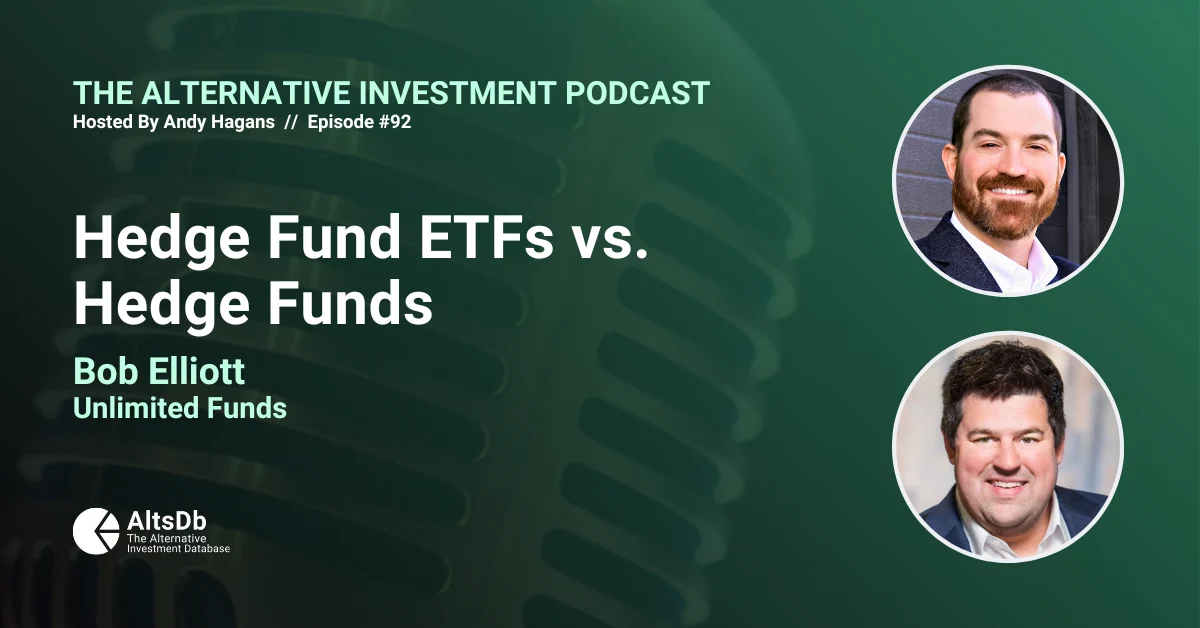
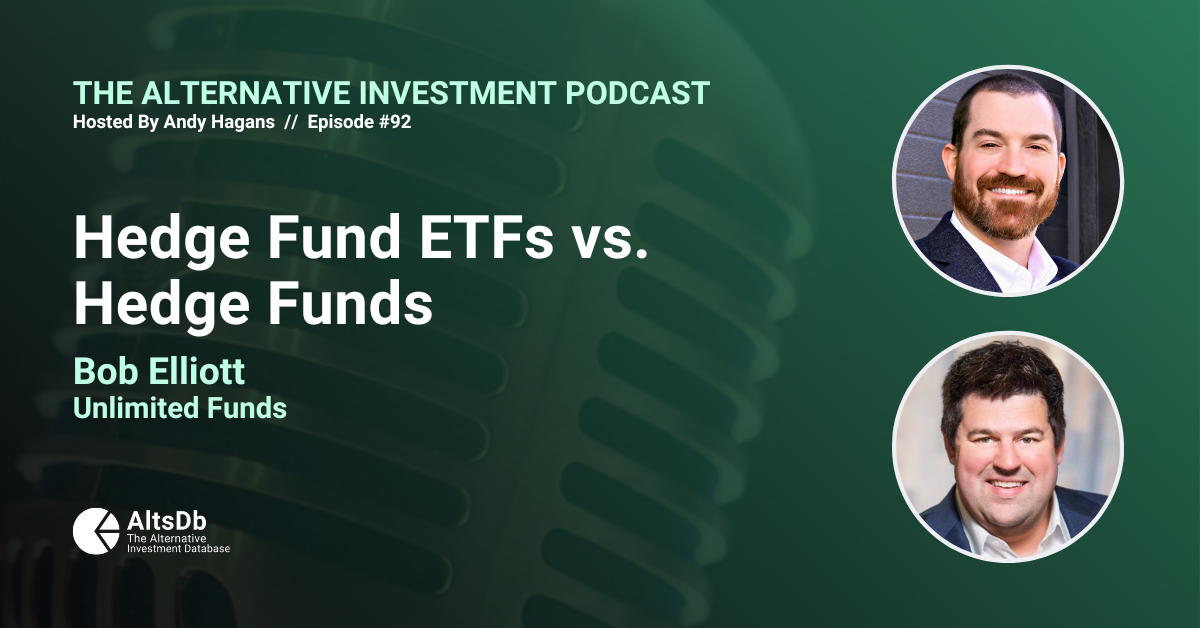
Leading hedge funds have long been recognized for their potential to generate substantial returns for investors. However, the active management inherent in these strategies comes with a significant price tag, often characterized by high fees, limited liquidity, and complex structures. Bob Elliott, CEO of Unlimited Funds, recently joined Andy Hagans on The Alternative Investment Podcast to discuss HFND, Unlimited’s innovative ETF, and to articulate his conviction that alternative ETFs, like HFND, possess the capability to outperform traditional hedge funds, even after accounting for fees. This conversation sheds light on a evolving landscape where sophisticated investment strategies are becoming more accessible and cost-effective for a broader range of investors.
The Allure and the Obstacles of Hedge Funds
Hedge funds, often perceived as exclusive investment vehicles, operate within a sophisticated financial ecosystem. Their core strength lies in employing a diverse array of strategies—from global macro and equity long-short to event-driven and relative value—aimed at generating alpha, or excess returns, irrespective of market direction. The allure of hedge funds stems from their potential to deliver superior risk-adjusted returns, provide diversification benefits, and offer capital preservation during turbulent market conditions.
Bob Elliott’s journey into this world began at Bridgewater Associates, a firm renowned for its systematic approach to macro investing. His nearly 15-year tenure provided him with a profound understanding of how macroeconomics influences asset classes and the power of systematic, quantified strategies. As he explained, Bridgewater’s innovation was in applying the rigorous, systematic methodologies of strategies like equity long-short to the macro space. This experience instilled in him a deep appreciation for the "intuitive cause-effect drivers of the macroeconomy" and the discipline required to translate these insights into repeatable investment processes.
However, the traditional hedge fund model presents several challenges for many investors. Elliott highlighted the significant "fee problem," where typical management and performance fees can amount to 300-400 basis points annually. This substantial cost can erode the gross returns generated by the underlying strategies, diminishing the net benefit to the investor. He pointed out that while hedge fund strategies, on average, have historically outperformed the S&P 500 by approximately 100 basis points with about half the volatility and a third of the drawdowns, these advantages can be significantly undermined by high fees.
Beyond fees, tax implications present another hurdle. Traditional limited partnership (LP) structures often result in annual distributions taxed at marginal income rates or higher, a considerable disadvantage for investors seeking tax efficiency. Furthermore, diversification within the hedge fund space can be problematic for smaller-scale investors. Accessing a sufficiently diverse portfolio of high-quality hedge funds often requires substantial capital, leading to the need for fund-of-funds structures that further layer on fees. Finally, the sheer volume of paperwork associated with alternative investments, including K-1s, can be a logistical nightmare for both individual investors and financial advisors.
The Rise of Alternative ETFs and the HFND Strategy
In response to these challenges, the financial industry has seen a growing interest in alternative Exchange Traded Funds (ETFs) that aim to provide access to hedge fund-like strategies in a more accessible and cost-effective wrapper. Unlimited Funds’ HFND ETF, the ticker symbol for the Unlimited HFND Multi-Strategy Return Tracker ETF, embodies this evolution.
Elliott’s core thesis is that alternative ETFs, by leveraging technology and a more efficient structure, can outperform hedge funds on a net-of-fees basis. The HFND ETF seeks to replicate the gross-of-fees return characteristics of the hedge fund industry. This is achieved through a proprietary approach that utilizes modern machine learning techniques to analyze vast amounts of market data and identify the collective insights and positioning of hedge fund managers in near real-time.
"The idea of bringing a systematic understanding to the world is not to have a perfect description of everything that happens," Elliott explained. "The idea of bringing a systematic approach to the world is to say, let me get an edge in predicting what the various people involved in the markets will do." This predictive capability, refined through sophisticated technology, allows HFND to translate these market observations into long and short positions in various index products.
The implications of this strategy are profound. By employing technology rather than relying solely on highly compensated star portfolio managers, Unlimited Funds can offer its ETF at a significantly lower management fee—approximately a quarter of what a typical hedge fund would charge. Moreover, the ETF structure itself is inherently more tax-efficient than traditional LP structures, potentially halving the tax burden for investors. This combination of lower costs and enhanced tax efficiency directly addresses two of the primary pain points associated with traditional hedge fund investments.
Navigating the Macroeconomic Landscape: A Systematic Approach
Elliott’s background, rooted in a deep understanding of macroeconomics and systematic investing, provides the foundation for HFND’s strategy. He emphasized that understanding the macroeconomy is not about possessing perfect foresight but about identifying and quantifying the linkages between economic indicators and market movements. This involves understanding the "motivations" of key economic actors, such as central banks, and how they respond to incoming data.
"The idea of saying that, you know, various folks’ actions are driven by, you know, a set of not necessarily cause-effect rules. They’re not rules, but there are motivations," he stated. He illustrated this by discussing the Federal Reserve, noting that its actions are a function of incoming data on growth and inflation, coupled with a constrained set of decision rules. By understanding these inputs and response functions, one can develop a more predictable model of central bank behavior.
This systematic approach, characterized by quantification and discipline, is crucial. While even the best macro investors may only be correct about 55% of the time in any given month, a consistent edge of 55-45 across numerous trades can lead to exceptional long-term performance. This is akin to being a skilled blackjack player who consistently makes the right decisions based on probabilities, even though outcomes are not guaranteed.
The Evolving Landscape of Alternative Investments
The performance of hedge funds in 2022, a year characterized by significant drawdowns in traditional 60/40 portfolios, underscored the value of alternative strategies. While the broader hedge fund industry, in aggregate, showed resilience by remaining roughly flat or experiencing minimal losses, this performance was net of substantial fees. Elliott’s analysis highlighted that strategies like equity long-short, despite underperforming cash, still delivered "a thousand basis points of alpha relative to passive investing." This demonstrates the inherent strength of these strategies in capital preservation and risk management during challenging environments.
The emergence of actively managed ETFs, including those focused on alternative strategies, represents a significant shift in the investment landscape. Historically, ETFs were primarily associated with low-cost, passive indexing. However, regulatory evolutions, particularly those implemented around 2020-2021, have enabled managers to run more sophisticated strategies within the ETF wrapper, provided they incorporate institutional-quality risk controls.
Elliott views the ETF structure as fundamentally investor-friendly due to its liquidity, transparency, tax efficiency, and ease of execution without the burdensome paperwork associated with traditional alternative investments. This investor-centric design is driving demand, as evidenced by HFND’s rapid growth, raising $70 million in just over three months since its launch.
The Future of Hedge Fund ETFs and Fee Rationalization
Looking ahead, Elliott anticipates a significant "rationalization of fees" across the investment management industry. In an era of historically low interest rates and abundant liquidity, the impact of fees was often masked. However, with the end of the "era of cheap money," a macroeconomic environment characterized by probabilistically lower returns, the focus on the actual skill of the investor relative to the fees charged will intensify.
This will likely lead to a bifurcation within the hedge fund industry. A select group of highly sophisticated managers who generate truly unique and differentiated alpha will continue to command premium fees. However, for the vast majority of hedge funds, their fee structures may become unsustainable when compared to more cost-effective alternatives.
Hedge fund ETFs, such as HFND, are positioned to capture a significant portion of this shifting capital. By replicating hedge fund-style strategies at a fraction of the cost and with enhanced tax efficiency, these ETFs offer investors access to sophisticated investment approaches that were previously out of reach or prohibitively expensive. This trend promises to benefit investors by providing diversified, consistent, and lower-cost access to strategies that have historically been difficult to obtain.
"Ultimately, that’s what we should be doing is trying our best to figure out a way to benefit the investor, not to enrich the manager through these strategies," Elliott concluded, underscoring Unlimited Funds’ commitment to investor-centric innovation. The growth of alternative ETFs signals a maturing market that is increasingly prioritizing value, accessibility, and transparency for investors seeking to navigate complex market environments.
For those interested in learning more about Unlimited Funds and the HFND ETF, the company’s website, unlimitedfunds.com, offers detailed information and regular commentary. Bob Elliott also maintains an active presence on Twitter (@BobEUnlimited), where he shares insights on macroeconomic trends and investment topics, further democratizing access to sophisticated financial analysis.
